
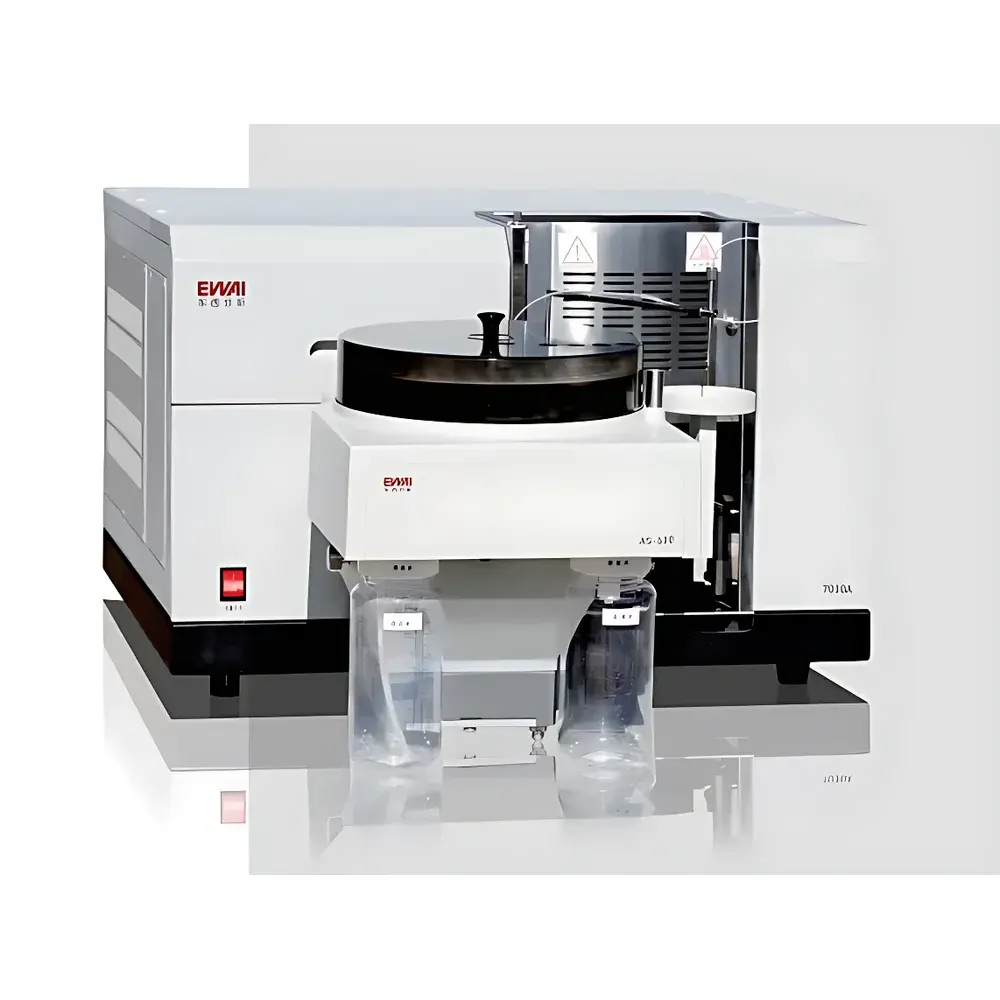
East & West Analysis 7030A Flame Atomic Absorption Spectrometer
| Brand | East & West Analysis |
|---|---|
| Origin | Beijing, China |
| Manufacturer Type | Direct Manufacturer |
| Instrument Type | Flame AAS |
| Model | 7030A |
| Monochromator | Concave Grating |
| Detector | Photomultiplier Tube (PMT) |
| Background Correction | Deuterium Lamp |
| Spectral Bandwidth | 0.2 nm (measured spectral line half-width ≤ 0.2 nm ± 0.02 nm) |
| Sensitivity | Cu, 2.0 mg/L → Abs ≥ 0.200 Abs |
| Repeatability (RSD) | ≤1% |
| Detection Limit | Cu ≤ 0.010 mg/L |
Overview
The East & West Analysis 7030A Flame Atomic Absorption Spectrometer (FAAS) is a dedicated clinical and environmental elemental analyzer engineered for precision quantification of trace metals in liquid samples using flame atomization and Beer–Lambert law-based absorbance measurement. Operating on the principle of atomic absorption spectroscopy, the instrument atomizes analyte elements—such as Cu, Zn, Fe, Ca, and Mg—in an air-acetylene flame, followed by wavelength-selective detection at characteristic resonance lines. Its optical path integrates a concave holographic grating monochromator for high spectral resolution and a low-noise photomultiplier tube detector to ensure stable signal acquisition. Designed specifically for high-throughput clinical laboratories, the 7030A delivers rapid multi-element analysis with measurement completion in under 4 seconds per sample—enabling simultaneous quantification of five essential elements without sequential lamp switching or manual reconfiguration.
Key Features
- Integrated flame control system with one-touch automatic ignition—eliminates external spark igniters and reduces operator dependency.
- Dual-safety architecture: includes flame-out detection, acetylene flow regulation with real-time leak monitoring, electromagnetic valve shutdown upon power failure, and air pressure interlock that halts gas supply if pressure falls below operational threshold.
- Automated sample introduction and sequence execution: supports unattended batch analysis with programmable rinse cycles, calibration curves, and QC checks—fully compliant with routine clinical workflow demands.
- High-resolution optical design: 0.2 nm spectral bandwidth ensures accurate isolation of narrow atomic absorption lines; measured half-width meets specification (≤ 0.2 nm ± 0.02 nm), minimizing spectral interference from adjacent lines or molecular bands.
- Deuterium lamp background correction provides robust compensation for non-specific absorption arising from matrix-derived molecular species or light scattering—critical for biological fluids with complex organic content.
Sample Compatibility & Compliance
The 7030A is optimized for aqueous-based clinical specimens—including serum, plasma, whole blood lysates, and urine—following standardized dilution and acidification protocols (e.g., 1% v/v HNO₃). It complies with core analytical validation requirements outlined in CLIA, ISO 15197, and ICH Q2(R2) for accuracy, precision, and detection capability. The instrument’s ≤1% RSD (n=10) and Cu detection limit of ≤0.010 mg/L meet minimum performance criteria specified in USP for elemental impurity testing in diagnostic reagents. All safety circuits and gas handling components conform to EN 61010-1:2019 for laboratory electrical equipment, and flame management logic adheres to NFPA 56 guidelines for fuel gas systems.
Software & Data Management
The 7030A operates under a Windows XP–based control platform engineered for clinical informatics integration. Its software suite includes a HIPAA-compliant patient record module supporting structured entry of demographic data, sample ID, test order, and clinician annotations. Full HL7 v2.5.1 message support enables bidirectional interfacing with hospital LIS and HIS systems—including ADT, ORU, and ACK transaction types. Audit trails record all user actions, method changes, calibration events, and result modifications with timestamps and operator IDs—satisfying FDA 21 CFR Part 11 requirements for electronic records and signatures when deployed in GLP/GMP-regulated environments. Data export is available in CSV, PDF, and XML formats, with optional integration into laboratory middleware for automated QC flagging and trending.
Applications
- Routine clinical assessment of essential trace elements: quantification of Cu, Zn, Fe, Ca, and Mg in serum for nutritional status evaluation, Wilson’s disease screening, and chronic kidney disease monitoring.
- Quality control of parenteral nutrition formulations and IV admixtures in pharmacy compounding units.
- Environmental surveillance of heavy metal contamination in drinking water and wastewater effluents per EPA Method 7000B.
- Validation of elemental purity in pharmaceutical excipients according to ICH Q3D guidelines.
- Research applications in metallomics and biomarker discovery where reproducible, low-cost elemental profiling is required across large cohort studies.
FAQ
What sample preparation is required prior to analysis?
Typical clinical samples require dilution (1:10 to 1:50) with 0.2–1% v/v nitric acid and filtration through 0.45 µm membrane filters. Serum and plasma may be stabilized with EDTA or ammonium heparin anticoagulants.
Is the 7030A compatible with graphite furnace accessories?
No—the 7030A is a dedicated flame-only system. Graphite furnace capabilities are available in the company’s 7050 series instruments.
Does the software support multi-user role-based access control?
Yes—administrator, analyst, and reviewer roles can be defined with granular permissions for method editing, result approval, and audit log access.
How often must the deuterium lamp be replaced?
Under standard usage (≤8 hours/day), the deuterium lamp maintains stable output for ≥1,000 hours; replacement is indicated when background correction efficiency drops below 90% during routine verification.
Can the instrument be validated for ISO/IEC 17025 accreditation?
Yes—full validation documentation packages (IQ/OQ/PQ), including traceable calibration certificates, uncertainty budgets, and performance verification reports, are available upon request.





