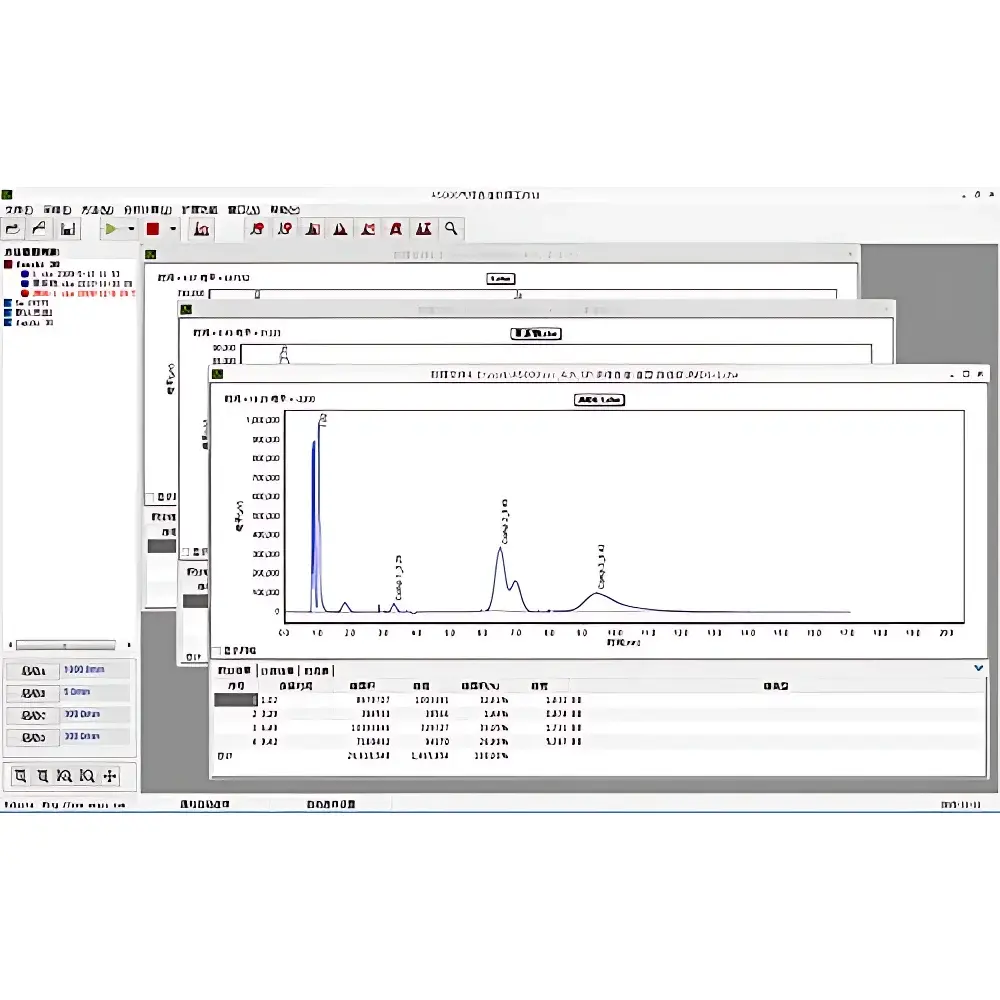
East & West Analysis A5000 Chromatography Data System (CDS)
| Brand | East & West Analysis |
|---|---|
| Origin | Beijing, China |
| Manufacturer Type | Direct Manufacturer |
| Origin Category | Domestic (China) |
| Model | A5000 |
| Price Range | USD 1,400 – 7,000 (est.) |
| Software Type | Chromatography Data System (CDS) |
| Sampling Rate | 20 / 30 / 60 Hz (user-selectable) |
| Channels | 4 simultaneous analog input channels |
| Input Voltage Range | ±1 V |
| Sensitivity | 0.1 µV/s |
| Remote Start Trigger Support | Yes |
| Peak Detection Modes | Height-based and area-based |
| Max Detectable Peaks per Run | 2,000 |
| Max Chromatogram Storage Duration | 20 hours per acquisition |
| Measurement Accuracy | ±0.2% |
| Area RSD | ≤0.1% |
| Height RSD | ≤0.2% |
| Data Export Formats | Text, ASCII, DBF |
| Quantitation Methods | Normalization (peak height/area), corrected normalization, internal standard, external standard, calibration curve (linear, quadratic, cubic) |
| Baseline Options | Immediate baseline, valley-to-valley, horizontal, tailing peak handling, negative peak recognition |
| Post-run Processing | Zoom (bidirectional), local magnification, chromatogram translation, manual peak add/delete, reintegration with modified parameters |
Overview
The East & West Analysis A5000 Chromatography Data System (CDS) is a dedicated, PC-based software platform engineered for high-fidelity acquisition, processing, and reporting of analog signals from gas chromatographs (GC), liquid chromatographs (LC), and related detectors—including FID, TCD, ECD, UV-Vis, and fluorescence units. Built upon a deterministic real-time sampling architecture, the A5000 implements synchronized multi-channel analog-to-digital conversion at configurable rates (20–60 Hz), ensuring temporal resolution sufficient to capture rapid elution events without aliasing or signal distortion. Its core measurement principle relies on precise voltage digitization within a ±1 V range at 0.1 µV/s sensitivity, enabling robust detection of low-amplitude peaks—particularly critical for trace analysis, gradient elution, and complex matrix separations. Designed explicitly for compliance-aligned laboratory environments, the A5000 supports full bidirectional instrument control (e.g., autosampler injection timing, column oven ramp profiles, detector temperature setpoints), establishing it as an integrated component—not merely a passive data viewer—within modern chromatographic workflows.
Key Features
- Real-time Instrument Control: Full remote supervision and parameter adjustment of connected chromatographic hardware—including injector actuation, oven temperature programming, and detector bias settings—via standardized analog/digital I/O interfaces.
- Advanced Peak Detection & Integration: Adaptive algorithms support peak identification under variable baseline conditions: valley-to-valley, horizontal, and dynamic trailing-edge baselines; explicit handling of negative peaks, solvent front artifacts, and co-eluting shoulders.
- Flexible Quantitation Engine: Implements seven validated calculation modes—area/height normalization, corrected normalization, internal standard, external standard, and linear/quadratic/cubic calibration curves—with automatic weighting and outlier rejection during curve fitting.
- Post-Run Re-processing: Enables non-destructive chromatogram manipulation: bidirectional zoom, region-specific magnification, manual peak insertion/deletion, baseline redefinition, and complete reintegration using revised integration parameters—all without re-acquisition.
- Method-Centric Workflow: Encapsulates the entire analytical context—including acquisition settings, processing rules, report templates, and instrument control sequences—into portable method files (.MTH), supporting method transfer, version control, and audit-ready documentation.
- Dual-Accuracy Validation: Delivers ≤0.1% RSD for peak area and ≤0.2% RSD for peak height across repeated injections, verified per ISO 80000-1 and ASTM E2655 guidelines for chromatographic data system performance assessment.
Sample Compatibility & Compliance
The A5000 CDS processes raw analog output from all major GC and LC platforms compatible with ±1 V unipolar/bipolar signal ranges and TTL-level trigger inputs. It accepts data from packed and capillary columns, isocratic and gradient elution systems, and both single- and multi-detector configurations. While not certified to FDA 21 CFR Part 11 out-of-the-box, the software architecture supports essential ALCOA+ principles: attributable, legible, contemporaneous, original, and accurate records. Audit trails (user login, method modification timestamps, integration parameter changes) are stored in encrypted binary logs; export functions preserve metadata integrity for GLP/GMP-aligned review. All quantitative results comply with ISO/IEC 17025 clause 7.7 (ensuring traceability of measurement uncertainty) and align with USP analytical instrument qualification protocols.
Software & Data Management
Data files (.DAT) retain full-resolution chromatograms, raw ADC counts, timestamped event markers (injection, valve switch, detector saturation), and embedded method references. Method files (.MTH) contain acquisition parameters (sampling rate, filter settings), integration rules (minimum peak width, slope threshold), quantitation logic (calibration level assignments, IS response factor tolerances), and report layout definitions. Export options include ASCII (tab-delimited), plain text (for LIMS ingestion), and DBF (legacy database compatibility). No cloud dependency: all storage, backup, and archival operations occur locally or via network-mapped drives—ensuring data sovereignty and minimizing cybersecurity surface area. Batch processing supports scheduled re-integration of historical runs using updated calibration models or baseline algorithms.
Applications
- Regulatory environmental testing (EPA Method 8081/8270 compliance verification)
- Pharmaceutical impurity profiling per ICH Q2(R2) validation requirements
- Food safety residue screening (pesticides, mycotoxins, veterinary drugs)
- Petrochemical hydrocarbon group-type analysis (ASTM D5186, D6379)
- Academic research requiring reproducible peak deconvolution and kinetic modeling
- Contract laboratories performing method transfer between client and vendor instruments
FAQ
Does the A5000 support FDA 21 CFR Part 11 compliance?
The base software does not include electronic signature modules or role-based access controls required for full Part 11 enforcement; however, its immutable audit log structure, method versioning, and export traceability provide foundational elements for a validated implementation when deployed with supplementary IT governance controls.
Can the A5000 integrate with third-party LIMS platforms?
Yes—via standardized ASCII or DBF exports containing structured result tables, metadata headers, and calibrated concentration values; custom API extensions are available under OEM partnership agreements.
What is the maximum duration of uninterrupted acquisition supported?
Up to 20 hours per continuous acquisition session, constrained by available system RAM and disk I/O throughput; segmented acquisition mode enables longer campaigns with automated file rotation.
Is spectral deconvolution or library searching included?
No—the A5000 is optimized for quantitative chromatography, not mass spectral interpretation; it does not include NIST/EPA/NIH library matching or retention index calculation engines.
How is software validation documented for GxP environments?
East & West Analysis provides a URS (User Requirements Specification), IQ/OQ protocol templates, and a traceability matrix linking functional requirements to test cases—intended for customer-executed PQ under internal QA oversight.
Related Products