
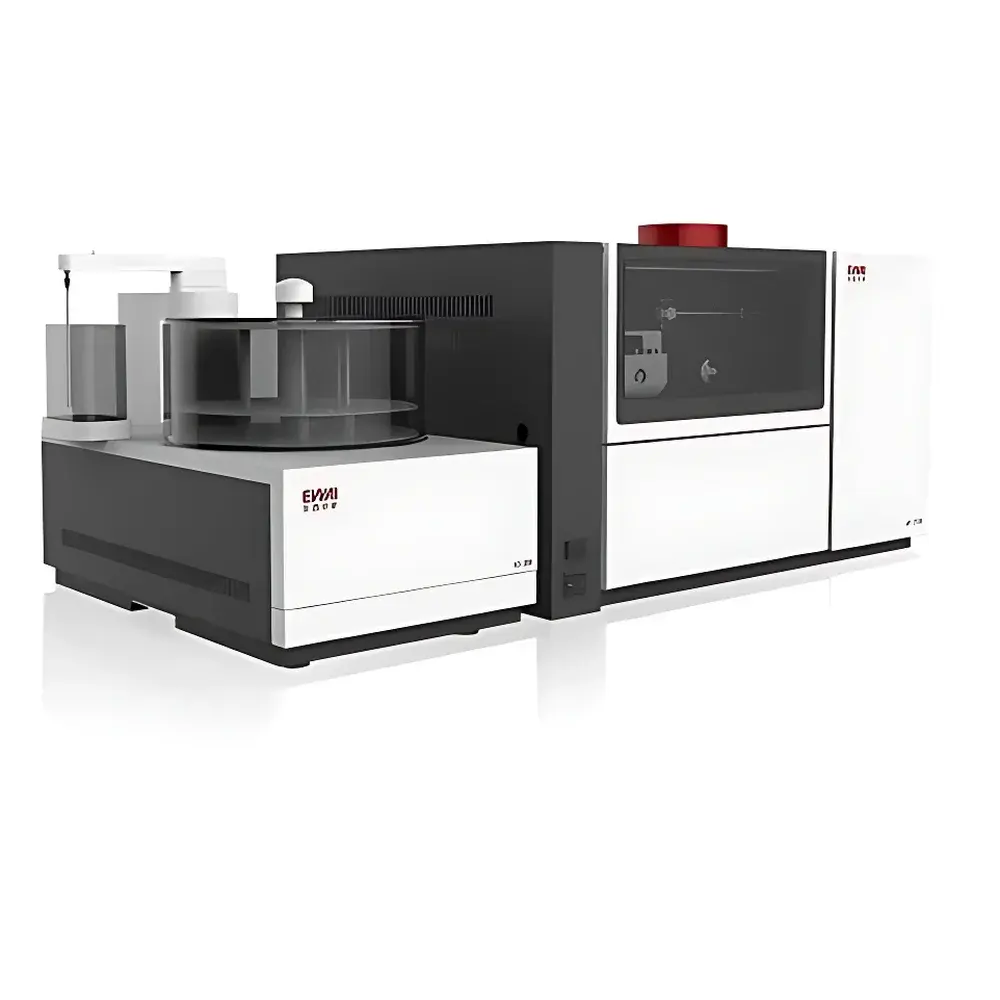
East & West Analysis AF-7550 Dual-Channel Hydride Generation Atomic Fluorescence Spectrometer
| Brand | East & West Analysis |
|---|---|
| Origin | Beijing, China |
| Manufacturer Type | Direct Manufacturer |
| Instrument Type | Multi-channel Atomic Fluorescence Spectrometer |
| Sample Introduction | Peristaltic Pump |
| Detectable Elements | As, Se, Pb, Sn, Te, Bi, Sb, Hg, Cd, Ge, Zn |
| Relative Standard Deviation (RSD) | <1% |
| Linear Dynamic Range | >3 orders of magnitude |
| Detection Limits | As, Se, Pb, Sn, Te, Bi, Sb < 0.01 µg/L |
Overview
The East & West Analysis AF-7550 Dual-Channel Hydride Generation Atomic Fluorescence Spectrometer is a precision analytical instrument engineered for trace-level quantification of hydride-forming elements in environmental, geological, food safety, pharmaceutical, and clinical laboratories. It operates on the principle of atomic fluorescence spectroscopy (AFS), where analyte elements—after chemical reduction to volatile hydride species—are atomized in a quartz tube heated by far-infrared radiation, and subsequently excited by a high-intensity, element-specific hollow cathode lamp. The resulting atomic fluorescence emission is collected at right angles to the excitation beam using a short-focal-length lens and measured via a low-noise photomultiplier tube (PMT). This configuration ensures high signal-to-noise ratio, minimal spectral interference, and exceptional sensitivity—particularly critical for regulatory compliance testing under EPA Method 200.9, ISO 17294-2, and China’s GB/T 5750.6–2023 for drinking water quality.
Key Features
- Dual-channel simultaneous detection architecture enables concurrent analysis of two elements (e.g., As and Se), improving throughput without cross-channel interference.
- Hydride generation system integrates a six-port injection valve with a variable-volume quantitative loop—combining the precision of syringe-based dosing with the robustness and maintenance-free operation of peristaltic pumping.
- Optimized gas–liquid separation module achieves near-complete phase separation, eliminating residual liquid carryover and suppressing flame flicker noise—directly contributing to sub-0.01 µg/L detection limits for key elements including As, Se, and Sb.
- Mass-flow-controlled gas regulation system provides continuous, programmable, and highly reproducible carrier gas (Ar) flow rates; eliminates manual pressure tuning and ensures long-term stability across multi-hour analytical sequences.
- Encoded hollow cathode lamps auto-identify installed elements and log operational hours—supporting GLP-compliant lamp lifetime tracking and automatic wavelength selection during method setup.
- Three-axis adjustable lamp mount and atomizer assembly enable precise spatial alignment between excitation beam, atomization zone, and optical collection axis—maximizing photon capture efficiency and measurement repeatability.
- Far-infrared heated quartz atomizer delivers rapid thermal ramping (≤15 s to operating temperature), superior temperature uniformity (±1 °C), and extended service life (>2,000 h) compared to conventional resistive heaters.
- Hermetically sealed, non-dispersive optical path with fused-silica lens minimizes stray light and environmental contamination—ensuring stable baseline performance even in shared lab environments.
Sample Compatibility & Compliance
The AF-7550 accommodates aqueous samples requiring hydride generation pretreatment—including digested soil extracts, filtered wastewater, acid-preserved biological fluids, and leachates from solid matrices. Its design conforms to international standard methods for hydride-AFS analysis, including ASTM D6722-22 (As in water), ISO 11969:2018 (determination of total As and Se), and USP for elemental impurities in pharmaceuticals. The instrument supports audit-ready data integrity through secure network (RJ45) connectivity, time-stamped acquisition logs, and user-access controls aligned with FDA 21 CFR Part 11 requirements when paired with compliant LIMS or dedicated AFS software.
Software & Data Management
Controlled via Windows-based acquisition software with intuitive workflow-driven interface, the AF-7550 supports automated calibration curve generation (linear, quadratic, or weighted regression), real-time QC flagging (e.g., drift correction, blank threshold violation), and customizable report templates compliant with ISO/IEC 17025 documentation standards. Raw spectral data, method parameters, and instrument status logs are stored in encrypted binary format with SHA-256 checksum validation. Export options include CSV, PDF, and XML formats compatible with enterprise ELN and statistical process control platforms.
Applications
- Regulatory monitoring of arsenic and selenium in municipal drinking water and groundwater per WHO and EU Directive 2020/2184.
- Speciation-unresolved total Hg and Cd quantification in rice flour and infant formula under China’s GB 2762–2022 contaminant limits.
- High-throughput screening of Pb and Bi in electronic waste leachates for RoHS and WEEE compliance verification.
- Quality control of Ge-doped optical fibers and Zn-containing dietary supplements where ultra-trace metal purity is critical.
- Research-grade quantification of Te and Sb in geothermal fluid studies and semiconductor precursor materials.
FAQ
What hydride-forming elements does the AF-7550 support for routine analysis?
The instrument is validated for As, Se, Pb, Sn, Te, Bi, Sb, Hg, Cd, Ge, and Zn—each with method-specific optimization protocols included in the standard software library.
Is the AF-7550 compatible with automated sample introduction systems?
Yes—it natively supports integration with optional XYZ robotic autosamplers capable of handling up to 160 vials, with full synchronization of rinse cycles, calibration bracketing, and carryover mitigation algorithms.
How does the mass-flow gas control improve analytical reproducibility?
Unlike traditional pressure-regulated systems, the digital mass-flow controller maintains ±0.5% setpoint accuracy across ambient temperature fluctuations and cylinder pressure decay—reducing RSD contribution from gas delivery to <0.3%.
Can the AF-7550 be used for speciation analysis?
No—the AF-7550 performs total elemental quantification only. Speciation requires coupling with HPLC or GC separation upstream of the hydride generator, which is not part of the base configuration.
What maintenance intervals are recommended for the quartz atomizer and gas–liquid separator?
Under typical usage (8 h/day, 5 days/week), the atomizer requires visual inspection every 200 h and cleaning every 500 h; the PTFE-lined gas–liquid separator is rated for >10,000 injections before replacement.





