
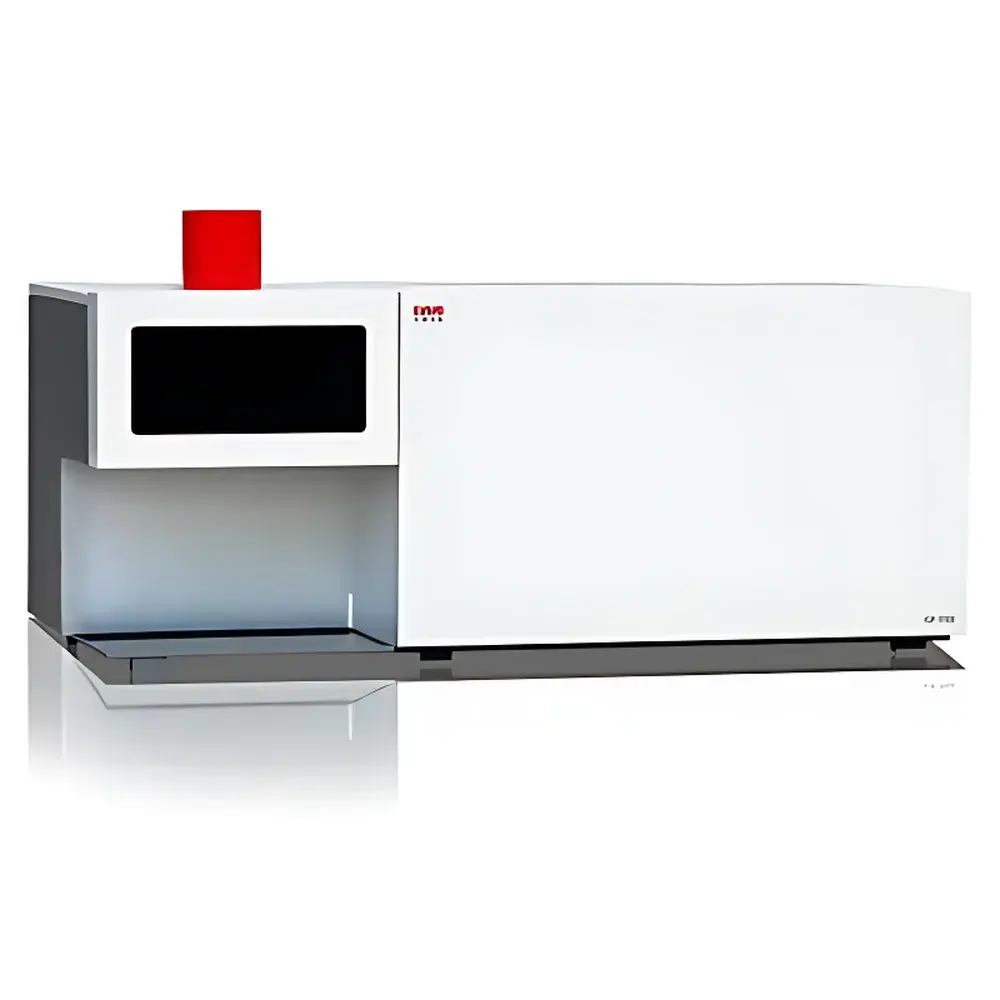
East & West Analysis ICP-7700 Inductively Coupled Plasma Optical Emission Spectrometer
| Brand | East & West Analysis |
|---|---|
| Origin | Beijing, China |
| Manufacturer Type | Direct Manufacturer |
| Instrument Type | Sequential Scanning ICP-OES |
| Detection Limit | Sub-ppb level |
| Precision (RSD) | ≤1.0% |
| Long-term Stability (RSD) | ≤2.0% |
| Wavelength Range | 180–500 nm |
| Optical Resolution | ≤0.012 nm |
Overview
The East & West Analysis ICP-7700 is a high-performance sequential scanning inductively coupled plasma optical emission spectrometer (ICP-OES) engineered for trace elemental analysis across diverse laboratory environments. It operates on the fundamental principle of atomic emission spectroscopy: liquid samples are nebulized into fine aerosols, transported into a high-temperature argon plasma (~6,000–10,000 K), where atoms and ions are thermally excited. Upon relaxation, they emit characteristic photons at discrete wavelengths unique to each element. The ICP-7700 employs a Czerny-Turner monochromator with a high-line-density grating and precision stepper-motor-driven wavelength selection to sequentially isolate and quantify spectral lines within the 180–500 nm range. Its solid-state RF generator delivers stable plasma excitation with output power stability better than ±0.1%, enabling robust analysis of both aqueous and organic matrices without plasma instability or torch damage.
Key Features
- Solid-state RF generator: Compact, lightweight, and highly efficient; features automatic impedance matching and real-time power regulation for consistent plasma conditions.
- End-on (axial) plasma viewing configuration: Maximizes photon collection path length through the plasma core, significantly enhancing sensitivity and achieving sub-part-per-trillion (sub-ppt) detection limits for key elements such as As, Cd, Pb, and U.
- Precision mass-flow-controlled nebulization system: Integrated digital mass flow controller ensures reproducible aerosol generation and carrier gas delivery, contributing directly to the instrument’s ≤1.0% RSD performance.
- Advanced double-pass Scott-type spray chamber: Temperature-stabilized design minimizes memory effects and condensation, improving washout efficiency and long-term signal stability.
- Comprehensive hardware interlock protection: Real-time monitoring of coolant water flow, argon pressure, RF current, and torch temperature; automatic shutdown upon detection of dry-run, gas interruption, overcurrent, or overheating to prevent torch erosion or RF coil failure.
Sample Compatibility & Compliance
The ICP-7700 supports direct analysis of dilute aqueous standards, acid-digested environmental and geological samples (e.g., EPA Method 200.7, 200.8), organic solvents (including kerosene, xylene, and MIBK), and high-salt matrices via optional matrix-matched calibration or internal standardization. Its optical architecture and plasma interface meet ISO/IEC 17025 requirements for analytical competence, and its operational parameters align with ASTM D1976 (trace metals in water), ISO 11885 (water quality—determination of selected elements by ICP-OES), and GB/T 30904–2014 (Chinese national standard for ICP-OES). All critical system events—including lamp status, plasma ignition sequence, calibration history, and error logs—are timestamped and stored for GLP-compliant audit trails.
Software & Data Management
The proprietary ICP-7700 acquisition and analysis software provides full instrument control, method development, quantitative calibration (linear, quadratic, and weighted least-squares), spectral interference correction (including background correction at multiple points), and QC reporting. It supports user-defined reporting templates compliant with LIMS export formats (CSV, XML, PDF). Audit trail functionality records all operator actions, parameter changes, and data modifications in accordance with FDA 21 CFR Part 11 requirements when configured with electronic signatures and role-based access control. Data integrity is reinforced via automatic backup, checksum validation, and immutable raw-data archiving.
Applications
The ICP-7700 serves as a primary elemental quantification platform in accredited environmental laboratories (soil, wastewater, drinking water per WHO and EU Directive 2020/2184), geological survey institutes (rare earth element profiling in monazite and bastnäsite ores), metallurgical R&D (impurity screening in high-purity NdFeB magnets), pharmaceutical QA/QC (catalyst residue testing per ICH Q2(R2)), nuclear fuel cycle facilities (U/Pu isotopic ratio surrogates), agrochemical research (micronutrient mapping in fortified fertilizers), and clinical toxicology (blood/urine metal biomonitoring). Its sequential architecture offers optimal cost-per-element efficiency for labs performing routine multi-element panels (<30 elements per run) with stringent regulatory reporting needs.
FAQ
Does the ICP-7700 support axial and radial viewing simultaneously?
No — it is configured exclusively for end-on (axial) plasma observation to maximize sensitivity for ultra-trace analysis.
Can it analyze hydrofluoric acid (HF)-digested samples?
Yes, when equipped with a quartz torch and PFA nebulizer/spray chamber; standard configurations require HF-free sample preparation.
Is the software validated for GMP environments?
The software includes configurable 21 CFR Part 11 modules; full validation documentation and IQ/OQ protocols are available upon request for regulated users.
What maintenance intervals are recommended for the RF generator and optics?
RF generator requires no scheduled maintenance beyond annual verification of cooling airflow and impedance calibration; optical alignment is factory-set and stable for ≥2 years under normal operation.
How is spectral interference managed for complex matrices like seawater or brines?
The software provides multi-point background correction, selectable alternative emission lines (e.g., Al 308.215 nm vs. 309.271 nm), and optional internal standardization using Y or Sc to correct for plasma drift and transport variability.





