
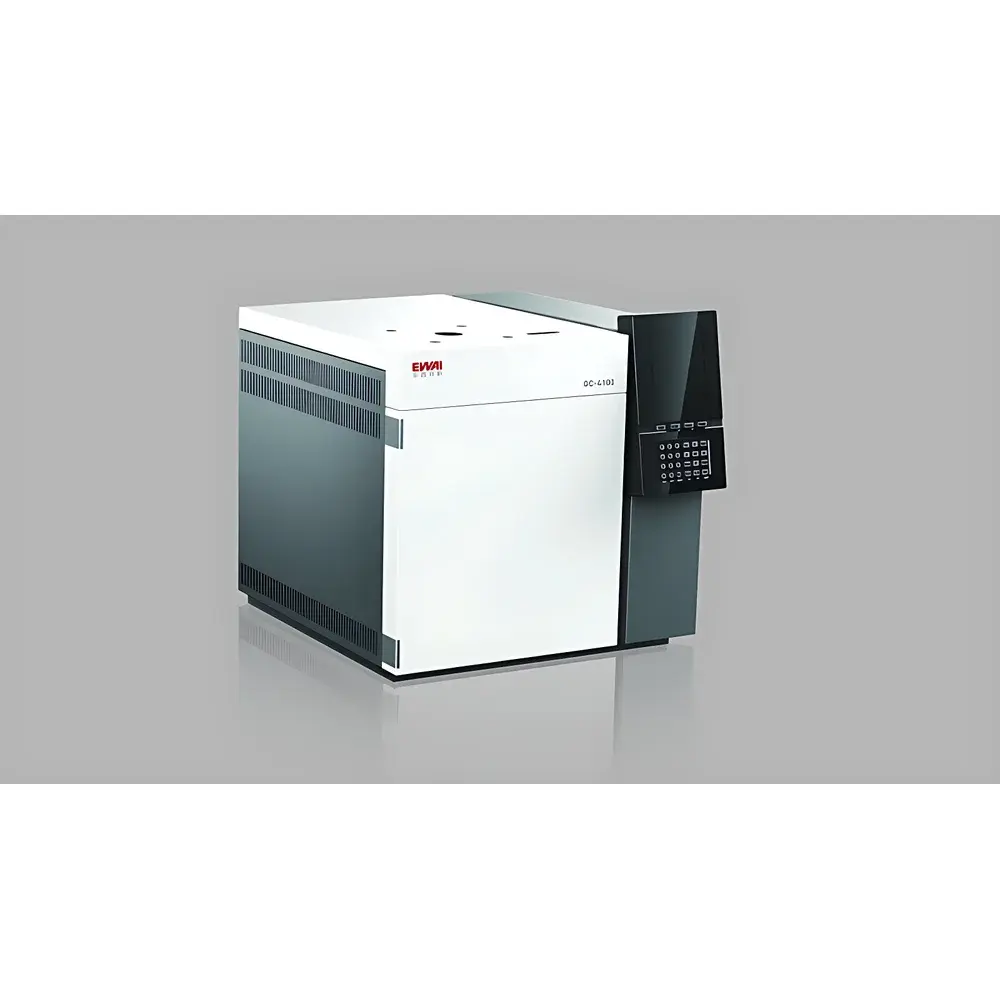
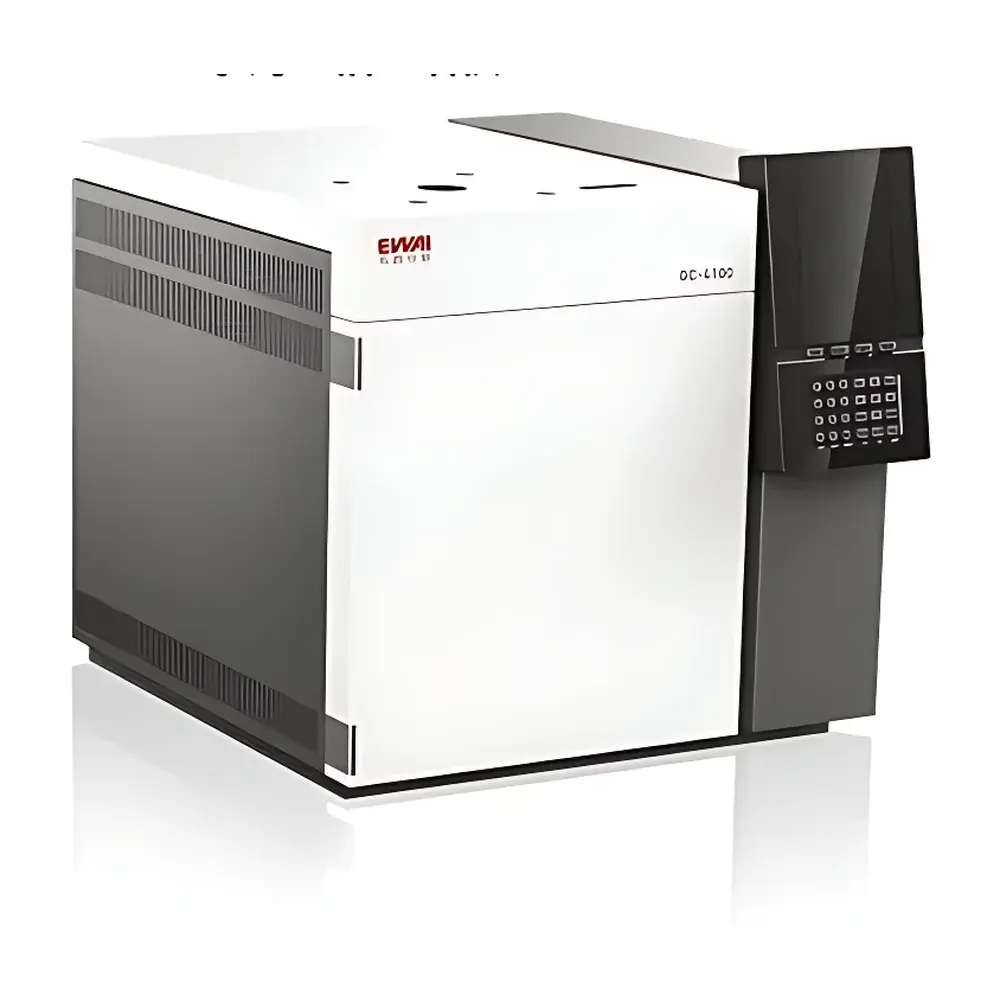
East & West Analytical GC-4100 Series Gas Chromatograph
| Brand | East & West Analytical |
|---|---|
| Origin | Beijing, China |
| Manufacturer Type | OEM Manufacturer |
| Regional Classification | Domestic (China) |
| Model | GC-4100 |
| Instrument Type | Laboratory Gas Chromatograph |
| Application Scope | General-Purpose |
| Oven Temperature Range | (Ambient + 5) °C to 400 °C |
| Oven Ramp Rate | 0.1–40 °C/min |
| Oven Cool-Down Rate | 400 °C → 50 °C (typical) |
| Carrier Gas Flow Control Range | 1–500 mL/min (EPC) |
| Carrier Gas Pressure Control Range | 0–145 psi (EPC) |
| Injector Maximum Operating Temperature | 400 °C |
| Injector Pressure Setting Range | 0–145 psi (EPC) |
| Injector Total Flow Setting Range | 1–500 mL/min (EPC) |
Overview
The East & West Analytical GC-4100 Series Gas Chromatograph is a high-performance, microprocessor-controlled laboratory instrument engineered for precision separation and quantitative analysis of volatile and semi-volatile organic compounds. Based on classical gas chromatographic principles—where analytes are partitioned between a mobile phase (inert carrier gas) and a stationary phase (coated capillary or packed column)—the GC-4100 delivers robust retention time reproducibility, high peak resolution, and low baseline drift across diverse sample matrices. Its architecture supports dual-column operation, multi-detector configurations, and seamless integration with auxiliary modules including thermal desorbers, purge-and-trap systems, pyrolyzers, and methanizers. Designed for routine QC/QA, environmental monitoring, petrochemical profiling, food safety testing, and pharmaceutical impurity analysis, the system meets fundamental operational requirements aligned with ISO/IEC 17025, ASTM D3612, USP , and EPA Methods 8021B, 8260, and 8270.
Key Features
- Eight independently programmable temperature zones: oven, up to three injectors, and up to four detectors (FID, TCD, ECD, NPD), each with PID-fuzzy logic temperature control for ±0.1 °C stability.
- Electronic Pressure Control (EPC) and Electronic Flow Control (EFC) for six gas channels—including carrier, makeup, fuel, oxidant, split vent, and septum purge—with real-time feedback and sub-psi pressure resolution.
- Ten-segment oven temperature programming with post-run rapid cool-down (400 °C → 50 °C in <10 min via motorized rear door actuation).
- Modular injector design supporting split/splitless, on-column, and packed-column injection; compatible with optional autosamplers, 6-port valves, and cold-on-column inlets.
- Integrated septum purge, backflush, and pre-cut functionality to minimize column contamination and extend maintenance intervals.
- Front-panel 5.7-inch LCD display with touch-sensitive interface and real-time parameter visualization (temperature, pressure, flow, status alarms).
- Full bidirectional communication between GC hardware and PC-based chromatography data system (CDS) for remote method loading, sequence control, and real-time diagnostics.
Sample Compatibility & Compliance
The GC-4100 accommodates liquid, gaseous, and solid-phase extracts introduced via syringe, headspace vial, thermal desorption tube, or purge-and-trap concentrator. It supports standard 0.53 mm, 0.32 mm, and 0.25 mm ID fused-silica capillaries, as well as stainless-steel or glass packed columns (up to 4 m). Column oven dimensions (28 × 28 × 18 cm) allow simultaneous installation of mixed column types. All hardware components comply with CE electromagnetic compatibility (EMC) directives and RoHS material restrictions. The system supports audit trail generation, electronic signatures, and secure user access levels—facilitating alignment with FDA 21 CFR Part 11 and GLP/GMP documentation workflows when paired with validated CDS software.
Software & Data Management
Control and data acquisition are performed using East & West’s proprietary ChromaVision™ CDS, a Windows-based application supporting method development, sequence scheduling, peak integration, calibration curve generation (linear, quadratic, weighted), and report export (PDF, CSV, XML). The software includes built-in diagnostic routines—leak detection, temperature sensor validation, pressure decay tests—and automatic error logging with timestamped event history. Raw data files adhere to ANDI/NetCDF format for cross-platform compatibility. Optional LIMS connectivity enables automated result transfer to enterprise-level quality management systems.
Applications
The GC-4100 serves laboratories requiring reliable, repeatable separations across regulated and non-regulated environments. Typical use cases include residual solvent analysis per ICH Q3C guidelines; hydrocarbon fingerprinting in fuels per ASTM D5292; pesticide residue screening in agricultural commodities (AOAC 2007.01); VOC profiling in indoor air (ISO 16000-6); fatty acid methyl ester (FAME) quantification in biodiesel (EN 14103); and trace halogenated compound detection in water (EPA 502.2). Its modular detector support enables concurrent FID/TCD analysis for permanent gases and organics within a single run.
FAQ
Does the GC-4100 support mass spectrometry coupling?
Yes—optional MS interface hardware (including transfer line heater, vacuum isolation valve, and signal synchronization module) can be factory-installed to enable direct GC-MS coupling with third-party quadrupole or TOF mass spectrometers.
What is the maximum number of detectors that can operate simultaneously?
Three detectors may be installed and operated concurrently, each with independent power supply, signal conditioning, and analog/digital output routing.
Is remote monitoring and control supported over Ethernet?
Yes—the GC-4100 features a built-in 10/100 Mbps Ethernet port compliant with TCP/IP and Modbus TCP protocols, enabling integration into centralized lab automation networks.
Can the system perform unattended overnight analysis?
Absolutely—the instrument supports fully automated sequences with up to 999 sample injections, integrated autosampler communication, and automatic shutdown/restart logic triggered by completion or fault conditions.
What calibration standards are recommended for routine performance verification?
NIST-traceable alkane mixtures (e.g., C8–C20) for retention time indexing, certified gas standards (e.g., 1 ppm benzene in nitrogen) for detector response linearity, and leak-check gases (e.g., 5% H₂ in Ar) for EPC validation.




