
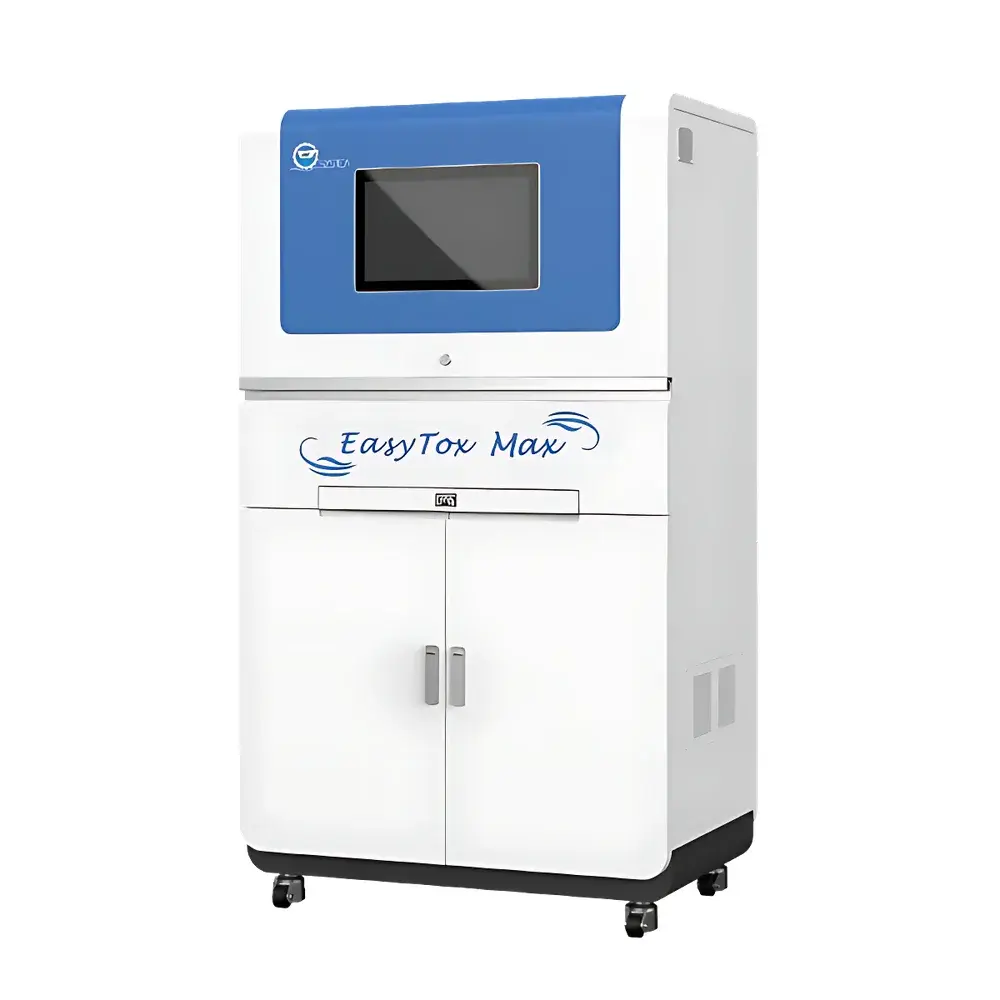
EasyTox Online Aquatic Toxicity Analyzer by SYSTEA
| Brand | SYSTEA |
|---|---|
| Model | EasyTox |
| Measurement Principle | Bioluminescence Inhibition Assay using Marine Luminescent Bacteria (Aliivibrio fischeri, Vibrio qinghaiensis sp.-Q67, or Photobacterium phosphoreum) |
| Compliance | ISO 11348-3, GB/T 15441 |
| Detection Mode | Qualitative (Inhibition Rate %) and Quantitative (EC₅₀) |
| Dilution Range | Up to 160× automated dilution |
| Measurement Interval | 60 s per sample cycle |
| Bacterial Culture Maintenance Interval | 7–14 days |
| Reagent & Control Storage | Integrated 4–8 °C refrigerated compartment |
| Cross-Contamination Control | Dedicated cleaning station with multi-stage rinse protocol |
| User Interface | Programmable touchscreen HMI with full workflow automation |
| Sample Types | Surface water, drinking water, groundwater, municipal wastewater, industrial effluent, seawater |
Overview
The EasyTox Online Aquatic Toxicity Analyzer is a fully automated, continuous-monitoring instrument engineered for real-time assessment of acute aquatic toxicity in diverse water matrices. It operates on the internationally validated bioluminescence inhibition principle: viable luminescent bacteria—selectably configured with Aliivibrio fischeri, Vibrio qinghaiensis sp. Q67, or Photobacterium phosphoreum—emit stable light under optimal physiological conditions; exposure to toxicants disrupts cellular metabolism, resulting in measurable reduction of bioluminescence intensity. This photometric response is quantified against calibrated reference curves to deliver both qualitative inhibition rate (%) and quantitative EC50 values (effective concentration causing 50% luminescence inhibition). Designed for unattended operation in central laboratories, water treatment plants, and environmental monitoring stations, the EasyTox integrates discrete segmented analysis architecture with strict adherence to ISO 11348-3 and GB/T 15441, ensuring regulatory traceability and methodological consistency across global compliance frameworks.
Key Features
- Automated dual-channel measurement: simultaneous analysis of sample and blank control to minimize stochastic variation and enhance statistical robustness
- Integrated bacterial viability verification: system performs pre-assay luminescence validation using ≥2 certified positive controls before each analytical sequence
- High-dynamic-range quantification: 160-fold programmable dilution capability enables accurate EC50 determination across low-to-high toxicity gradients without manual intervention
- Continuous 60-second signal acquisition per reaction cuvette: supports rapid event detection and high-temporal-resolution toxicity profiling
- Dedicated 4–8 °C refrigerated storage module for reagents, lyophilized bacterial cultures, and quality control standards—extending shelf life and reducing maintenance frequency
- Onboard cleaning station with sequential decontamination steps (air purge, wash solution flush, ultrapure water rinse) to eliminate carryover between samples and reagents
- Full workflow programmability via intuitive touchscreen HMI: users define sampling intervals, dilution schemes, QC schedules, and alarm thresholds without scripting
Sample Compatibility & Compliance
The EasyTox analyzer accommodates raw and filtered aqueous samples across a broad physicochemical spectrum—including turbid surface waters, chlorinated drinking supplies, saline coastal influents, and complex industrial effluents—with minimal pretreatment. Its optical path design mitigates interference from suspended solids and colored dissolved organic matter through integrated signal normalization algorithms. Method validation aligns with ISO 11348-3 (Water quality — Determination of the inhibitory effect of water samples on the light emission of Vibrio fischeri (Luminescent bacteria test)) and China’s national standard GB/T 15441, supporting data acceptance in regulatory reporting, emergency response protocols, and GLP-compliant environmental risk assessments. The platform supports audit-ready electronic records compliant with FDA 21 CFR Part 11 requirements when deployed with optional secure user authentication and electronic signature modules.
Software & Data Management
Embedded firmware provides real-time visualization of inhibition kinetics, dose-response curves, and historical EC50 trends. Raw luminescence counts, normalized inhibition percentages, and calculated EC50 values are timestamped and stored locally with configurable export options (CSV, PDF, XML). Remote access via secure HTTPS interface enables centralized fleet monitoring and integration into SCADA or LIMS environments. All analytical events—including calibration verifications, QC failures, maintenance alerts, and alarm triggers—are logged with immutable timestamps and operator identifiers, satisfying traceability requirements under ISO/IEC 17025 and EU Water Framework Directive reporting guidelines.
Applications
- Early-warning systems for accidental chemical spills or wastewater overflows in municipal intake networks
- Process control and toxicity screening at drinking water treatment plants post-chlorination or ozonation
- Compliance monitoring of industrial discharge permits under national effluent guidelines
- Ecotoxicological assessment of reclaimed water and desalination brine prior to environmental release
- Research-grade toxicity profiling in environmental laboratories conducting mixture toxicity studies or bioassay-guided fractionation
- Marine and estuarine monitoring programs requiring salt-tolerant bioassays (via V. qinghaiensis configuration)
FAQ
What bacterial strains are supported, and how is strain selection performed?
The EasyTox allows user-selectable deployment of Aliivibrio fischeri, Vibrio qinghaiensis sp. Q67, or Photobacterium phosphoreum, each pre-qualified for specific salinity ranges and toxicant sensitivity profiles. Strain configuration is software-defined during method setup.
How frequently must bacterial cultures be replenished?
Lyophilized cultures maintain viability for 7–14 days under refrigerated storage; the system automatically logs culture age and prompts replacement based on usage cycles and luminescence decay thresholds.
Is method validation documentation available for regulatory submissions?
Yes—SYSTEA provides comprehensive validation packages including precision/repeatability data, spike recovery studies, inter-laboratory comparison reports, and ISO 11348-3 conformance statements upon request.
Can the EasyTox integrate with existing plant SCADA systems?
Standard Modbus TCP and OPC UA interfaces are provided; custom API endpoints (RESTful JSON) are available for LIMS or enterprise data lake ingestion.
What maintenance tasks require operator intervention?
Primary interventions include weekly visual inspection of fluidic lines, monthly cleaning of optical windows, and scheduled replacement of consumables (cuvettes, filters, bacterial vials)—all tracked and scheduled via the onboard maintenance calendar.
Related Products







