
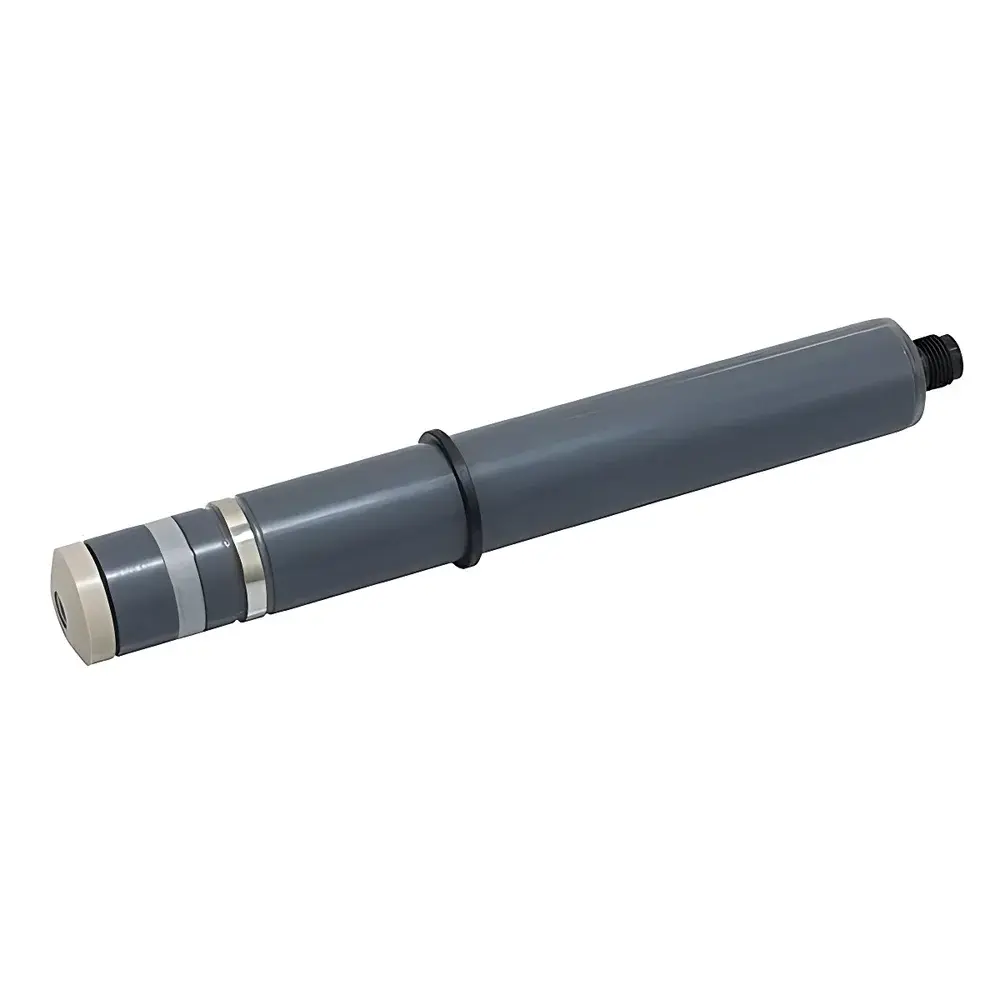
eCHEM Free Chlorine Sensor by TriOS
| Brand | TriOS |
|---|---|
| Origin | Germany |
| Model | eCHEM Free Chlorine |
| Instrument Type | Portable |
| Measurement Principle | Electrochemical Amperometric (3-Electrode, Membrane-Covered, Potentiostatic) |
| Measurement Parameter | Free Chlorine |
| Range | 0–2 mg/L and 0–20 mg/L |
| Accuracy | ±0.4 mg/L (≤2 mg/L range) |
| Temperature Compensation | Integrated Pt100 |
| Response Time (T90%) | ~2 min |
| Drift | ~1%/month |
| Membrane | Hydrophilic Microporous |
| Housing Material | PVC-U + Stainless Steel 1.4571 |
| Dimensions (L×Φ) | 205 mm × 25 mm |
| Weight | 0.1 kg |
| Interface | RS-485, Modbus RTU |
| Power Supply | 9–30 VDC (±10%) |
| Connector | 8-pin M12 |
| Power Consumption | 0.6 W |
| IP Rating | IP68 |
| Operating Temperature | 0–45 °C (liquid, ice-free) |
| Flow Rate Dependency | 15–30 L/h (in FLC-3 flow cell) |
| pH Range | 4–9 (low pH dependency: ~−10% signal change per pH unit) |
| Conductivity Range | 10–50 mS/cm |
| Cross-Sensitivity | Combined chlorine causes positive interference |
| Calibration Method | DPD-1 reference standard |
| Pressure Rating | 1 bar (static, no shock/vibration |
| Maintenance Interval | Weekly |
| Maintenance Time | ≤0.5 h/month |
Overview
The eCHEM Free Chlorine Sensor is a high-stability, membrane-covered amperometric sensor engineered for continuous, in-situ measurement of free chlorine concentration in aqueous environments. Developed by TriOS—Germany’s leading manufacturer of optical and electrochemical water quality sensors—the device employs a potentiostatic three-electrode system with a hydrophilic microporous membrane that selectively permits diffusion of molecular hypochlorous acid (HOCl) and hypochlorite ion (OCl⁻), the primary species constituting free chlorine. Unlike colorimetric or iodometric methods, this electrochemical approach delivers real-time, reagent-free output with minimal dependence on pH—signal attenuation remains within approximately −10% per unit pH increase across the operational range (pH 4–9). The sensor is designed for integration into fixed or portable monitoring platforms and meets the functional requirements for regulatory-grade residual disinfectant monitoring in drinking water distribution systems, swimming pool circuits, and seawater treatment applications.
Key Features
- Stable amperometric detection with low pH cross-sensitivity—enables reliable operation without inline pH correction in most municipal and recreational water matrices.
- Integrated Pt100 temperature sensor enables automatic thermal compensation, ensuring consistent accuracy across 0–45 °C operating conditions.
- Robust mechanical architecture: stainless steel 1.4571 sensing tip and PVC-U housing rated IP68 for submersion up to 1 bar static pressure; mounting ring included for vibration-resistant installation.
- Modbus RTU over RS-485 interface ensures seamless integration with SCADA, PLC, and data loggers compliant with IEC 61158 and ISO/IEC 8802-3 standards.
- Low power consumption (0.6 W) and wide supply range (9–30 VDC ±10%) support battery-powered field deployments and solar-hybrid telemetry stations.
- Calibration traceable to DPD-1 spectrophotometric reference method (ASTM D1253, ISO 7393-2), supporting GLP-compliant validation protocols.
Sample Compatibility & Compliance
The eCHEM sensor demonstrates validated performance in diverse water matrices including potable water (turbidity <5 NTU, DOC 100 mg/L H₂O₂) or strongly reducing environments (e.g., sulfide-rich groundwater).
Software & Data Management
TriOS provides native firmware support for its TriBox3 and TriBox Mini controllers, enabling automated zero/span calibration, drift compensation algorithms, and dual-range switching (0–2 mg/L / 0–20 mg/L) via Modbus register configuration. All sensor data—including raw current, compensated concentration, temperature, and diagnostic flags (e.g., membrane saturation, electrode polarization status)—are timestamped and logged with microsecond resolution. When deployed with TriOS HS100 telemetry modules, data streams comply with IEC 62443-3-3 cybersecurity profiles and support FDA 21 CFR Part 11 audit trails when hosted on validated TriOS Cloud or on-premise DataHub instances. Export formats include CSV, JSON, and OPC UA for integration into LIMS and enterprise asset management (EAM) systems.
Applications
- Real-time monitoring of free chlorine residuals at drinking water treatment plant clearwells and distribution network entry points.
- Automated dosing control in public and commercial swimming pools, complying with EN 15288-1 safety requirements.
- Seawater cooling circuit surveillance in power generation and desalination facilities, where chlorine demand fluctuates with biofouling activity.
- Validation of UV/chlorine advanced oxidation processes (AOPs) in wastewater reuse schemes, requiring sub-mg/L resolution and rapid response.
- Mobile surveying using handheld TriBox Mini units equipped with GPS and Bluetooth for spatial mapping of disinfectant decay in aging infrastructure.
FAQ
How often does the sensor require calibration?
Field calibration is recommended weekly using DPD-1 reagent kits; factory calibration certificates are traceable to NIST SRM 2811. Automatic zero-point verification is supported during low-flow or offline intervals.
Can the sensor operate in seawater without fouling?
Yes—its hydrophilic membrane resists organic adsorption, and the 1.4571 stainless steel body withstands chloride-induced pitting. For long-term deployment (>3 months), periodic cleaning with 0.1% NaOCl solution is advised.
What is the minimum flow rate required for accurate measurement?
In the FLC-3 flow cell, stable readings are achieved at 15–30 L/h. Below 10 L/h, diffusion-limited response may cause underestimation; flow-independent operation is not supported.
Does the sensor require routine membrane replacement?
The microporous membrane is designed for 12-month service life under typical municipal water conditions. Replacement kits (part no. MEM-eCHEM-FC) are available with torque-controlled installation tools.
Is Modbus RTU configuration compatible with third-party PLCs?
Yes—register maps conform to Modbus Application Protocol v1.1b; all function codes (03h, 06h, 10h) and exception responses are fully documented in TriOS Communication Protocol Specification Rev. 4.2.
Related Products







