
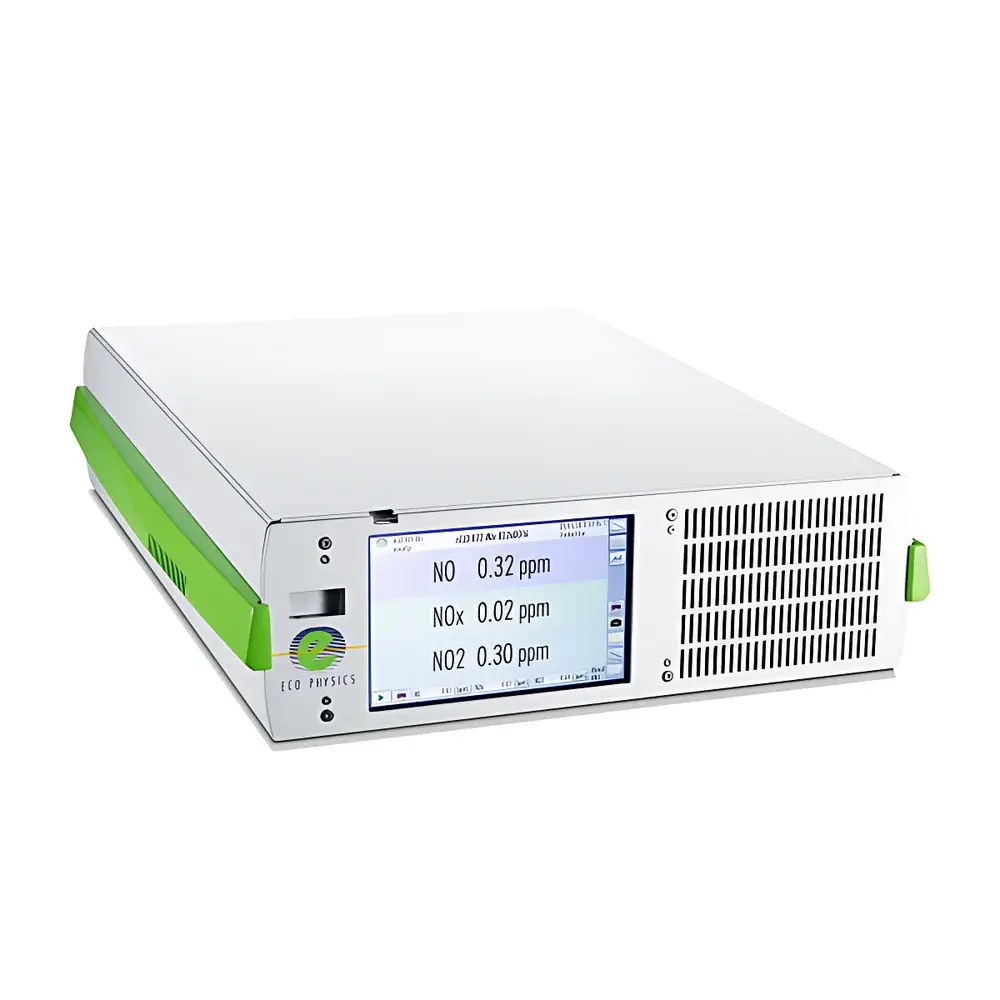
ECO Physics nCLD 844 Chemiluminescence NOₓ and NH₃ Analyzer
| Brand | AGC |
|---|---|
| Origin | Switzerland |
| Model | ECO Physics nCLD 844 |
| Measurement Principle | Gas-Phase Chemiluminescence Detection |
| Detection Targets | NO, NO₂, NOₓ, NH₃ (via catalytic conversion) |
| Measurement Range | 0.5–500 ppm (4 programmable ranges) |
| Response Time (T90) | < 1 s |
| Minimum Detectable Concentration | 0.025 ppm |
| Sample Flow Rate | 1.2 L/min |
| Reaction Chamber Temperature | Up to 190 °C (heated sample line) |
| Ozone Generator | High-voltage, high-output |
| O₃ Decomposition | Integrated thermal catalytic decomposer (no consumables) |
| Compliance | Designed for EN 14181, ISO 11665, EPA Method 7E, ASTM D5158, and GLP/GMP-aligned data integrity workflows |
Overview
The ECO Physics nCLD 844 is a high-precision, dual-analyte chemiluminescence detector engineered for simultaneous, real-time quantification of nitrogen oxides (NO, NO₂, NOₓ) and ammonia (NH₃) in demanding environmental, industrial, and research applications. Based on the well-established gas-phase chemiluminescence reaction between nitric oxide (NO) and ozone (O₃), the instrument achieves trace-level sensitivity and exceptional temporal resolution. To extend detection capability to NH₃ and NO₂—species that do not directly emit light in the CLD reaction—the nCLD 844 integrates two independent, temperature-controlled catalytic converters: one for selective NH₃-to-NO conversion (e.g., via Cr₂O₃ or Pt-based catalysts at >650 °C), and another for NO₂-to-NO reduction (e.g., using molybdenum or carbon-based converters). This architecture enables true multi-species analysis without cross-interference, supporting regulatory-grade monitoring in stack emissions, ambient air quality networks, cleanroom process gas verification, and atmospheric chemistry studies.
Key Features
- Dual-converter architecture: Integrated, independently controlled NH₃ and NO₂ catalytic converters ensure stoichiometric and reproducible conversion prior to chemiluminescent detection.
- Heated sample pathway: Entire gas transport system—including sampling line, filters, flow restrictors, and converter inlet—is maintained up to 190 °C to prevent ammonium salt condensation and wall adsorption, preserving quantitative NH₃ recovery.
- High-efficiency ozone generation: Solid-state high-voltage ozone generator delivers stable, high-concentration O₃ output (>100 mg/L), ensuring complete NO oxidation and maximizing photon yield across full dynamic range.
- Zero-maintenance ozone destruction: Thermal catalytic ozone decomposer operates continuously at >300 °C, eliminating need for activated carbon cartridges and preventing secondary VOC breakthrough or pressure drift.
- Rapid response & stability: T90 response time <1 second with <±1% zero drift over 24 h and <±0.5% span drift per week under calibrated conditions—meeting EN 14181 QAL1 requirements for automated monitoring systems.
- Modular hardware design: Field-upgradable components—including optical detector, converter modules, and flow control units—support long-term serviceability and application-specific configuration.
Sample Compatibility & Compliance
The nCLD 844 accepts gaseous samples across a wide pressure range (600–1200 mbar absolute) with automatic pressure compensation, enabling direct connection to flue ducts, ambient air inlets, or ultra-high-purity gas lines (e.g., semiconductor-grade N₂ or Ar). It is compatible with corrosive matrices (e.g., wet stack gases containing SO₂ or HCl) when paired with optional Nafion dryers or heated particulate filters. The analyzer meets essential performance criteria outlined in EU Directive 2010/75/EU (IED), U.S. EPA Performance Specification 2 (PS-2) for NOₓ CEMS, and ISO 21258 for stationary source emission monitoring. Its firmware supports audit-trail logging, electronic signatures, and user-access controls aligned with FDA 21 CFR Part 11 and EU Annex 11 for regulated environments.
Software & Data Management
The instrument operates under ECO Physics’ proprietary CLD Control Suite—a Windows-based application supporting real-time spectral visualization, multi-point calibration validation, and automated zero/span scheduling. Raw photomultiplier tube (PMT) signals, converter temperatures, O₃ concentration, and pressure-compensated flow are logged at 1 Hz with timestamped metadata. Export formats include CSV, XML, and Modbus TCP for integration into SCADA, LIMS, or cloud-based environmental data platforms (e.g., Siemens Desigo, Honeywell Experion, or custom AWS IoT deployments). All data modifications are immutably recorded with operator ID, timestamp, and reason-for-change fields—fully compliant with GLP and GMP documentation standards.
Applications
- Continuous emissions monitoring (CEMS) of NOₓ and NH₃ slip in SCR/SNCR de-NOₓ systems.
- Calibration and verification of reference gas mixtures (ppb–ppm level) for metrology labs and gas standard providers.
- Atmospheric boundary layer studies requiring sub-second NH₃ flux measurements via eddy covariance coupling.
- In-line purity verification of high-purity process gases used in semiconductor fabrication (e.g., NH₃ dopant lines).
- Human breath analysis research—quantifying exhaled NO as a biomarker for airway inflammation under controlled humidity and temperature protocols.
- Mobile laboratory deployment for roadside or industrial fence-line monitoring, supported by optional battery power and GPS-synchronized logging.
FAQ
What is the fundamental detection principle of the nCLD 844?
It relies on gas-phase chemiluminescence: NO reacts with ozone to form excited NO₂*, which emits photons (~600–3000 nm) upon relaxation; NH₃ and NO₂ are first catalytically converted to NO prior to detection.
Can the nCLD 844 measure NO and NO₂ separately without interference?
Yes—by operating the NO₂ converter in bypass mode while measuring NO directly, then switching to conversion mode for total NOₓ; differential calculation yields NO₂ concentration with uncertainty <±2% of reading.
Is the heated sample line sufficient to prevent NH₄NO₃ formation in high-humidity samples?
When operated at ≥180 °C and with residence time <0.5 s, thermodynamic modeling confirms negligible ammonium nitrate nucleation; optional permeation dryer integration further mitigates condensation risk.
Does the instrument support remote diagnostics and firmware updates?
Yes—via Ethernet interface with SSH/TLS-enabled CLI and web-based status dashboard; updates require digital signature verification and rollback capability.
What maintenance intervals are recommended for routine operation?
Annual preventive maintenance includes PMT gain verification, converter catalyst activity check, flow restrictor cleaning, particulate filter replacement, and pump membrane inspection—typical downtime <2 hours.
Related Products







