
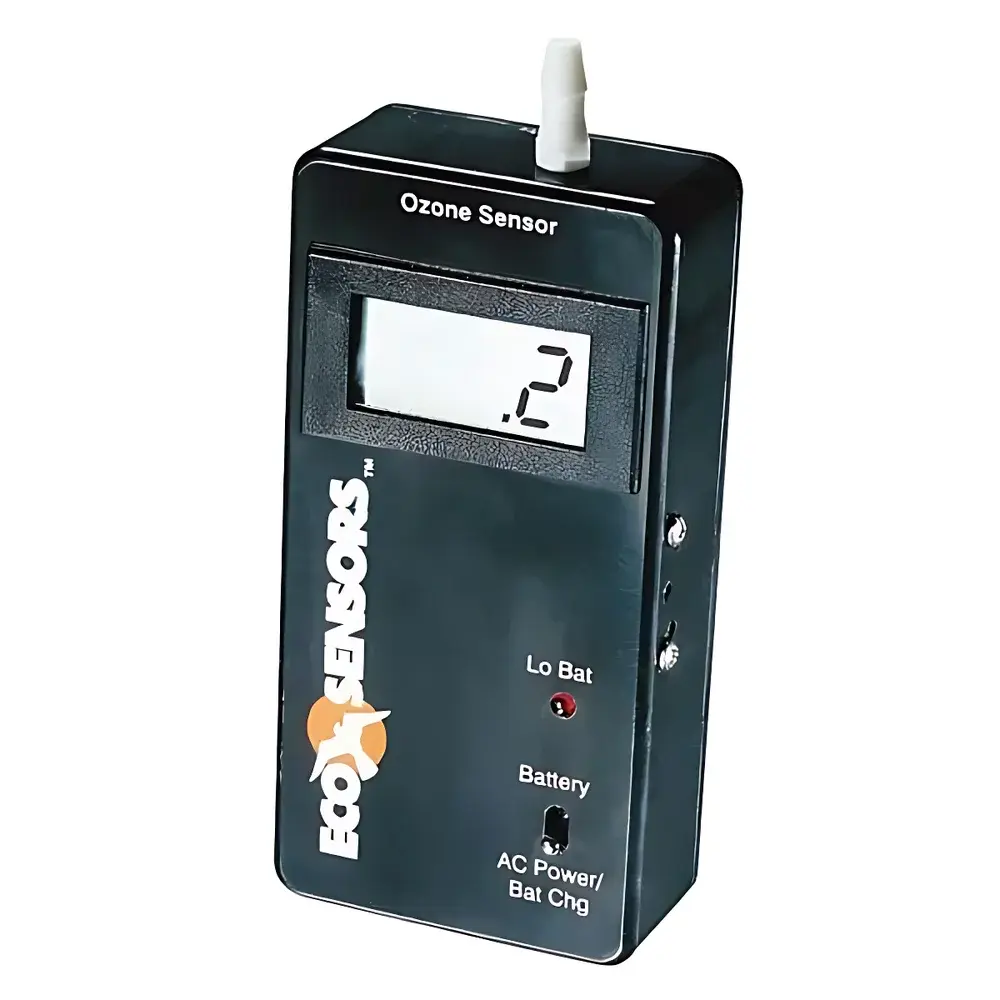
Eco Sensors A-21ZX Fixed-Mount Ozone Analyzer
| Origin | USA |
|---|---|
| Manufacturer Type | Authorized Distributor |
| Origin Category | Imported |
| Model | A-21ZX |
| Instrument Type | Fixed-Mount |
| Measurement Range | 0–10 ppm |
| Detection Limit | 0.01 ppm (resolution) |
| Response Time | <60 seconds (T90) |
| Zero Drift | <±0.02 ppm/week |
| Resolution | 0.01 ppm |
| Dimensions | 110 × 220 × 64 mm (L×W×H) |
| Weight | 570 g |
| Power Supply | 12–24 VDC, 500 mA |
| Operating Temperature | 0–40 °C |
| Relative Humidity | 0–95% RH (non-condensing) |
Overview
The Eco Sensors A-21ZX Fixed-Mount Ozone Analyzer is a compact, field-deployable gas sensing instrument engineered for continuous, real-time monitoring of ozone (O3) concentrations in ambient air and industrial process environments. It employs a calibrated metal oxide semiconductor (MOS) sensor operating on the principle of reversible surface oxidation–reduction reactions, where ozone exposure modulates the electrical resistance of a heated tin dioxide (SnO2) sensing element. This electrochemical transduction mechanism delivers stable, repeatable output signals proportional to ozone partial pressure within the 0–10 ppm range. Designed for fixed installation in HVAC ducts, ozone generator enclosures, water treatment off-gas lines, and laboratory ventilation systems, the A-21ZX provides reliable leak detection and environmental compliance verification without requiring carrier gases, optical paths, or complex calibration infrastructure.
Key Features
- Fixed-mount architecture with integrated mounting flange and IP54-rated enclosure for wall, panel, or duct installation
- High-sensitivity MOS sensor optimized for low-concentration ozone detection down to 0.01 ppm resolution
- Fast response dynamics: T90 ≤ 60 seconds for rapid event detection during ozone generation or purge cycles
- Low zero drift specification (<±0.02 ppm/week) ensures long-term measurement stability between scheduled calibrations
- Wide input voltage tolerance (12–24 VDC, 500 mA) compatible with industrial control power rails and battery-backed systems
- Compact footprint (110 × 220 × 64 mm) and lightweight design (570 g) facilitate integration into space-constrained OEM and retrofit applications
- Onboard analog output (4–20 mA or 0–10 VDC selectable) and digital RS-485 Modbus RTU interface for seamless integration into SCADA, BMS, and PLC networks
Sample Compatibility & Compliance
The A-21ZX is validated for use in clean, non-corrosive, non-condensing airstreams with particulate loading <1 mg/m³. It is not intended for direct sampling of humidified, high-temperature (>40 °C), or chemically aggressive process gases containing chlorine, nitrogen oxides, or volatile organic compounds (VOCs) above 50 ppm — such matrices may interfere with MOS sensor selectivity or accelerate baseline drift. The analyzer complies with CE marking requirements for electromagnetic compatibility (EN 61326-1) and safety (EN 61010-1). While not certified to UL 2075 or IEC 60079 for hazardous locations, it meets general-purpose indoor air quality (IAQ) monitoring expectations per ASHRAE Standard 62.1 and OSHA PEL guidelines (0.1 ppm TWA). Routine calibration using NIST-traceable ozone standards is recommended every 3–6 months to maintain data integrity for GLP-aligned environmental reporting.
Software & Data Management
The A-21ZX operates as a standalone analog transmitter; no embedded firmware or proprietary software is required for basic operation. Configuration and diagnostics are performed via DIP switches and front-panel LED indicators. For advanced data logging and remote monitoring, the device integrates natively with third-party industrial automation platforms supporting Modbus RTU over RS-485. When connected to a compliant data acquisition system, timestamped ozone concentration records can be archived with audit-trail metadata, satisfying documentation requirements under FDA 21 CFR Part 11 for pharmaceutical facility environmental monitoring. Optional analog-to-digital converters with built-in SD card storage enable local trend capture independent of network infrastructure.
Applications
- Continuous verification of ozone destruction efficiency downstream of UV or corona discharge generators
- Leak detection at flange joints, valve stems, and ozone contactor access ports in municipal water treatment plants
- Occupational exposure monitoring in laboratories and manufacturing facilities handling ozone-based sterilization equipment
- Real-time feedback control for ozone dosing systems in food processing and semiconductor cleaning lines
- Baseline ambient ozone surveillance in HVAC intake zones to prevent occupant exposure exceeding ACGIH TLV (0.05 ppm STEL)
- Validation support for ISO 14644-1 cleanroom classification where ozone residuals must remain below 0.02 ppm
FAQ
What calibration standard is recommended for the A-21ZX?
NIST-traceable ozone gas standards generated by photometric ozone calibrators (e.g., UV absorption at 254 nm) are preferred. Dynamic dilution systems delivering certified 0.1–5.0 ppm ozone in synthetic air are suitable for full-span verification.
Can the A-21ZX be used outdoors?
No — its IP54 rating protects against dust and splashing water but does not guarantee performance under rain, freezing temperatures, or solar radiation exposure. Outdoor deployment requires an environmentally controlled enclosure with temperature stabilization.
Does the sensor require periodic replacement?
Yes — the MOS sensing element exhibits gradual sensitivity decay after ~18–24 months of continuous operation in typical indoor air. Eco Sensors recommends annual sensor replacement to maintain stated resolution and drift specifications.
Is the 4–20 mA output intrinsically safe?
No — the analog output is non-isolated and not certified for Class I, Division 1 hazardous areas. Signal isolation modules meeting IEC 60079-11 must be installed upstream if used in potentially explosive atmospheres.
How is zero calibration performed?
Zero adjustment is executed using certified zero air (ozone-free synthetic air, <0.005 ppm O3) delivered at specified flow rate (0.5–1.0 L/min) through the inlet port while holding the ZERO CAL button for 5 seconds. Full details are provided in the OEM Calibration Procedure Manual (Rev. C).
Related Products







