
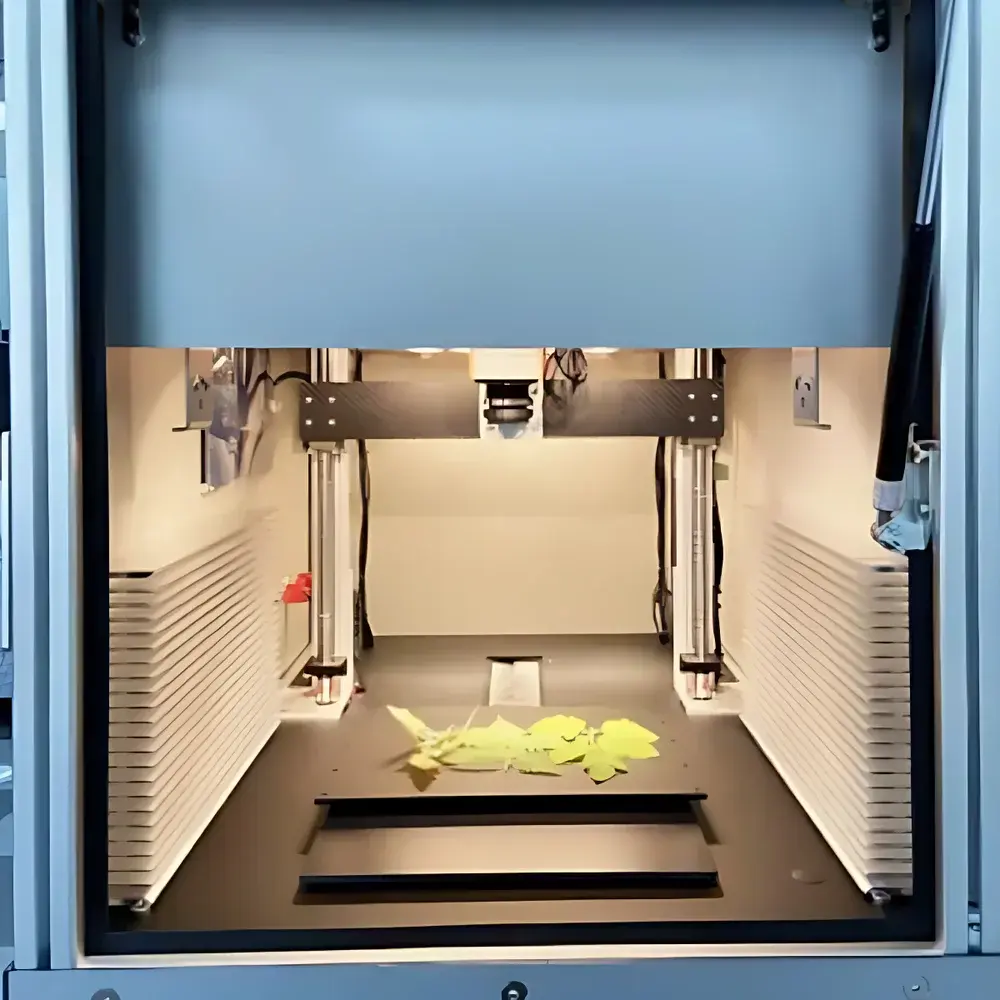
EcoTech FluorTron Standard Edition Plant Photosynthetic Phenotyping Imaging System
| Brand | EcoTech |
|---|---|
| Origin | Beijing, China |
| Manufacturer Type | Authorized Distributor |
| Product Origin | Domestic (China) |
| Model | FluorTron Standard Edition |
| Pricing | Available Upon Request |
| Chlorophyll Fluorescence Imaging Area | ≥20 cm × 20 cm |
| Imaging Resolution | 2448 × 2048 pixels |
| Sensor | 5 MP, 2/3″ CMOS |
| Pixel Size | 3.45 µm × 3.45 µm |
| Max Frame Rate | ≥70 fps |
| Exposure Time Range | 15 µs – 10 s |
| Binning Modes | 1×1, 2×2 |
| Excitation Source | Tunable Blue LED (Optional Multi-Wavelength Excitation) |
| Measured Parameters | Fo, Fm, Fp, Ft, Fs, Fm′, Fv/Fm (QYmax), ∆F/Fm′ (Y(II)), Fv/Fo, NPQ, Rfd, Y(NPQ), Y(NO) |
| Optional Morphometric Analysis | Projected Area (Relative Biomass), Length, Width, Aspect Ratio, Convex Hull Area, ROI Area, Roundness |
| Optional Video Spectral Imaging | Chlorophyll Fluorescence Spectral Imaging, Red-Edge Reflectance Imaging, Up to 120 Data Cubes per Second |
| Modularity | Fully Modular Architecture for Future Expansion |
Overview
The EcoTech FluorTron Standard Edition Plant Photosynthetic Phenotyping Imaging System is a research-grade, non-invasive platform engineered for quantitative, spatially resolved analysis of photosynthetic performance across intact plant canopies and individual leaves. It operates on the principle of pulse-amplitude modulated (PAM) chlorophyll fluorescence imaging—leveraging high-sensitivity detection of variable fluorescence kinetics induced by precisely controlled blue LED excitation. By capturing dynamic fluorescence responses under standardized light protocols—including rapid induction (Kautsky effect), steady-state quenching analysis, and light-adapted quantum yield assessment—the system delivers pixel-level maps of photochemical efficiency, energy dissipation pathways, and stress-induced physiological perturbations. Designed for integration into controlled-environment phenotyping facilities, growth chambers, and greenhouse laboratories, the FluorTron Standard Edition supports both single-plant and small-plot imaging with reproducible optical geometry and calibrated photometric output. Its architecture adheres to fundamental principles of plant biophysics and conforms to widely accepted experimental frameworks defined in peer-reviewed literature (e.g., Maxwell & Johnson, 2000; Baker, 2008).
Key Features
- High-resolution, high-dynamic-range chlorophyll fluorescence imaging at 2448 × 2048 pixels with 3.45 µm pixel pitch and ≥70 fps acquisition speed—enabling sub-second kinetic profiling of fluorescence transients.
- Programmable blue LED excitation source with stable spectral output centered at 450 nm; optional multi-wavelength excitation modules support comparative spectral response analysis.
- Full protocol automation including dark-adapted Fv/Fm (QYmax), actinic light-driven Y(II), NPQ kinetics, Rfd decay analysis, and custom-defined illumination sequences compliant with JIP-test conventions.
- Modular mechanical design permits future integration of complementary imaging modalities—such as thermal IR, multispectral reflectance, or UV-induced fluorescence—without hardware replacement.
- Real-time exposure control from 15 µs to 10 s with programmable binning (1×1 or 2×2), ensuring optimal signal-to-noise ratio across diverse sample types—from thin Arabidopsis rosettes to thick maize leaves.
- Embedded synchronization interface for external environmental control systems (e.g., climate chambers, CO₂ regulators) enabling time-stamped correlation between physiological imaging data and environmental variables.
Sample Compatibility & Compliance
The FluorTron Standard Edition accommodates a broad range of plant material: seedlings, mature rosettes, detached leaves, whole pots (up to 20 cm × 20 cm field-of-view), and small-scale hydroponic arrays. Sample positioning is facilitated by an adjustable stage with millimeter-scale precision and integrated leveling indicators. All optical components meet ISO 9022-3:2015 standards for environmental resistance to dust and humidity during laboratory operation. The system’s firmware and data acquisition software are structured to support audit-ready workflows aligned with GLP-compliant plant physiology studies. While not FDA-certified (as it is a research instrument), raw fluorescence parameter outputs—including Fo, Fm, Y(II), NPQ, and Y(NO)—are traceable to internationally recognized definitions published in *Photosynthesis Research* and endorsed by the International Society of Photosynthesis Research (ISPR). Export documentation complies with EAR Category 3A991 and EU Dual-Use Regulation Annex I controls.
Software & Data Management
The FluorTron Control Suite is a Windows-based application built on Qt framework with native HDF5 file handling for lossless storage of multidimensional fluorescence time-series datasets. Each acquired image stack includes embedded metadata: timestamp, exposure settings, excitation intensity, temperature sensor readings (optional), and user-defined ROI annotations. Batch processing supports automated parameter extraction across hundreds of images using customizable region-of-interest (ROI) masks. Morphometric modules—when enabled—compute projected area (as proxy for relative biomass), convex hull metrics, aspect ratio, roundness, and perimeter-based descriptors following standard ImageJ/Fiji morphological algorithms. Data export formats include CSV (for statistical packages), TIFF (8/16-bit), and MATLAB .mat files. Software architecture supports 21 CFR Part 11–compliant user access control when deployed on domain-managed networks—featuring electronic signatures, session logging, and immutable audit trails for critical parameter changes.
Applications
- High-throughput screening of photosynthetic efficiency in mutant libraries or breeding populations under abiotic stress (drought, heat, salinity, nutrient deficiency).
- Spatiotemporal mapping of photoinhibition recovery kinetics following high-light exposure or herbicide treatment.
- Quantification of non-photochemical quenching (NPQ) capacity as a biomarker for stress acclimation potential in crop improvement programs.
- Validation of transgenic lines expressing photoprotective proteins (e.g., PsbS, LHCSR) via pixel-wise Y(NPQ)/Y(NO) ratio analysis.
- Integration with metabolomic or transcriptomic datasets through time-resolved fluorescence phenotyping in controlled-environment experiments.
- Support for FAO-recommended early vigor assessment in cereals using Fv/Fm spatial heterogeneity as a proxy for seedling establishment robustness.
FAQ
What is the minimum detectable change in Fv/Fm that the FluorTron Standard Edition can resolve?
Under optimal conditions (dark-adapted samples, 500-ms saturation pulse, ≥100 averaged frames), the system achieves a coefficient of variation (CV) < 1.2% for Fv/Fm across homogeneous leaf tissue—translating to reliable discrimination of differences ≥0.02 units.
Can the system be used for field-deployable measurements?
The FluorTron Standard Edition is designed for lab- and greenhouse-based use. For field applications, EcoTech offers the mobile FluorTron Field Edition with battery-powered operation, ruggedized housing, and ambient-light compensation algorithms.
Is third-party software integration supported?
Yes—via TCP/IP API and documented DLL libraries, enabling direct control from Python, MATLAB, or LabVIEW environments. Raw frame buffers and metadata streams are accessible in real time for custom algorithm development.
Does the system comply with ASTM E2912-13 or ISO 10211 standards?
While ASTM E2912-13 applies to thermal bridge simulation and ISO 10211 addresses thermal transmission, neither is relevant to chlorophyll fluorescence imaging. However, all fluorescence parameters adhere to ISPR-endorsed nomenclature and calculation methods specified in “Guidelines for Measurement of Chlorophyll Fluorescence” (Lichtenthaler & Burkart, 2021).





