
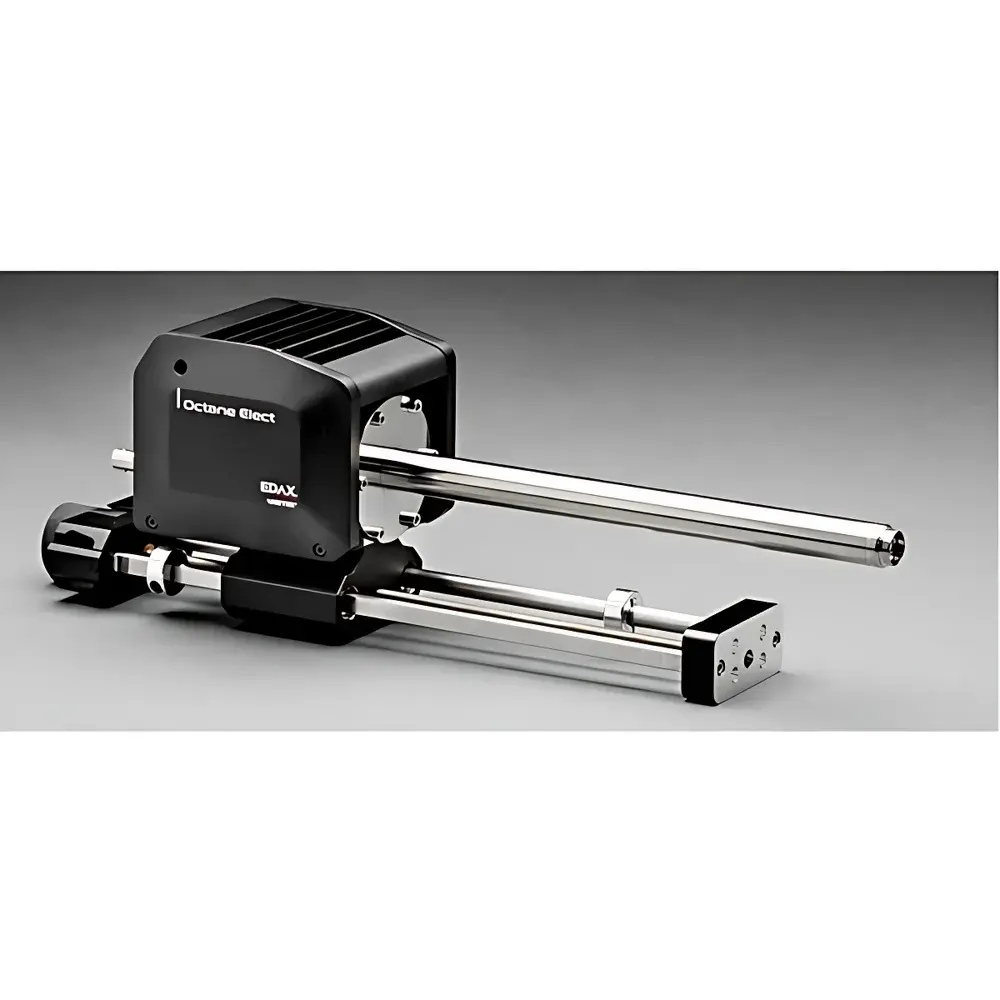
EDAX Octane Elect Energy Dispersive Spectrometer
| Brand | EDAX |
|---|---|
| Origin | USA |
| Model | Octane Elect |
| Energy Resolution | 127 eV |
| Maximum Count Rate | 400,000 cps |
| Detector Active Area | 30 mm² or 70 mm² |
| Window Material | Silicon Nitride (Si₃N₄) |
Overview
The EDAX Octane Elect Energy Dispersive Spectrometer (EDS) is a high-performance, silicon drift detector (SDD)-based microanalysis system engineered for integration with scanning electron microscopes (SEM) and transmission electron microscopes (TEM). It operates on the fundamental principle of energy-dispersive X-ray spectroscopy: incident electron beams excite characteristic X-ray emissions from sample atoms, and the Octane Elect SDD precisely resolves photon energies across the range of ~0.1–20 keV to deliver quantitative elemental composition and spatial distribution data. Designed for laboratories requiring enhanced analytical capability beyond entry-level EDS platforms, the Octane Elect delivers superior light-element sensitivity—particularly for B, C, N, O, and F—without cryogenic cooling, leveraging its ultra-thin silicon nitride (Si₃N₄) window and optimized pulse-processing electronics.
Key Features
- Ultra-high energy resolution of ≤127 eV at Mn Kα (5.89 keV), enabling precise peak separation for overlapping transitions (e.g., S Kα/Pb Mα, Ti Kβ/V Kα)
- Two detector configurations: Octane Elect Plus (30 mm² active area) for balanced performance in routine SEM-EDS; Octane Elect Super (70 mm²) for maximum solid angle and throughput in demanding TEM or low-dose applications
- Silicon nitride (Si₃N₄) window—mechanically robust, chemically inert, and <100 nm thick—enabling efficient transmission of low-energy X-rays (<1 keV) and compatibility with plasma cleaning protocols
- Real-time pulse processing architecture supporting stable operation up to 400,000 output counts per second (cps), with intelligent pile-up rejection and dead-time correction applied at all count rates
- Integrated hardware synchronization with EDAX’s Pegasus EBSD system, allowing simultaneous acquisition of crystallographic orientation (EBSD) and compositional (EDS) data within a single software environment
- Onboard diagnostics and automated acquisition optimization (Smart Collect™) adjust live parameters—including dwell time, beam current, and processing gain—to maximize signal-to-noise ratio without user intervention
Sample Compatibility & Compliance
The Octane Elect EDS is compatible with conductive, semi-conductive, and insulating samples when paired with standard SEM charge compensation techniques (e.g., low-vacuum mode, carbon coating, or beam deceleration). Its Si₃N₄ window ensures stability under moderate vacuum conditions (≤1×10⁻⁵ Torr) and resistance to hydrocarbon contamination. The system complies with IEC 61000-6-3 (EMC emission standards) and meets CE marking requirements for laboratory instrumentation. Software workflows support audit-trail-enabled data acquisition in accordance with GLP and GMP principles; optional FDA 21 CFR Part 11 compliance packages are available for regulated environments requiring electronic signature validation and secure user access control.
Software & Data Management
Controlled by EDAX’s TEAM™ Software Suite, the Octane Elect provides unified access to spectrum acquisition, qualitative/quantitative analysis, elemental mapping (point, line, and area), phase identification (via integrated Phase ID™ library), and correlative EDS-EBSD visualization. The software features EXpert ID™ for automated element identification, Smart Map™ for adaptive pixel dwell optimization during mapping, and Rapid Phase Distribution™ (patent-pending) for statistically robust phase segmentation based on composition and morphology. All raw spectra, processed maps, and metadata are stored in vendor-neutral HDF5 format, enabling interoperability with third-party analysis tools (e.g., Python-based hyperspectral libraries, MATLAB, or ImageJ/Fiji plugins). Data integrity is maintained via timestamped acquisition logs, version-controlled processing history, and exportable XML-based reports compliant with ISO 14971 risk management documentation frameworks.
Applications
- Light-element quantification in polymers, ceramics, and battery cathode materials (e.g., Li, B, O distribution in NMC cathodes)
- In situ and low-kV (<5 kV) analysis of beam-sensitive biological specimens and nanomaterials
- Failure analysis of solder joints, intermetallic compounds, and thin-film stack interfaces in semiconductor packaging
- Mineralogical phase mapping in geoscience samples using combined EDS-EBSD texture analysis
- Regulatory-compliant elemental impurity screening in pharmaceutical excipients per ICH Q3D guidelines
- Automated inclusion analysis in steel and aluminum alloys per ASTM E1245 and ISO 16232 standards
FAQ
What is the minimum accelerating voltage suitable for reliable light-element detection with the Octane Elect?
Optimal light-element sensitivity (B, C, N, O) is achieved at 5–10 kV in SEM mode; sub-5 kV operation is supported with appropriate beam current and dwell optimization.
Does the Octane Elect require liquid nitrogen cooling?
No—it employs thermoelectric (Peltier) cooling to maintain the SDD at –20°C to –30°C, eliminating dependency on cryogens and enabling continuous unattended operation.
Can the Octane Elect be retrofitted onto existing SEMs from other manufacturers?
Yes—EDAX provides OEM-integrated and field-installable versions compatible with major SEM platforms (Thermo Fisher, Zeiss, JEOL, Hitachi) via standard detector mounting flanges and digital interface protocols (e.g., PCIe, USB 3.0, or proprietary OEM bus).





