
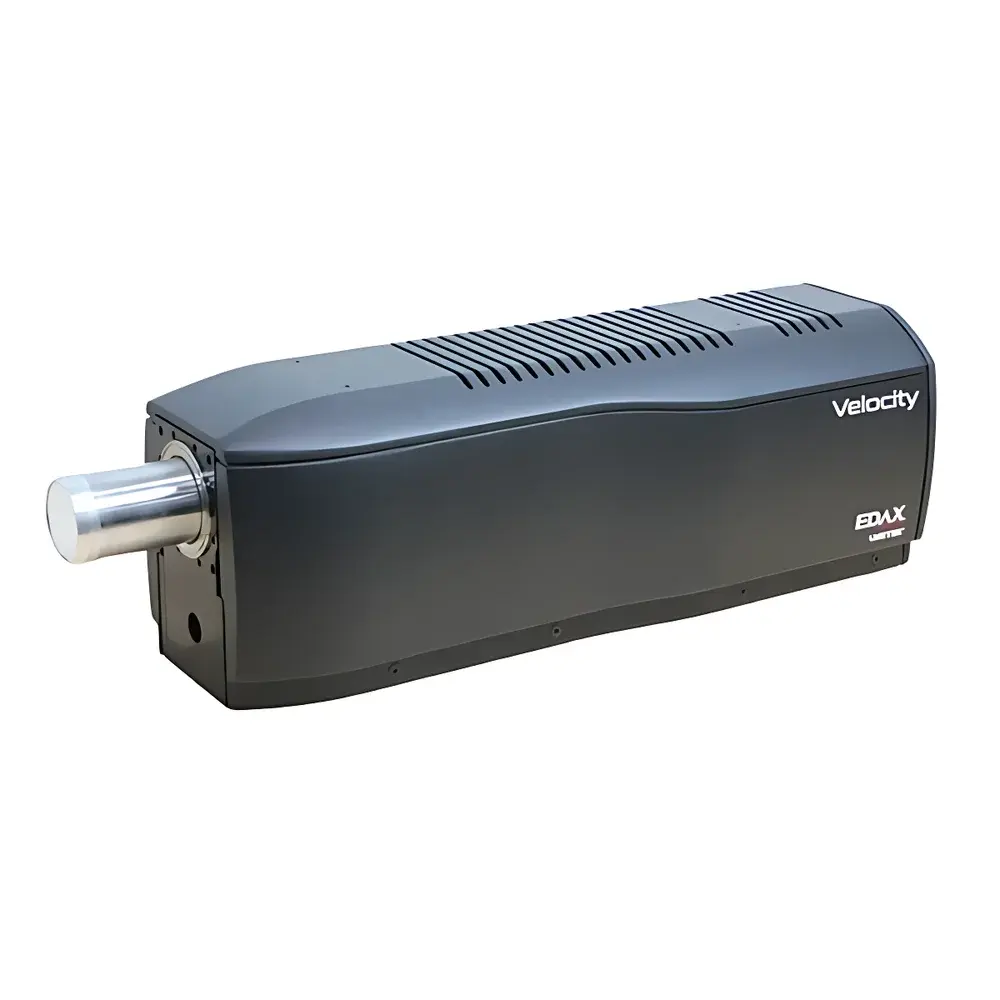
EDAX Velocity Super Electron Backscatter Diffraction (EBSD) System
| Brand | EDAX |
|---|---|
| Origin | USA |
| Model | Velocity Super |
| Maximum Acquisition Speed | 4500 points/sec |
| Orientation Resolution | < 0.1° |
| Image Resolution (during high-speed acquisition) | 120 × 120 pixels |
| Detector Type | High-sensitivity, low-noise CMOS |
| Calibration Algorithm | Triplet-band confidence-based indexing |
| EDS-EBSD Synchronization | Yes, with compatible EDAX EDS detectors |
| Compliance | Designed for ASTM E112, ISO 11937, and ASTM E2627-compliant microstructural quantification workflows |
| Software Integration | OIM Analysis™ v9+ with GLP-compliant audit trail and 21 CFR Part 11-ready data handling |
Overview
The EDAX Velocity Super Electron Backscatter Diffraction (EBSD) System is a high-performance, CMOS-based orientation mapping platform engineered for precision crystallographic characterization within scanning electron microscopes (SEM). Operating on the fundamental principle of Kikuchi pattern formation from backscattered electrons in crystalline solids, the Velocity Super delivers quantitative grain structure, phase distribution, and lattice orientation data at unprecedented acquisition speeds—up to 4500 indexed points per second—without compromising indexing confidence or angular resolution. Its design targets demanding applications in metallurgy, geosciences, nuclear materials, and advanced manufacturing where rapid, statistically robust microstructural quantification is essential. Unlike legacy CCD-based EBSD detectors, the Velocity Super leverages a custom high-dynamic-range CMOS sensor optimized for low-dose, high-fidelity pattern capture under variable beam conditions, enabling reliable analysis of beam-sensitive, deformed, or low-symmetry materials.
Key Features
- Ultra-high-speed acquisition: Up to 4500 indexed points/sec (Velocity Super) with >99% indexing success rate under standard operating conditions (120 × 120 pixel pattern resolution)
- Sub-degree angular resolution: Orientation precision better than 0.1°, validated per ASTM E2627 guidelines for angular reproducibility
- Triplet-band indexing algorithm: Proprietary confidence-weighted pattern matching that eliminates reliance on external correction modules—even for heavily deformed, nanocrystalline, or multiphase samples
- Integrated EDS-EBSD synchronization: Real-time, frame-locked acquisition with compatible EDAX EDS detectors (e.g., Octane Elite, Vulcan), enabling correlated phase–chemistry–orientation analysis without temporal misregistration
- Low-noise, high-sensitivity CMOS detector: Optimized quantum efficiency across typical SEM accelerating voltages (10–30 kV); supports low-beam-current operation for sensitive or insulating specimens
- Robust hardware architecture: Vacuum-compatible, thermally stabilized detector head with automated pattern center calibration and drift compensation
Sample Compatibility & Compliance
The Velocity Super is validated for use across a broad spectrum of crystalline and polycrystalline materials—including FCC, BCC, HCP metals, ceramics, intermetallics, geological minerals, and additively manufactured alloys. It maintains high indexing fidelity on samples with severe plastic deformation, fine grain sizes (<500 nm), and complex multi-phase microstructures (e.g., duplex stainless steels, Ti-6Al-4V + α₂ precipitates). System compliance aligns with industry-standard metrology frameworks: data output conforms to ASTM E112 (grain size), ISO 11937 (crystallographic texture), and ASTM E2627 (EBSD angular resolution validation). Full audit trails, user access controls, and electronic signature support are implemented via OIM Analysis™ software to meet GLP and GMP documentation requirements.
Software & Data Management
OIM Analysis™ v9.4+ serves as the native processing and visualization environment, supporting batch indexing, grain reconstruction, boundary characterization (CSL, misorientation), and 3D EBSD reconstruction workflows. All raw pattern data, indexing logs, and metadata are stored in vendor-neutral HDF5 format with embedded timestamps, SEM parameters, and detector configuration. The software includes FDA 21 CFR Part 11-compliant features: role-based permissions, electronic signatures, immutable audit logs, and secure export protocols. Automated report generation supports ISO/IEC 17025-compliant laboratory reporting templates.
Applications
- High-throughput grain structure mapping for quality control in hot-rolled steel or aluminum extrusions
- In situ deformation studies tracking dislocation substructure evolution during mechanical loading inside SEM chambers
- Phase identification and orientation relationship analysis in Ni-based superalloys and turbine blade coatings
- Residual stress estimation via high-resolution kernel average misorientation (KAM) and geometrically necessary dislocation (GND) density mapping
- 3D microstructure reconstruction using serial sectioning (FIB-SEM + EBSD) with positionally registered datasets
- Geological provenance analysis of zircon, olivine, and quartz aggregates under low-kV, low-dose conditions
FAQ
What is the difference between Velocity Plus and Velocity Super?
The Velocity Super achieves up to 4500 indexed points/sec, while the Velocity Plus operates at up to 3000 points/sec—both maintain >99% indexing success at full speed with identical angular resolution and algorithmic architecture.
Does Velocity require additional licensing for triplet-band indexing?
No. The triplet-band confidence-based indexing engine is embedded in all Velocity systems and requires no optional module or runtime license.
Can Velocity be retrofitted onto existing SEMs?
Yes. The system integrates with major SEM platforms (Thermo Fisher Scientific, Zeiss, JEOL, Hitachi) via standard flange interfaces and digital I/O synchronization ports.
Is EDS-EBSD synchronization supported at maximum acquisition speed?
Yes. Frame-locked acquisition is maintained at 4500 pts/sec when paired with EDAX’s latest-generation EDS detectors and compatible SEM scan generators.
How is orientation accuracy validated on Velocity Super?
Angular precision is verified using certified reference materials (e.g., NIST SRM 2840 Si single crystal) and cross-checked against repeat measurements per ASTM E2627 Annex A2 procedures.






