
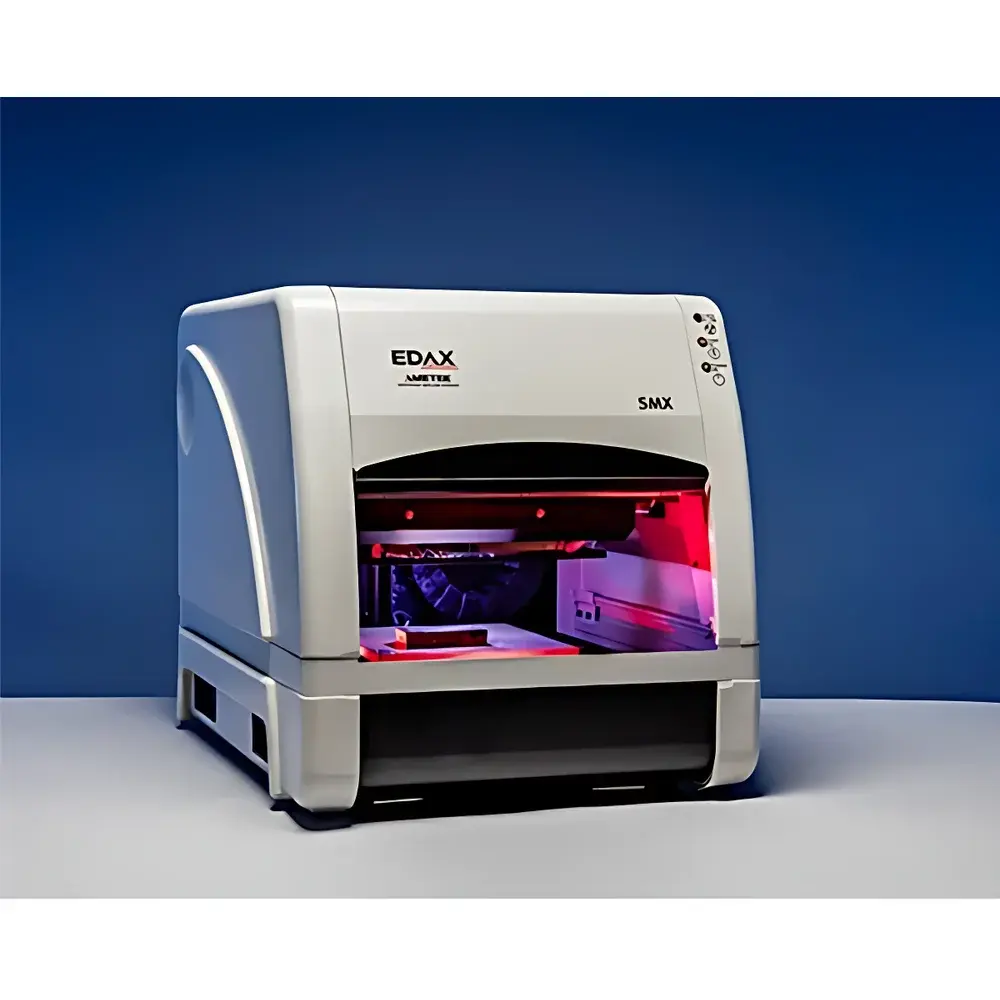
EDAX XLNCE SMX-BEN Benchtop Energy Dispersive X-ray Fluorescence Spectrometer
| Brand | EDAX |
|---|---|
| Origin | USA |
| Manufacturer Type | Authorized Distributor |
| Origin Category | Imported |
| Model | XLNCE SMX-BEN |
| Quotation | Upon Request |
| Energy Resolution | See Technical Datasheet |
| Peak-to-Background Ratio | See Technical Datasheet |
| Maximum Count Rate | See Technical Datasheet |
| Detector Active Area | See Technical Datasheet |
Overview
The EDAX XLNCE SMX-BEN is a high-performance benchtop energy dispersive X-ray fluorescence (EDXRF) spectrometer engineered for non-destructive elemental analysis and thin-film thickness measurement across diverse solid and powdered materials. Operating on the fundamental principle of X-ray fluorescence—where primary X-rays excite characteristic secondary (fluorescent) X-rays from sample atoms—the system enables quantitative and semi-quantitative determination of elemental composition from sodium (Na, Z=11) to uranium (U, Z=92). Its optimized X-ray optics—including selectable primary beam filters and interchangeable collimators—enhance spectral selectivity and signal-to-noise ratio for demanding applications in R&D, process development, quality assurance, and failure analysis. Designed with industrial robustness and laboratory-grade precision, the XLNCE SMX-BEN integrates seamlessly into GLP-compliant workflows and supports traceable calibration protocols aligned with ISO 8258 (control charts), ASTM E1621 (EDXRF for metals), and IEC 62321-5 (RoHS screening).
Key Features
- Next-generation silicon drift detector (SDD) with Peltier cooling, delivering high count-rate capability and excellent energy resolution at room temperature operation
- Programmable XYZ sample stage with motorized positioning and repeatable accuracy ≤ ±1 µm, enabling automated multi-point mapping and heterogeneous sample characterization
- Large-volume analytical chamber (≥ 300 mm × 300 mm × 150 mm) accommodating irregularly shaped parts, wafers up to 300 mm diameter, and bulk samples without sectioning
- Modular X-ray source optics: configurable anode targets (Rh, Mo, Cr), variable kV/mA settings (up to 50 kV / 1 mA), and interchangeable primary filters for matrix-specific excitation optimization
- Embedded touchscreen interface with preloaded application methods for coatings, alloys, ceramics, and environmental matrices—requiring no prior spectroscopy expertise
- Compliance-ready architecture supporting audit trails, user access levels, electronic signatures, and data export formats compatible with LIMS and ERP systems
Sample Compatibility & Compliance
The XLNCE SMX-BEN accepts flat, curved, or irregular solid specimens; pressed pellets; fused beads; and coated substrates without vacuum requirements or conductive coating. It meets key regulatory and industry standards including ISO/IEC 17025 for testing laboratories, ASTM F2734 (coating thickness on metallic substrates), and USP (elemental impurities in pharmaceuticals). All measurement routines support full documentation per FDA 21 CFR Part 11 for electronic records and signatures. System validation packages include IQ/OQ documentation, certified reference material (CRM) verification reports (e.g., NIST SRM 2582, 2583), and repeatability/reproducibility (R&R) studies per AIAG MSA guidelines.
Software & Data Management
Controlled by EDAX’s proprietary TEAM™ EDS software platform (v5.x or later), the XLNCE SMX-BEN provides both empirical and fundamental parameters (FP) quantification models with automatic matrix correction. The software features real-time spectrum visualization, peak deconvolution using iterative least-squares fitting, and statistical process control (SPC) charting for trend monitoring. All raw spectra, processed results, instrument parameters, and operator metadata are stored in encrypted SQLite databases with time-stamped entries. Export options include CSV, PDF reports (with customizable templates), and XML for integration with enterprise data management systems. Audit trail functionality logs all user actions—including method edits, calibration updates, and result overrides—with immutable timestamps and operator IDs.
Applications
- Photovoltaic manufacturing: Quantification of CdTe, CIGS, and perovskite layer stoichiometry; interfacial diffusion analysis in tandem cells
- Metallic corrosion and wear assessment: Depth-resolved elemental profiling of oxide scales, galvanic couples, and thermal barrier coatings (TBCs)
- Wafer-level metallization: Thickness and composition verification of Cu, Co, Ru, and barrier layers in advanced logic and memory devices
- Failure analysis in electronics: Identification of solder joint contaminants, intermetallic formation, and electrochemical migration pathways
- Process control in plating lines: Real-time monitoring of bath composition and deposit uniformity for Ni-P, Zn-Ni, and Cr(VI)/Cr(III) systems
- Regulatory screening: RoHS, WEEE, and ELV compliance testing for Pb, Cd, Hg, Cr(VI), Br, and Cl in polymers and assemblies
FAQ
Is the XLNCE SMX-BEN suitable for regulatory compliance testing (e.g., RoHS)?
Yes—it supports fully validated methods compliant with IEC 62321-5 and EPA Method 6200, including limit checking, uncertainty estimation, and reporting templates required for third-party certification.
Can it measure ultra-thin films (<1 nm) on semiconductor wafers?
With optimized excitation geometry and high-resolution SDD detection, it achieves reliable quantification down to ~0.3 nm for high-Z elements (e.g., Ta, W) on Si substrates under controlled conditions.
Does the system require liquid nitrogen or external chillers?
No—the integrated thermoelectric (Peltier) cooler maintains stable detector operating temperature without consumables or external infrastructure.
How is calibration maintained over time?
Automated daily drift correction uses internal reference sources; annual recalibration is supported via NIST-traceable CRMs and factory-certified verification services.
What sample preparation is needed for powder analysis?
Minimal preparation: powders are homogenized and pressed into pellets using binder-free hydraulic presses; fusion is optional for challenging matrices like silicates or oxides.




