
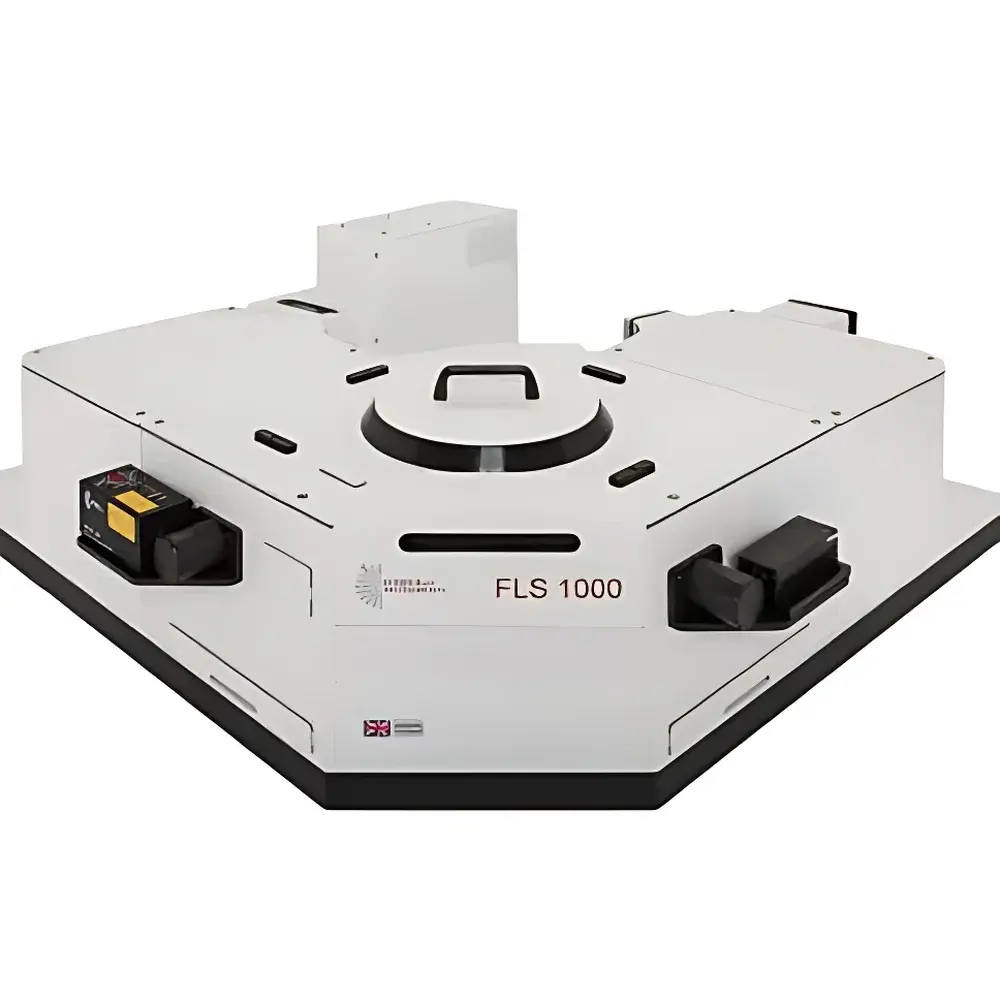
Edinburgh Instruments FLS1000 Modular Steady-State and Time-Resolved Fluorescence Spectrometer
| Brand | Edinburgh Instruments |
|---|---|
| Origin | United Kingdom |
| Manufacturer Type | Original Equipment Manufacturer (OEM) |
| Product Origin | Imported |
| Model | FLS1000 |
| Dispersion Element | Grating Monochromator |
| Instrument Type | Steady-State and Time-Resolved Fluorescence Spectrometer |
| Slit Width (Spectral Bandpass) | 0–30 nm |
| Optical Resolution | 0.05 nm |
| Sensitivity | 35,000:1 (RMS method) |
| Wavelength Accuracy | ±0.2 nm |
Overview
The Edinburgh Instruments FLS1000 is a fully modular, research-grade fluorescence spectrometer engineered for high-fidelity steady-state and time-resolved photoluminescence characterization. Based on a double-monochromator optical architecture with motorized grating selection and precision slit control, the system operates on the principle of wavelength-selective excitation and emission detection using pulsed or continuous-wave light sources. Its design enables quantitative measurement of absolute quantum yields, excited-state lifetimes, anisotropy decay, and spectral dynamics across a broad temporal window—from sub-picosecond (≥10 ps) to multi-second decays—making it suitable for probing complex photophysical pathways in molecular, nanoscale, and solid-state systems.
Key Features
- Modular optical platform supporting configurable excitation/emission paths, interchangeable monochromators (single- or dual-grating), and scalable detector options including PMTs, NIR-enhanced detectors, and time-correlated single-photon counting (TCSPC) modules
- High-throughput Czerny–Turner monochromators with 325 mm focal length and automated triple-grating turret for seamless switching between UV, visible, and NIR spectral ranges (185–5500 nm)
- Motorized filter wheel integrated with each monochromator to suppress higher-order diffraction and stray light; achieves stray-light rejection better than 1×10⁻⁶
- Variable slit width (0–30 nm) enabling precise control over spectral bandwidth and signal-to-noise optimization for both intensity and lifetime measurements
- RMS sensitivity of 35,000:1 under standard configuration (using 150 W Xe lamp and red-sensitive PMT), validated per ASTM E1358–21 guidelines for luminescence instrumentation
- Wavelength accuracy maintained at ±0.2 nm across the full range via onboard wavelength calibration using Hg/Ne and Ar spectral lines
Sample Compatibility & Compliance
The FLS1000 accommodates diverse sample formats—including cuvettes (10 mm pathlength standard), solid substrates, powders, thin films, and fiber-coupled microsamples—via interchangeable sample compartments and optional accessories such as integrating spheres, cryostats (4 K–300 K), and temperature-controlled stages. All optical and electronic subsystems comply with IEC 61010-1 (Safety Requirements for Electrical Equipment for Measurement, Control, and Laboratory Use) and CE marking directives. Data acquisition and processing workflows support audit-trail functionality and electronic signature capability in accordance with FDA 21 CFR Part 11 when deployed in regulated GLP/GMP environments. Instrument validation documentation aligns with ISO/IEC 17025 requirements for testing laboratories.
Software & Data Management
FluOracle® v4.x is the native software environment for instrument control, data acquisition, and advanced photophysical analysis. It provides synchronized acquisition of steady-state spectra, time-resolved decays, and global lifetime fitting using iterative reconvolution algorithms. The software supports batch processing, spectral deconvolution, multi-exponential decay modeling (up to 5 components), and anisotropy lifetime mapping. Export formats include ASCII, CSV, JCAMP-DX, and HDF5 for interoperability with MATLAB, Python (SciPy/NumPy), and third-party chemometrics platforms. Raw TCSPC histogram files retain full timestamp resolution (≤10 ps binning), ensuring traceability for reproducibility-critical studies.
Applications
- Materials Science: Characterization of OLED emitters, perovskite quantum dots, MOFs, and photocatalytic semiconductors—quantifying triplet harvesting efficiency, energy transfer kinetics, and defect-state lifetimes
- Life Sciences: Time-resolved Förster resonance energy transfer (TR-FRET), protein conformational dynamics, ligand-binding kinetics, and autofluorescence lifetime imaging (FLIM) correlation studies
- Environmental Science: Detection and speciation of polycyclic aromatic hydrocarbons (PAHs), dissolved organic matter (DOM), and microplastic-associated fluorophores in aqueous matrices
- Forensics & Security: Non-destructive identification of ink formulations, document authenticity verification, and latent fingerprint enhancement via lifetime contrast
- Geosciences: Luminescence dating proxies, mineral phase discrimination (e.g., feldspar vs. quartz), and rare-earth element distribution mapping in geological samples
FAQ
What is the minimum measurable fluorescence lifetime with the FLS1000?
The system achieves an instrument response function (IRF) width of ≤25 ps using ultrafast laser excitation and microchannel plate PMTs, enabling reliable resolution of lifetimes down to ~10 ps under optimized conditions.
Can the FLS1000 perform absolute quantum yield measurements?
Yes—when equipped with an integrating sphere accessory and calibrated reference standards (e.g., quinine sulfate in 0.1 M H2SO4), the system calculates absolute photoluminescence quantum yield (PLQY) per ISO 11253 and ASTM E2758 protocols.
Is remote operation supported?
FluOracle® supports secure network-based instrument control via Ethernet, including real-time monitoring, scheduled acquisitions, and collaborative data sharing through role-based access permissions.
How is wavelength calibration maintained over time?
Automatic recalibration is triggered during startup or user-defined intervals using internal Hg/Ne and Ar emission line references; calibration coefficients are stored per grating and slit setting to ensure long-term repeatability.
Does the system meet regulatory requirements for pharmaceutical QC labs?
When configured with 21 CFR Part 11-compliant software settings (audit trail, user authentication, electronic signatures), IQ/OQ/PQ documentation packages, and GxP-aligned SOP templates, the FLS1000 supports validated use in pharmaceutical quality control and development laboratories.






