
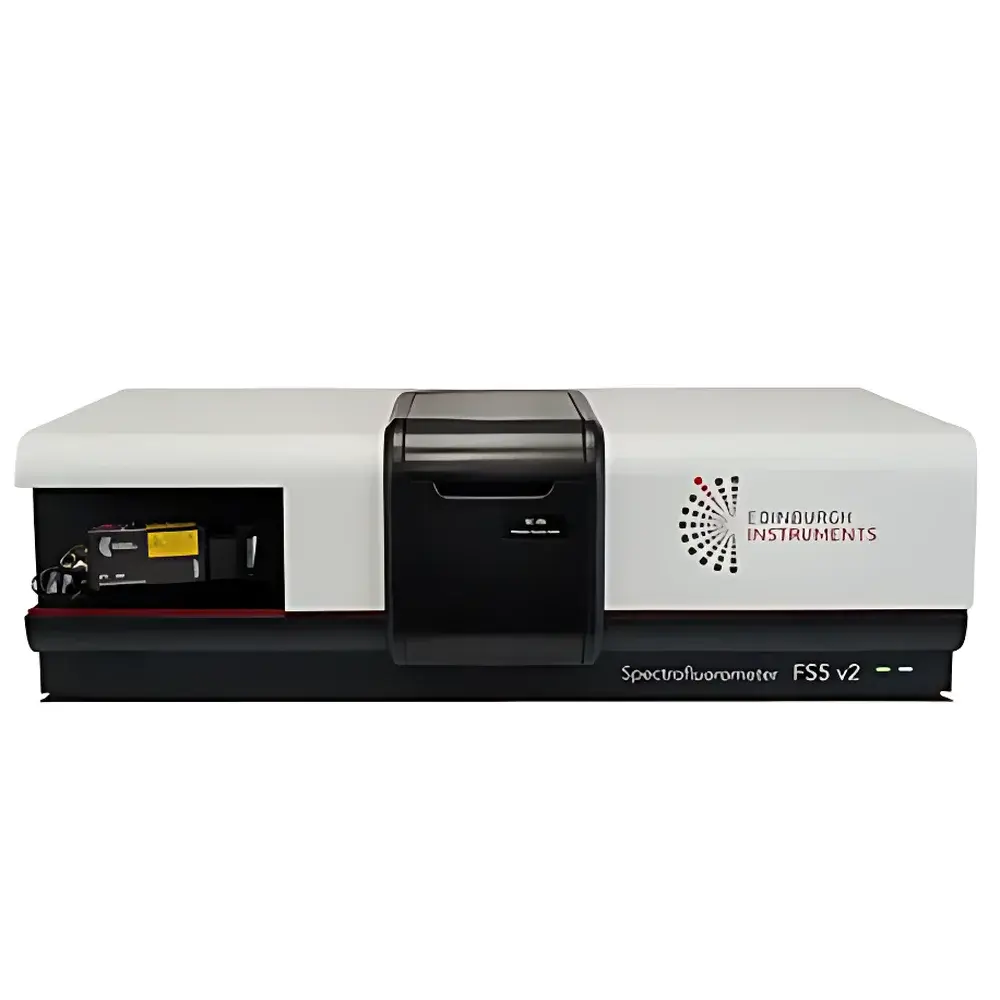
Edinburgh Instruments FS5 v2 Integrated Steady-State and Time-Resolved Fluorescence Spectrometer
| Brand | Edinburgh Instruments |
|---|---|
| Origin | United Kingdom |
| Manufacturer Type | Original Equipment Manufacturer (OEM) |
| Origin Category | Imported |
| Model | FS5 v2 |
| Dispersion Element | Grating |
| Instrument Type | Steady-State and Time-Resolved Fluorescence Spectrometer |
| Slit Width (Spectral Bandpass) | 0–30 nm |
| Optical Resolution | 0.01 nm |
| Sensitivity | 4000:1 (Signal-to-Noise Ratio) |
| Wavelength Accuracy | ±0.5 nm |
| Excitation Sources | Xenon Arc Lamp, Pulsed Laser Diodes (e.g., 375 nm, 405 nm, 445 nm, 485 nm, 635 nm), Optional OPO/UV Laser Systems |
Overview
The Edinburgh Instruments FS5 v2 is an integrated, benchtop fluorescence spectrometer engineered for rigorous steady-state and time-resolved photoluminescence characterization of molecular and nanoscale emissive materials. Based on a dual-grating monochromator architecture with high-efficiency optics and thermoelectrically cooled red-sensitive PMT or NIR-enhanced InGaAs detectors, the FS5 v2 implements both conventional analog detection and time-correlated single-photon counting (TCSPC) methodologies. Its optical design adheres to the principles of front-face and right-angle fluorescence collection, enabling quantitative quantum yield measurements, lifetime decay analysis, and polarization-resolved spectroscopy under controlled environmental conditions. The system operates across a broad excitation range (200–1000 nm) and emission range (200–2050 nm, with optional NIR extension), making it suitable for applications spanning organic LEDs, perovskite semiconductors, bioconjugates, lanthanide complexes, and carbon-based nanomaterials.
Key Features
- Integrated dual-mode operation: simultaneous access to steady-state intensity spectra and time-resolved decay profiles without hardware reconfiguration
- High-fidelity TCSPC electronics with <10 ps instrument response function (IRF) and 100 µs
- Four modular upgrade paths: NIR (up to 2050 nm), POL (fluorescence anisotropy & polarization degree), MCS (multi-channel scaling for µs–s kinetics), and TCSPC (picosecond–microsecond decay analysis)
- Motorized slit control (0–30 nm spectral bandpass) with real-time feedback for reproducible spectral resolution down to 0.01 nm
- Wavelength accuracy maintained at ±0.5 nm across full spectral range via internal He–Ne reference laser calibration
- Thermoelectrically stabilized detector options: red-enhanced PMT (200–900 nm), NIR InGaAs (900–2050 nm), and optional liquid-nitrogen-cooled CCD for enhanced dynamic range
Sample Compatibility & Compliance
The FS5 v2 accommodates standard 1 cm quartz cuvettes, solid-sample holders (including cryostat-compatible stages), microvolume cells (down to 5 µL), and fiber-coupled probes for remote or in-situ measurements. It supports ambient, nitrogen-purged, and temperature-controlled environments (–196 °C to +200 °C with accessory cryostats or ovens). All optical and electronic subsystems comply with IEC 61010-1 (safety requirements for electrical equipment) and CE marking directives. Data acquisition and instrument control meet GLP/GMP traceability requirements when used with Edinburgh’s Fluoracle® software configured for 21 CFR Part 11 compliance (audit trail, electronic signatures, user access levels).
Software & Data Management
Fluoracle® v4.x — the proprietary, Windows-native software platform — provides unified control of excitation sources, monochromators, detectors, and time-gating modules. It supports batch acquisition, automated wavelength scanning, kinetic series collection, global lifetime fitting (e.g., multi-exponential, distributed decay models), and absolute quantum yield calculation using integrating sphere coupling. Raw data are stored in HDF5 format with embedded metadata (wavelengths, integration times, detector gain, temperature, lamp status), ensuring FAIR (Findable, Accessible, Interoperable, Reusable) data principles. Export options include ASCII, CSV, and industry-standard JCAMP-DX for third-party spectral libraries.
Applications
- Photophysical characterization of emissive organic molecules, metal–organic frameworks (MOFs), and quantum dots
- Time-resolved studies of energy transfer (FRET, Dexter), charge recombination, and triplet–triplet annihilation
- Quantitative determination of fluorescence quantum yields, lifetimes, and anisotropy decay for structure–dynamics correlations
- Stability assessment of OLED emitters and perovskite thin films under thermal or photochemical stress
- Protein conformational dynamics via tryptophan lifetime heterogeneity and solvent accessibility mapping
- Quality control of phosphor materials in lighting and display manufacturing (per ISO 11664-7 and CIE 122)
FAQ
What excitation sources are included as standard?
The FS5 v2 ships with a 150 W continuous-wave xenon arc lamp. Pulsed laser diodes (375 nm, 405 nm, 445 nm, 485 nm, 635 nm) are available as factory-installed options.
Can the system measure absolute quantum yield without external accessories?
Yes — when equipped with the integrated 60 mm integrating sphere (optional), Fluoracle® performs automatic correction for sphere geometry, detector sensitivity, and lamp spectral output to deliver traceable quantum yield values per ASTM E2662 and ISO 11664-7.
Is TCSPC lifetime analysis limited to single-exponential fits?
No — Fluoracle® includes nonlinear least-squares fitting algorithms supporting up to five exponential components, stretched exponentials, and continuous lifetime distribution models (e.g., MEM, NNLS), with χ² validation and residual analysis.
How is wavelength calibration maintained over long-term operation?
The system performs automated wavelength calibration using an internal He–Ne reference laser prior to each measurement sequence, ensuring drift-free accuracy within ±0.5 nm across 10,000+ hours of operation.
Does the FS5 v2 support synchronization with external equipment such as temperature controllers or electrochemical cells?
Yes — the instrument features TTL-compatible trigger I/O ports and LabVIEW-compatible drivers (NI-VISA), enabling precise synchronization with cryostats, potentiostats, modulated light sources, and motorized sample stages.






