
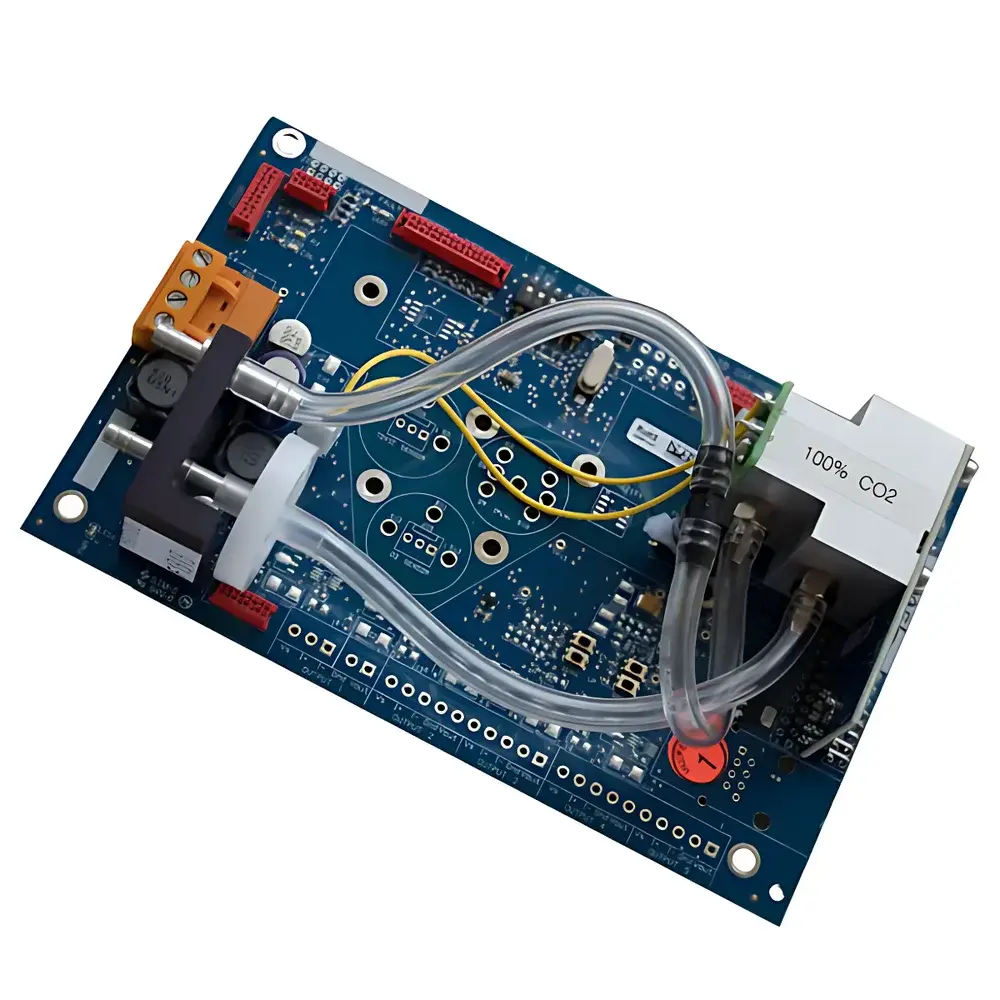
Edinburgh Instruments Gascard NG Infrared Gas Sensor Module
| Brand | Edinburgh Instruments |
|---|---|
| Origin | United Kingdom |
| Manufacturer Type | Original Equipment Manufacturer (OEM) |
| Product Category | Imported Instrument |
| Model | Gascard NG |
| Operating Range | 0–5000 ppm to 0–100% (gas-dependent) |
| Pressure Compensation | 800–1150 mbar |
| Supply Voltage | 7–30 V DC |
| Communication Interface | RS232 |
| Light Source | Field-replaceable infrared source |
| Display Support | 4-bit and 128 × 64 pixel graphical LCD via expansion port |
| Target Gases | CO, CO₂, CH₄, N₂O (customizable) |
Overview
The Edinburgh Instruments Gascard NG is a compact, OEM-grade infrared gas sensor module engineered for integration into industrial, environmental, and safety-critical gas monitoring systems. Based on non-dispersive infrared (NDIR) spectroscopy, the Gascard NG delivers stable, repeatable quantification of key greenhouse and toxic gases—including carbon dioxide (CO₂), carbon monoxide (CO), methane (CH₄), and nitrous oxide (N₂O)—across configurable concentration ranges from 0–5000 ppm up to 0–100% volume, depending on the target analyte and optical path design. Its modular architecture enables seamless embedding into larger instrumentation platforms, such as fixed-site air quality monitors, agricultural process controllers, combustion efficiency analyzers, and portable leak detection units. Unlike consumer-grade sensors, the Gascard NG features factory-calibrated optical absorption cells and temperature-stabilized electronics to ensure long-term baseline stability and minimal drift over extended operational cycles—critical for applications requiring regulatory compliance or multi-year deployment without recalibration.
Key Features
- Modern microprocessor-based platform supporting firmware updates and enhanced signal processing algorithms for improved noise rejection and dynamic range optimization.
- On-board barometric pressure compensation (800–1150 mbar), enabling accurate gas concentration reporting across variable altitudes and weather conditions without external transducers.
- Wide input voltage tolerance (7–30 V DC), facilitating direct integration with battery-powered field instruments, 24 V industrial PLCs, and solar-charged telemetry systems.
- RS232 serial interface with ASCII command protocol for real-time control, configuration, and streaming of analog-equivalent digital output—compatible with standard SCADA, LabVIEW, and Python-based data acquisition environments.
- Field-replaceable infrared source assembly, minimizing downtime during maintenance and extending service life beyond typical NDIR module expectations.
- Dedicated expansion header supporting optional peripheral modules, including 4-bit status indicators and monochrome graphical LCD displays (128 × 64 pixels), enabling local readout without host system dependency.
Sample Compatibility & Compliance
The Gascard NG is designed for continuous measurement of dry or low-humidity gas streams in ambient or mildly conditioned sample lines. It is not intended for corrosive, condensing, or particulate-laden environments without upstream filtration, drying, or dilution. While the sensor itself does not carry CE, UKCA, or ATEX certification, its electrical and mechanical specifications align with IEC 61000-6-2 (immunity) and IEC 61000-6-4 (emissions) standards. When integrated into final equipment, it supports compliance with ISO 14001 environmental management systems, OSHA 1910.120 (HAZWOPER) exposure monitoring protocols, and EPA Method TO-11A for ambient CO/CO₂ screening. Its pressure-compensated architecture ensures traceable performance under GLP-aligned validation procedures.
Software & Data Management
The Gascard NG operates autonomously once configured; no proprietary software is required for basic operation. Configuration and diagnostics are performed via simple ASCII commands sent over RS232—enabling straightforward scripting in Python, MATLAB, or Node-RED. Edinburgh Instruments provides a reference command set documentation package (PDF), including register maps, calibration coefficient storage conventions, and error code definitions. For audit-ready deployments, users may implement timestamped data logging with checksum verification and dual-channel redundancy (e.g., simultaneous analog output + digital stream). While the module does not natively support FDA 21 CFR Part 11 electronic signatures, its deterministic response and persistent memory registers allow integration into validated systems that enforce electronic record integrity through external middleware.
Applications
- Industrial leak detection in biogas upgrading plants, natural gas distribution networks, and refrigeration systems.
- Occupational health and safety monitoring in confined spaces, laboratories, and manufacturing facilities subject to COSHH or OSHA PEL requirements.
- Real-time control of anaerobic digesters and composting operations via CO₂/CH₄ ratio feedback loops.
- Soil respiration studies and precision agriculture systems measuring root-zone gas exchange.
- TOC (Total Organic Carbon) analyzer subsystems where CO₂ quantification serves as a proxy for organic load.
- Calibration transfer standards in metrology labs performing inter-instrument cross-validation.
FAQ
Is the Gascard NG suitable for outdoor, unheated installations?
Yes—its operating temperature range spans –10 °C to +50 °C, and its pressure compensation ensures accuracy across seasonal atmospheric variations. However, condensation must be prevented via heated sample lines or Nafion dryers.
Can multiple Gascard NG modules be daisy-chained on one RS232 bus?
No—each unit requires a dedicated serial port or multiplexer due to lack of addressable addressing; however, TTL-level UART variants support hardware flow control for synchronized polling.
Does Edinburgh provide NIST-traceable calibration certificates?
Yes—certified calibration against primary gas standards (e.g., NIST SRM 1662 for CO₂) is available as an optional service, including uncertainty budgets per ISO/IEC 17025.
What is the expected lifetime of the infrared source?
Rated for >5 years of continuous operation at 25 °C ambient; field replacement takes <5 minutes using standard Torx tools and requires no optical realignment.
Can the Gascard NG measure oxygen (O₂) or volatile organic compounds (VOCs)?
No—O₂ requires electrochemical or paramagnetic detection; VOCs require photoionization (PID) or metal-oxide semiconductor (MOS) technologies. The Gascard NG is optimized exclusively for diatomic and polyatomic IR-active gases.







