
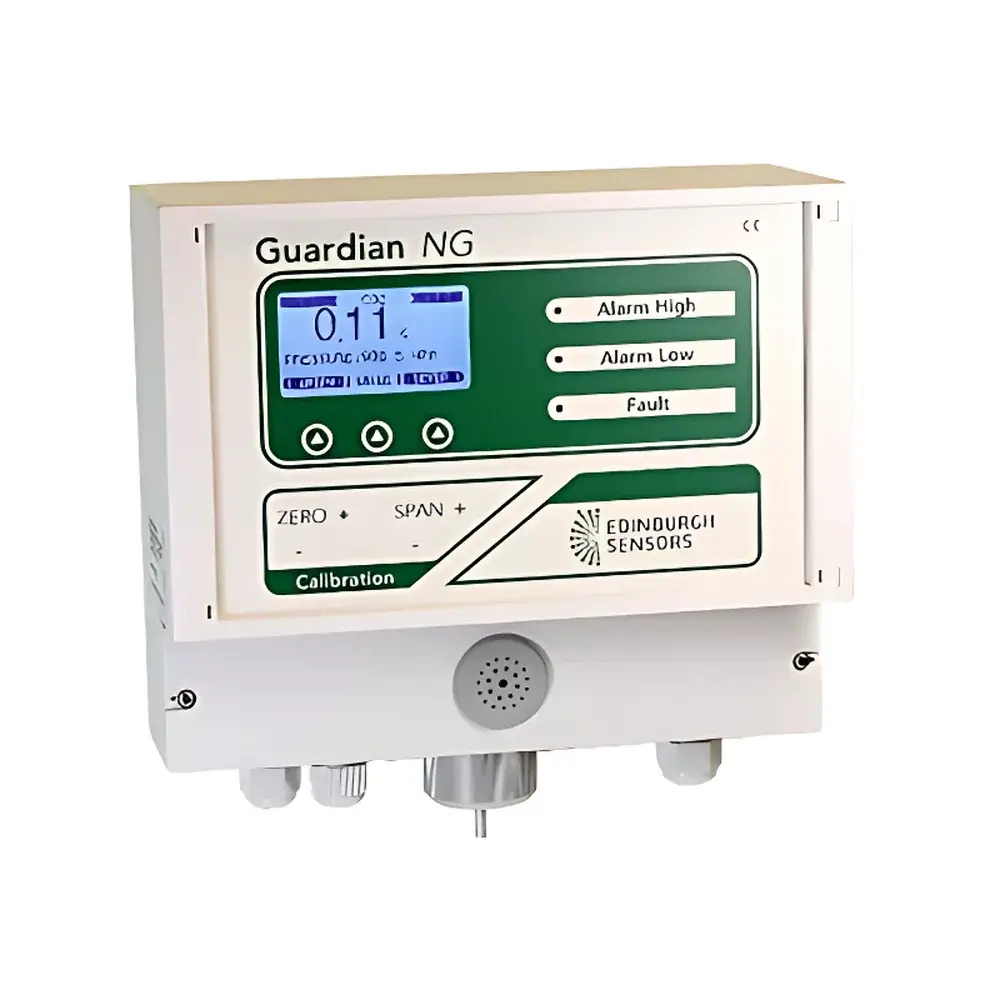
Edinburgh Instruments Guardian NG Infrared Gas Monitor
| Brand | Edinburgh Instruments |
|---|---|
| Origin | United Kingdom |
| Manufacturer Type | Original Equipment Manufacturer (OEM) |
| Origin Category | Imported Instrument |
| Model | Guardian NG |
| Price Range | USD 3,800 – 5,100 (FOB UK) |
Overview
The Edinburgh Instruments Guardian NG is a high-stability, single-beam non-dispersive infrared (NDIR) gas monitor engineered for continuous, real-time quantitative analysis of trace and percent-level concentrations of key industrial and environmental gases. Based on fundamental absorption spectroscopy principles—where target gas molecules absorb specific mid-infrared wavelengths—the Guardian NG delivers calibrated, pressure-compensated volumetric concentration readings across dynamic process conditions. Its optical architecture employs thermally stabilized light sources and precision-matched reference/detector channels to ensure long-term baseline stability and minimal drift (<±1% FS/year). Designed for unattended operation in fixed-location monitoring applications, the instrument meets the functional requirements of continuous emission monitoring (CEM), workplace exposure assessment, biogas quality control, and indoor air quality (IAQ) compliance verification.
Key Features
- Pressure-compensated volumetric concentration output: Automatically corrects for barometric and process pressure fluctuations to report true %v/v or ppmv values—critical for regulatory reporting under ISO 14644-1 and EN 13725.
- Graphical monochrome LCD with backlight: Supports intuitive navigation via on-screen menu system; displays real-time concentration, status flags, alarm states, and diagnostic indicators.
- User-configurable digital alarm thresholds: Up to two independent alarm levels per gas channel, with latching/non-latching modes and configurable hysteresis.
- Secure access control: Password-protected configuration interface prevents unauthorized parameter modification—supports audit-ready change logs per GLP/GMP Annex 11 guidelines.
- Embedded data logging: Stores up to 32,000 timestamped readings with user-defined intervals (1 s to 24 h); historical trends visualized directly on screen over selectable time windows (1 hr to 30 days).
- Dual communication interfaces: Standard RS-232 serial port (ASCII protocol, Modbus RTU optional) and factory-installable Ethernet module (Modbus TCP/IP, HTTP API) for SCADA integration and remote diagnostics.
- Programmable relay outputs: Two SPDT relays (250 VAC / 5 A) configurable for alarm actuation, sample pump control, or external valve triggering—certified to IEC 61000-6-2/6-4 for industrial EMC environments.
Sample Compatibility & Compliance
The Guardian NG is validated for quantitative measurement of CO (0–500 ppm), CO₂ (0–3% v/v), CH₄ (0–3% v/v), N₂O (0–500 ppm), and R125 (0–1,000 ppm) in clean, dry, non-corrosive sample streams. It complies with IEC 61000-6-2 (immunity) and IEC 61000-6-4 (emissions), carries CE marking under the EU Electromagnetic Compatibility Directive 2014/30/EU and Low Voltage Directive 2014/35/EU, and meets IP54 ingress protection for panel-mounted or enclosure-based deployment. While not intrinsically safe certified, it is suitable for Zone 2/Class I Div 2 environments when installed with appropriate barrier systems per IEC 60079-11. Calibration traceability follows UKAS-accredited standards (NPL/NIST-traceable gas standards), supporting ISO/IEC 17025-compliant QA/QC workflows.
Software & Data Management
The Guardian NG operates autonomously but integrates seamlessly with Edinburgh Instruments’ optional Guardian Control Suite—a Windows-based configuration, calibration, and data export utility. The suite enables full instrument setup (gas selection, span calibration, zero adjustment), firmware updates, and CSV/Excel-compatible export of logged data with UTC timestamps. For enterprise deployments, the Ethernet-enabled unit supports secure HTTPS access, JSON RESTful API endpoints for third-party middleware (e.g., Ignition SCADA, Siemens Desigo), and configurable email/SNMP alerts. All configuration changes and calibration events are recorded with operator ID, timestamp, and pre/post-values—fulfilling FDA 21 CFR Part 11 requirements for electronic records and signatures when deployed with validated IT infrastructure.
Applications
- Biogas upgrading & anaerobic digestion: Real-time CH₄/CO₂ ratio monitoring for scrubber optimization and pipeline injection compliance (EN 16723-1).
- Occupational health & safety: Continuous CO and CO₂ surveillance in confined spaces, laboratories, and agricultural silos per OSHA PEL and ACGIH TLV® limits.
- Controlled environment agriculture: Precision CO₂ dosing feedback control in greenhouses and vertical farms to maximize photosynthetic efficiency.
- Indoor air quality (IAQ) management: Long-term CO₂ trending in offices, schools, and hospitals to validate HVAC performance against ASHRAE Standard 62.1.
- Environmental research: Field-deployable N₂O flux monitoring in soil chambers and aquatic mesocosms, supporting IPCC Tier 1–2 emission inventories.
FAQ
What gases can the Guardian NG measure simultaneously?
The Guardian NG is configured for a single target gas per unit. Multi-gas monitoring requires separate analyzers or the modular Guardian NG Multi-Channel variant (not covered under this model specification).
Is field calibration possible without specialized equipment?
Yes—zero calibration uses ambient air (for CO₂, CH₄) or nitrogen; span calibration requires certified NIST-traceable gas standard cylinders. Both procedures are guided step-by-step via the front-panel interface.
Does the instrument support analog 4–20 mA output?
No—4–20 mA is not natively supported. Output is digital-only (RS-232/Ethernet). External signal converters may be integrated at system level.
What maintenance intervals are recommended?
Optical path inspection and filter replacement every 12 months; annual full calibration verification recommended under ISO 17025-accredited laboratory conditions.
Can the Guardian NG operate in high-humidity environments?
It requires sample gas dew point ≤ −10 °C. Use of integrated or external permeation dryers (e.g., Nafion™) is strongly advised for humid biogas or agricultural applications.







