
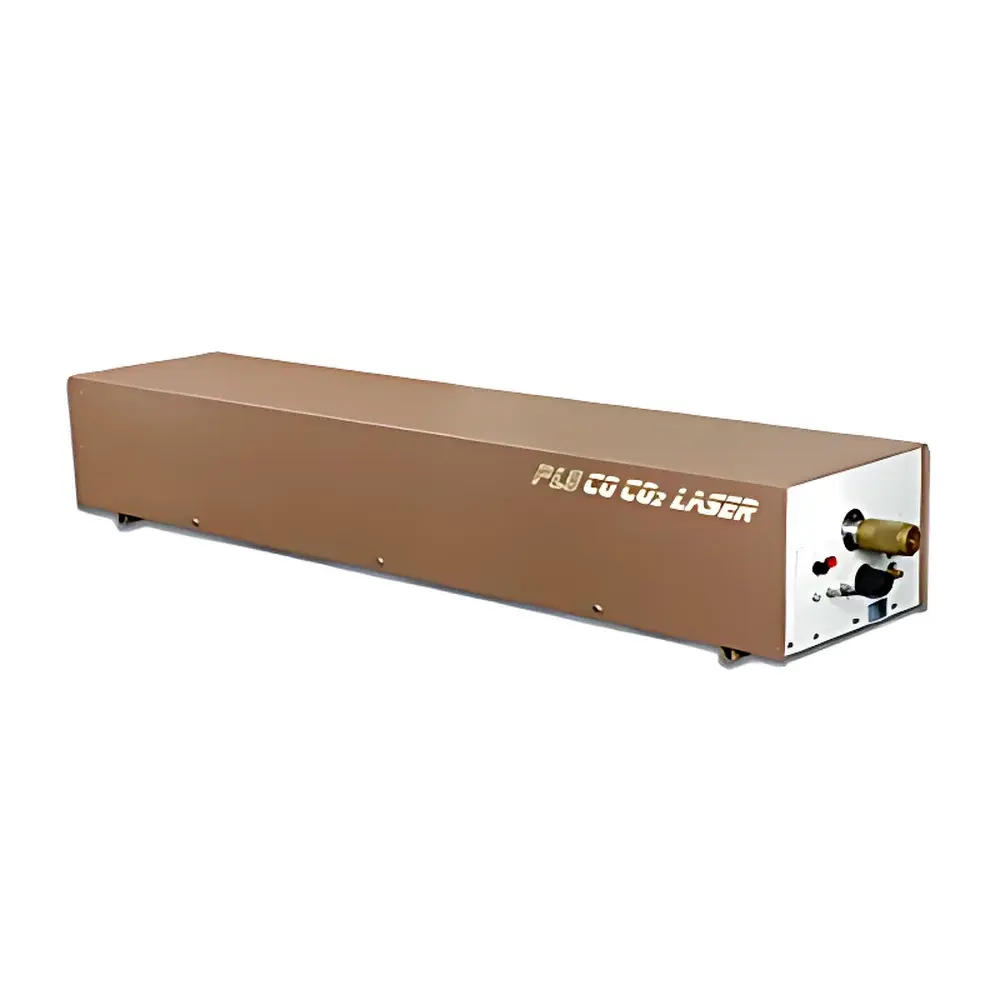
Edinburgh Instruments PL Series Grating-Tuned CO₂ and CO Infrared Laser Systems
| Brand | Edinburgh Instruments |
|---|---|
| Origin | United Kingdom |
| Manufacturer Type | Original Equipment Manufacturer (OEM) |
| Product Category | Imported |
| Model Range | PL2-S, PL2-M, PL3, PL5, PL6 |
| Output Wavelength Ranges | 5.2–6.0 µm (CO mode), 9.1–10.9 µm (CO₂ mode) |
| Output Power | Up to 180 W CW (PL6), up to 2 kW peak (PL5 Q-switched) |
| Tuning Mechanism | Precision diffraction grating + piezoelectric cavity length control |
| Beam Polarization | Linear, fixed orientation |
| Spectral Linewidth | < 100 MHz (typical, free-running) |
| Pulse Operation | Available on PL5 (200 ns pulse width, 1 kHz repetition rate) |
| Number of Accessible Rotational-Vibrational Lines | > 80 (PL5), > 90 (PL6), with > 60 lines ≥ 120 W (PL6) |
| Mechanical Construction | Invar-based rigid monolithic frame |
| Compliance | CE-marked, RoHS-compliant, designed for ISO/IEC 17025-aligned laboratory environments |
Overview
The Edinburgh Instruments PL Series comprises a family of high-performance, grating-tuned continuous-wave (CW) and pulsed infrared laser systems based on gas-discharge excitation of carbon dioxide (CO₂) and carbon monoxide (CO) molecules. Engineered for precision spectroscopic applications, these lasers operate across two fundamental mid-infrared atmospheric transmission windows: 5.2–6.0 µm (CO gain medium) and 9.1–10.9 µm (CO₂ gain medium). The PL Series leverages molecular ro-vibrational transitions to deliver narrow-linewidth, single-frequency output with exceptional amplitude and frequency stability—critical for high-resolution absorption spectroscopy, heterodyne detection, and nonlinear frequency conversion. Unlike diode-pumped solid-state or quantum cascade alternatives, the PL platform offers intrinsically high spectral purity, broad tunability across discrete rotational lines, and scalable power output—from milliwatt-level benchtop units (PL2-S) to industrial-grade 180 W CW sources (PL6). All models feature a monolithic Invar mechanical architecture ensuring long-term alignment retention under thermal and mechanical stress.
Key Features
- Monolithic Invar frame providing superior mechanical rigidity and thermal stability—minimizing drift in cavity alignment over extended operation.
- High-precision Littrow-mounted diffraction grating enabling reproducible, stepwise wavelength selection across > 90 discrete CO₂ rotational lines (PL6) or > 80 lines (PL5).
- Piezoelectric transducer (PZT)-actuated cavity length control for fine frequency tuning (< 1 MHz resolution) and active stabilization integration.
- Optimized discharge tube geometry with micro-roughened bore surface suppressing higher-order transverse modes—ensuring TEM₀₀-dominant beam profile with M² < 1.2.
- Linearly polarized output with extinction ratio > 100:1, facilitating polarization-sensitive experiments and efficient nonlinear crystal coupling.
- Optional active frequency stabilization module compliant with Pound–Drever–Hall (PDH) locking schemes for sub-MHz linewidth operation under GLP/GMP traceable conditions.
- Q-switched operation available on PL5 model: 200 ns pulses at 1 kHz repetition rate, typical peak power ~2 kW, enabling time-resolved pump-probe and plasma diagnostics.
Sample Compatibility & Compliance
The PL Series is compatible with standard vacuum-compatible optical tables, FTIR spectrometers (e.g., Bruker VERTEX series), and custom-built multipass absorption cells (Herriott, White-type). All models meet CE marking requirements per Directive 2014/35/EU (Low Voltage Directive) and 2014/30/EU (EMC Directive). Optical housing materials comply with RoHS 2011/65/EU restrictions. For regulated laboratories, system firmware supports audit-trail logging (ISO/IEC 17025 Annex A.3), and optional configuration files are exportable in ASTM E2500-17–compliant format. No hazardous substances are employed in the sealed gas fill; CO₂ and CO gas mixtures are pre-qualified per ISO 8573-1 Class 2 purity standards.
Software & Data Management
Laser operation is managed via Edinburgh Instruments’ proprietary PL Control Suite—a Windows-based application supporting both local USB and Ethernet (TCP/IP) interfaces. The suite provides full parameter logging (wavelength, output power, cavity temperature, PZT voltage), real-time spectral line identification using embedded HITRAN-based line databases, and automated calibration sequence execution. Data exports conform to ASTM E1382-21 (spectral data interchange format) and include metadata tags for instrument ID, operator, date/time stamp, and environmental conditions (ambient T/P). Raw analog outputs (0–10 V) for power and frequency feedback signals are provided for integration into SCADA or LabVIEW-based process control architectures.
Applications
- Molecular spectroscopy: High-resolution ro-vibrational absorption studies of greenhouse gases (CH₄, N₂O, CO), isotopic analysis (¹³CO₂, C¹⁸O), and transient species detection in combustion environments.
- Nonlinear optics: Difference-frequency generation (DFG) and optical parametric oscillation (OPO) pumping in ZnGeP₂, GaSe, and AgGaS₂ crystals for THz and far-IR generation.
- Plasma diagnostics: Interferometric electron density mapping in fusion-relevant plasmas (e.g., tokamak edge regions) using 9.2–9.6 µm CO₂ lines.
- Atmospheric remote sensing: Ground-based and airborne differential absorption lidar (DIAL) systems targeting CO and CO₂ column density retrieval.
- Materials science: Photoacoustic spectroscopy of polymers, semiconductors, and thin-film coatings; defect characterization via mid-IR photothermal response.
- Process analytical technology (PAT): Real-time in-line monitoring of chemical reactions in pharmaceutical synthesis (e.g., carbonylation, hydrogenation) per ICH Q8(R3) guidelines.
FAQ
What gas mixtures are used in the PL3 and PL6 models, and how are they replenished?
The PL3 operates with either pure CO or CO₂ gas fills, selected manually via external valve manifold; PL6 uses sealed, factory-optimized CO₂/N₂/He mixtures with lifetime exceeding 20,000 hours. Refills require certified service technicians and are performed under ISO 14644-1 Class 5 cleanroom conditions.
Is the PL5 Q-switched output synchronized to an external TTL trigger?
Yes—PL5 supports external triggering with jitter < 5 ns (RMS) and programmable delay (0–10 ms) relative to master clock input.
Can the PL Series be integrated into a GMP-regulated manufacturing environment?
When equipped with the optional 21 CFR Part 11–compliant firmware package (including electronic signatures, role-based access, and immutable audit trails), PL systems meet FDA requirements for analytical instrumentation in pharmaceutical QC labs.
What beam delivery options are available for coupling into hollow-core fibers or multipass cells?
Standard output includes Ø12.7 mm kinematic mount with SM1-threaded collimator; optional fiber-coupling kits (ZnSe aspheric lenses, AR-coated for 9–11 µm) support coupling efficiencies > 75% into 400 µm core Kagome-style hollow fibers.
Does Edinburgh Instruments provide NIST-traceable wavelength calibration certificates?
Yes—each shipped unit includes a factory calibration report referencing NIST SRM 2519a (methane absorption lines) and SRM 1976b (CO₂ line positions), with uncertainty ≤ ±0.005 cm⁻¹ (k = 2).




