
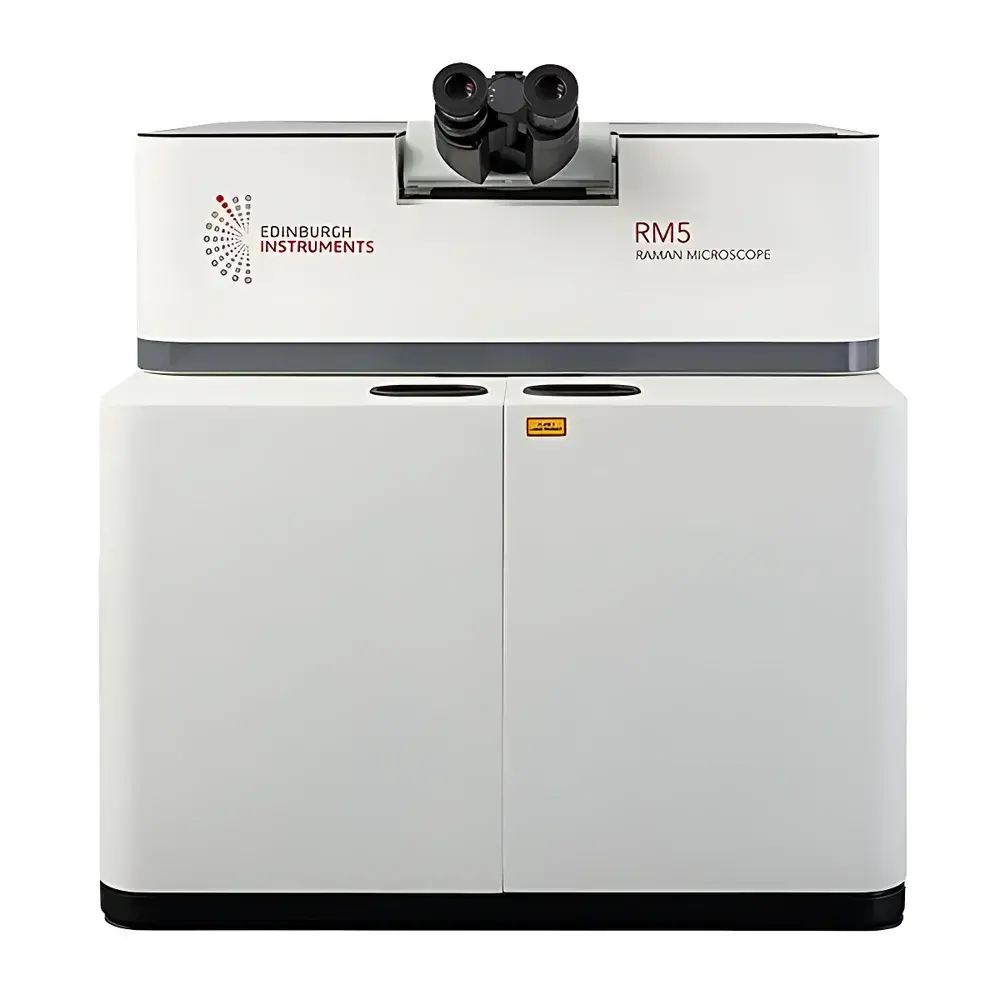
Edinburgh Instruments RM5 Integrated Automated Confocal Raman Microscope
| Brand | Edinburgh Instruments |
|---|---|
| Origin | United Kingdom |
| Manufacturer Type | Original Equipment Manufacturer (OEM) |
| Import Status | Imported |
| Model | RM5 |
| Instrument Type | Confocal Raman Microspectrometer |
| Spectral Range | 50–15000 cm⁻¹ |
| Spectral Resolution | ≥1 cm⁻¹ (FWHM) |
| Spatial Resolution | Down to 1 µm |
| Low-Wavenumber Cutoff | <50 cm⁻¹ |
| Spectral Reproducibility | ≤0.02 cm⁻¹ |
Overview
The Edinburgh Instruments RM5 is a fully integrated, research-grade confocal Raman microspectrometer engineered for high-precision molecular fingerprinting in demanding scientific environments. Based on true confocal optical architecture—featuring motorized pinhole positioning and tunable entrance slits—the RM5 delivers exceptional spectral fidelity, spatial discrimination, and fluorescence suppression without compromising throughput. Its design adheres to fundamental principles of confocal microscopy combined with high-throughput dispersive Raman spectroscopy: excitation light is focused to a diffraction-limited spot within the sample; only Raman-scattered photons originating from that precise focal volume pass through the confocal pinhole to the spectrometer, effectively rejecting out-of-focus background and enabling unambiguous depth-resolved chemical mapping. The system supports multiple excitation wavelengths (configurable via up to three integrated narrow-linewidth lasers), full spectral coverage from sub-50 cm⁻¹ to 15,000 cm⁻¹, and maintains long-term wavenumber stability (<0.02 cm⁻¹ reproducibility) critical for quantitative time-series or multi-instrument comparative studies.
Key Features
- True confocal optics with software-controlled, multi-position pinhole and adjustable slit—enabling real-time optimization of resolution, signal-to-noise ratio, and background rejection per application.
- Integrated laser engine supporting up to three independently controlled, air-cooled diode-pumped solid-state (DPSS) lasers (e.g., 405 nm, 532 nm, 638 nm, 785 nm), each with active power stabilization and TTL-triggered modulation.
- Five-position grating turret with optimized blazed gratings—delivering ≤1 cm⁻¹ FWHM resolution across the entire 50–15000 cm⁻¹ range, including ultra-low-frequency (<100 cm⁻¹) phonon mode analysis.
- Dual-detector capability: simultaneous or sequential mounting of back-illuminated deep-depletion CCD, electron-multiplying CCD (EMCCD), and thermoelectrically cooled InGaAs array detectors—extending sensitivity into NIR (up to 11,000 cm⁻¹ shift with 785 nm excitation) and enabling photon-starved measurements.
- Four-position automated edge/Notch filter turret—fully synchronized with laser selection and grating position to ensure optimal rejection of Rayleigh scatter and maximize Raman signal transmission.
- On-board NIST-traceable calibration source and automated wavelength calibration routine—executed prior to each acquisition session to guarantee metrological integrity and compliance with ISO/IEC 17025 traceability requirements.
Sample Compatibility & Compliance
The RM5 accommodates diverse sample geometries—including bulk solids, thin films, powders, liquids, gels, biological tissues (fixed or live under environmental control), and microfabricated devices—via its modular microscope platform compatible with standard RMS-threaded objectives (10× to 100×, NA 0.25–0.95). Optional accessories include motorized XYZ stages (±50 mm travel, 100 nm repeatability), polarization optics (linear/circular, dual-channel), temperature-controlled stages (−190 °C to +600 °C), and humidity chambers. The system meets CE marking requirements and conforms to IEC 61000-6-3 (EMC) and IEC 61000-6-2 (immunity) standards. Data acquisition workflows support audit trails, electronic signatures, and secure user-role management—facilitating alignment with FDA 21 CFR Part 11, EU Annex 11, and GLP/GMP documentation protocols when paired with validated software configurations.
Software & Data Management
Controlled entirely by Ramacle™—a native 64-bit Windows application developed in-house by Edinburgh Instruments—RM5 operations span instrument configuration, real-time spectral preview, hyperspectral mapping (point-by-point, line-scan, area-scan), multivariate analysis (PCA, cluster analysis, spectral unmixing), and report generation. Ramacle™ implements HDF5-based data storage with embedded metadata (excitation wavelength, grating, filter, objective, exposure time, stage coordinates), ensuring FAIR (Findable, Accessible, Interoperable, Reusable) data principles. Batch processing, scripting via Python API, and export to industry-standard formats (JCAMP-DX, ASCII, CSV, MATLAB .mat) are natively supported. Software validation packages—including IQ/OQ documentation templates and change control logs—are available for regulated laboratories.
Applications
The RM5 serves as a core analytical tool across disciplines requiring non-destructive, label-free chemical identification and spatial heterogeneity assessment. In pharmaceutical development, it characterizes polymorphic distribution in tablet cross-sections and monitors crystallization kinetics in situ. In semiconductor metrology, it maps strain in SiGe heterostructures and identifies contaminant residues at sub-micron scale. In cultural heritage science, it identifies pigments, binders, and degradation products in historical paintings without sampling. In nanomaterials research, it resolves layer-dependent phonon shifts in 2D materials (e.g., MoS₂, graphene) and quantifies defect density via D/G band ratios. In life sciences, it enables live-cell metabolic imaging using spontaneous Raman or surface-enhanced Raman scattering (SERS) substrates—supported by optional environmental enclosures and low-noise EMCCD detection.
FAQ
What distinguishes “true confocal” design from pseudo-confocal or slit-based systems?
True confocal operation requires a physical pinhole placed conjugate to the sample plane in both illumination and detection paths. The RM5 employs a motorized, multi-position pinhole aligned with precision kinematic mounts—ensuring axial resolution ≤1 µm and eliminating reliance on software deconvolution or slit-only depth gating.
Can the RM5 perform low-wavenumber Raman measurements below 100 cm⁻¹?
Yes. With optimized notch filters, high-transmission gratings, and detector cooling, the RM5 achieves reliable spectral acquisition down to <50 cm⁻¹—enabling analysis of lattice vibrations, intermolecular modes, and acoustic phonons in crystals, MOFs, and battery electrode materials.
Is the system compatible with third-party automation platforms or LIMS integration?
Ramacle™ provides COM/ActiveX and Python APIs for bidirectional communication with external controllers (e.g., PLCs, robotic arms) and laboratory information management systems (LIMS); custom middleware development is supported under NDA.
How is spectral calibration maintained over extended operational periods?
The RM5 performs automatic wavelength calibration using an internal Ne/Ar hollow-cathode lamp before each measurement sequence. Drift compensation algorithms reference known atomic emission lines (e.g., Ne 585.25 nm → 1023 cm⁻¹) and adjust grating angle in real time, ensuring ≤0.02 cm⁻¹ reproducibility over weeks of continuous use.
Does the RM5 support time-resolved or kinetic Raman measurements?
Yes. With programmable laser pulsing (down to 10 ns gate width via external trigger), EMCCD gating, and millisecond-stage positioning, the RM5 enables reaction monitoring—such as polymer crosslinking, photocatalytic degradation, or protein folding—with temporal resolution limited only by detector readout and stage inertia.




