
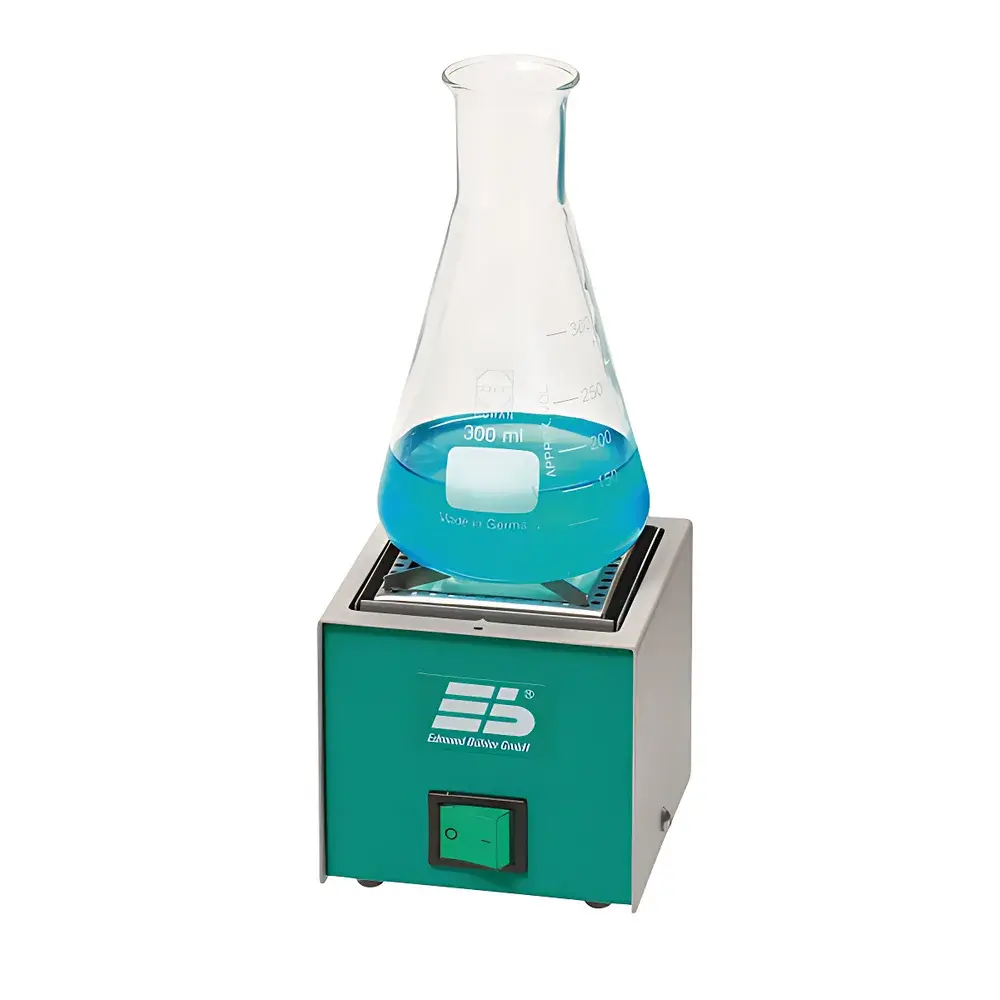
Edmund Büehler IRB 1 Infrared Laboratory Heater
| Brand | Edmund Büehler |
|---|---|
| Origin | Germany |
| Model | IRB 1 |
| Max. Temperature | 700 °C |
| Heating Power | 250 W |
| Heating Area | 60 × 60 mm |
| Ambient Temperature Limit | 30 °C |
| Power Supply | 230 V, 50/60 Hz |
| Dimensions (W × D × H) | 100 × 105 × 105 mm |
| Weight | 0.7 kg |
Overview
The Edmund Büehler IRB 1 is a compact, high-response infrared laboratory heater engineered for precise, localized thermal treatment of small samples in research and quality control environments. Unlike convection or contact-based heating systems, the IRB 1 employs medium-wave infrared radiation (peak emission ~2.5–4 µm) to deliver rapid, non-contact energy transfer directly to surfaces and thin substrates. This principle enables fast thermal response—typically reaching 700 °C within seconds—and minimizes thermal lag or ambient heat buildup. Designed and manufactured in Germany, the unit adheres to stringent CE marking requirements and conforms to IEC 61000-6-3 (EMC emissions) and IEC 61000-6-2 (immunity) standards. Its all-metal housing, integrated thermal cutoff, and low-mass ceramic emitter ensure stable operation under continuous duty cycles in controlled lab settings.
Key Features
- Compact footprint (100 × 105 × 105 mm) and lightweight design (0.7 kg) optimized for benchtop integration in fume hoods, gloveboxes, or analytical workstations.
- Medium-wave infrared emitter with uniform irradiance across the 60 × 60 mm active heating zone—validated via calibrated thermographic mapping per ISO 18434-1.
- Digital temperature control via front-panel potentiometer with visual LED indication; no external controller required for basic operation.
- Thermal safety architecture includes dual-stage overtemperature protection: primary electronic limit at 750 °C and passive bimetallic cutout at 800 °C.
- Robust stainless-steel and anodized aluminum construction resistant to chemical splashes and mechanical abrasion typical in academic and industrial labs.
- Low standby power consumption (<0.5 W) and absence of moving parts contribute to long-term reliability and minimal maintenance.
Sample Compatibility & Compliance
The IRB 1 is compatible with a wide range of inert and semi-conductive substrates—including quartz, alumina, borosilicate glass, silicon wafers, and metal foils—provided surface emissivity exceeds ε ≥ 0.6 in the 2–5 µm spectral band. It is not recommended for highly reflective materials (e.g., polished copper or aluminum) without surface conditioning. The device complies with EN 60598-1 (luminaires), EN 60335-1 (household and similar electrical appliances), and meets essential health and safety requirements under the EU Machinery Directive 2006/42/EC. While not certified for hazardous area use (ATEX/IECEx), it is routinely deployed in ISO 17025-accredited laboratories performing thermal pre-treatment prior to XRD, TGA, or SEM sample preparation.
Software & Data Management
The IRB 1 operates as a standalone analog-controlled heater and does not include embedded digital interfaces (e.g., RS-232, USB, or Ethernet). For traceable thermal protocols, users may integrate the unit into external data acquisition systems using its optional 0–10 V analog output (available upon request with IRB 1-AN variant). When used in GLP- or GMP-regulated workflows, temperature profiles can be logged externally via calibrated thermocouple inputs (Type K or S) connected to validated DAQ hardware. Audit trails, calibration records, and operational logs must be maintained per ISO/IEC 17025 Clause 7.7 and FDA 21 CFR Part 11 requirements if employed in regulated pharmaceutical or medical device manufacturing environments.
Applications
- Rapid drying and solvent removal from thin-film coatings, inkjet-printed electronics, and spin-coated photoresists.
- Pre-heating of crucibles and sample boats prior to thermogravimetric analysis (TGA) or differential scanning calorimetry (DSC).
- Controlled annealing of nanomaterials on TEM grids or conductive substrates without substrate warping.
- Localized thermal activation of catalyst layers in electrochemical cell assembly.
- Calibration reference source for infrared pyrometer validation in metrology labs (traceable to NIST or PTB standards).
- Teaching applications in materials science curricula demonstrating radiative heat transfer fundamentals.
FAQ
Does the IRB 1 support programmable ramp-soak temperature profiles?
No—the IRB 1 features manual analog control only. For programmable thermal cycling, integration with an external PID controller or programmable power supply is required.
Can the IRB 1 be used inside a nitrogen-purged glovebox?
Yes, provided the glovebox feedthrough accommodates the 230 V AC cable and internal ambient temperature remains ≤30 °C. Verify compatibility with glovebox manufacturer regarding electromagnetic interference and outgassing from housing materials.
What is the expected lifetime of the infrared emitter?
Under nominal operating conditions (≤700 °C, intermittent use), the ceramic emitter typically exceeds 5,000 hours of cumulative operation before measurable irradiance decay (>10% reduction at center wavelength).
Is calibration documentation included with shipment?
A factory-issued conformity statement and EC Declaration of Conformity are supplied. NIST-traceable calibration certificates are available as a paid option (order code: CAL-IRB1-TC).
How should the heating surface be cleaned after residue buildup?
Use lint-free wipes dampened with isopropanol or acetone. Avoid abrasive cleaners or metallic scrapers, which may damage the emitter’s anti-reflective coating or alter emissivity distribution.



