
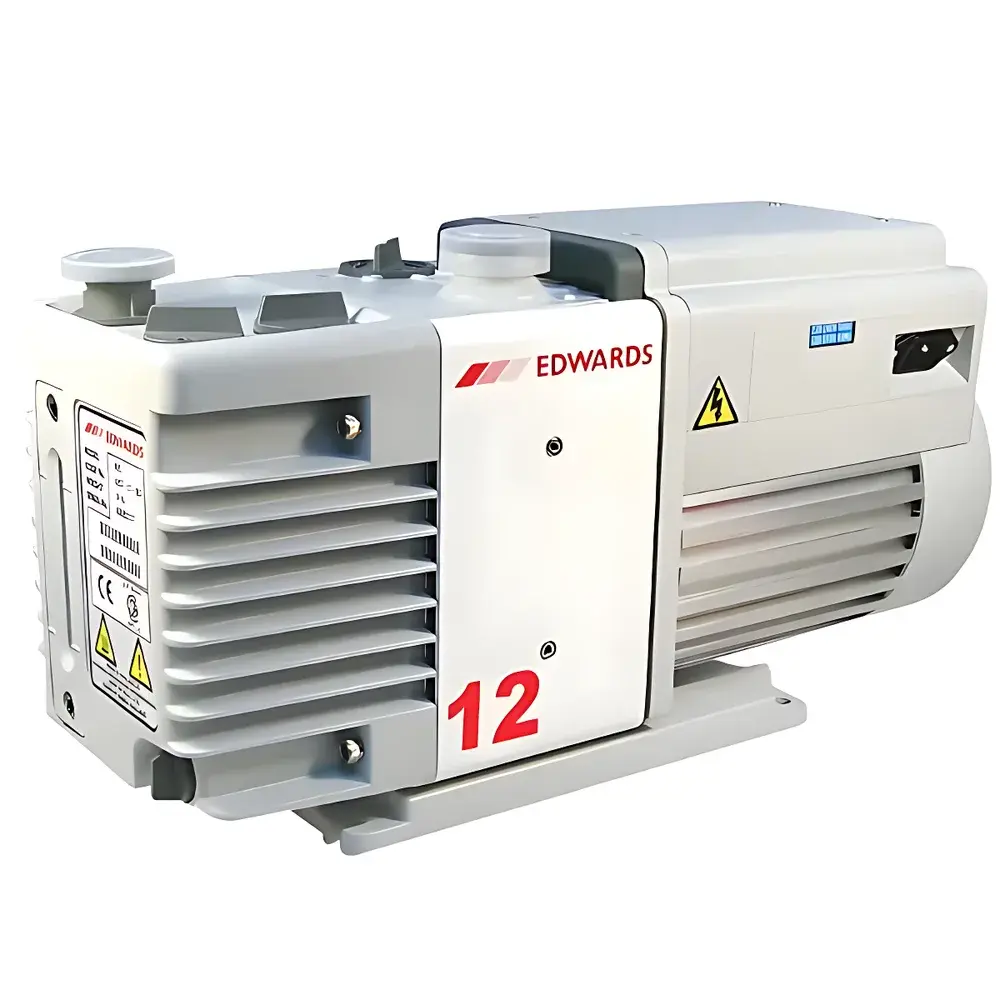
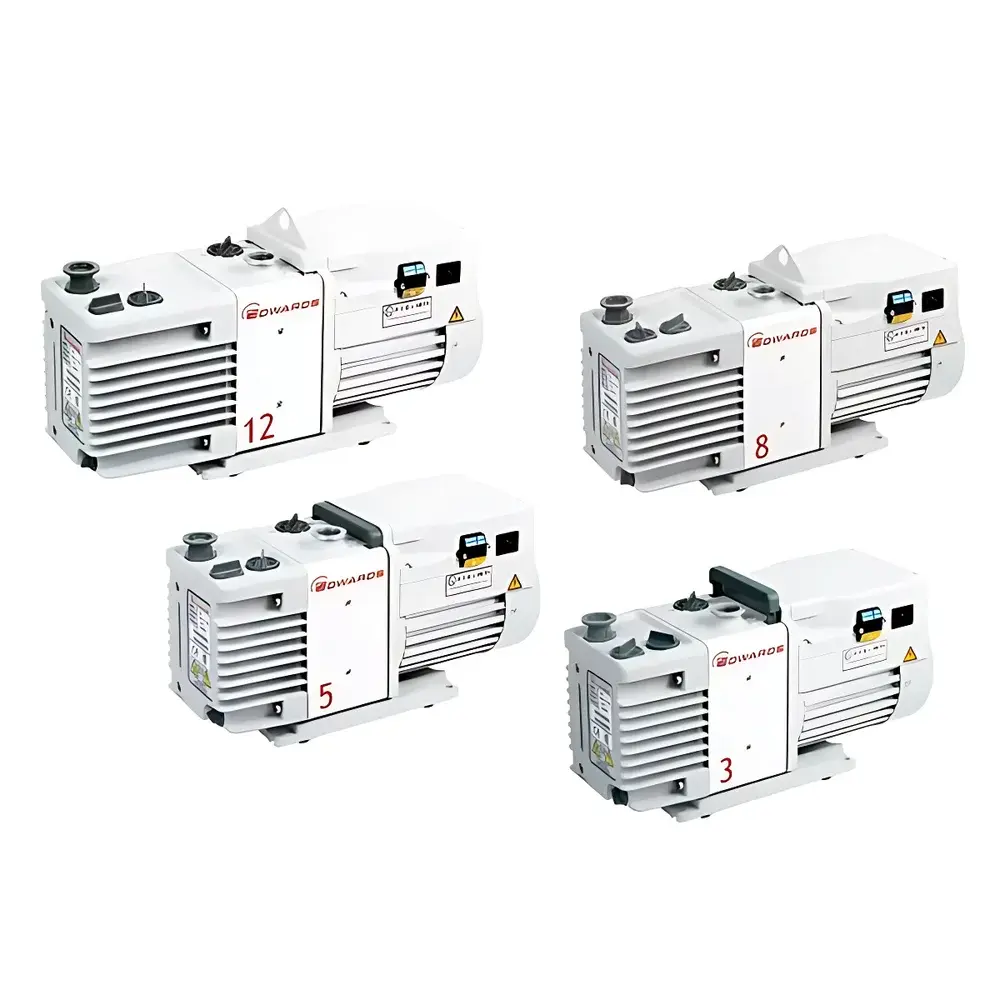
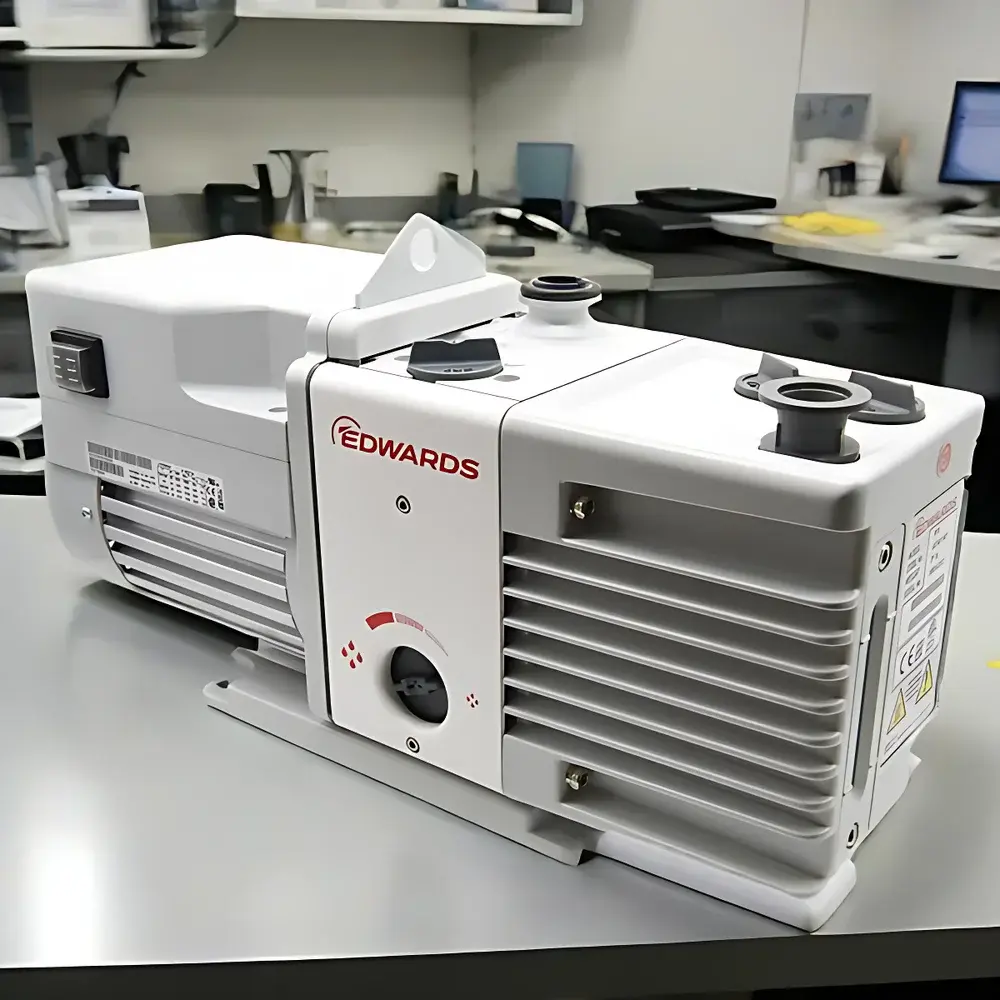
Edwards RV12 Two-Stage Oil-Sealed Rotary Vane Vacuum Pump
| Brand | Edwards Vacuum |
|---|---|
| Origin | United Kingdom |
| Model | RV12 |
| Pump Type | Rotary Vane |
| Lubrication | Oil-Sealed |
| Ultimate Pressure | 2 × 10⁻³ mbar |
| Pumping Speed (50 Hz) | 14.2 m³/h |
| Motor Power | 450 W (50 Hz) / 550 W (60 Hz) |
| Noise Level | 48 dB(A) @ 50 Hz |
| Weight (dry) | 26.3 kg |
| Inlet/Outlet Flange | NW25 |
| Operating Temperature Range | 12–40 °C |
| Recommended Oil | Ultragrade 19 (1 L included) |
| Compliance | UL, CSA certified |
| Application | Fore-vacuum for turbomolecular pumps, GC-MS, freeze dryers, SEM, glove boxes, R&D vacuum systems |
Overview
The Edwards RV12 is a two-stage, oil-sealed rotary vane mechanical vacuum pump engineered for precision, reliability, and quiet operation in demanding laboratory and analytical environments. Based on the proven Pneurop 6602 standard methodology, the RV12 employs a robust cast-iron housing with high-torque dual-voltage motor (1500 rpm @ 50 Hz / 1800 rpm @ 60 Hz) and large-diameter polymer vanes to deliver stable, high-reproducibility pumping performance across variable load conditions. Its dual-mode design enables optimized operation under both high-throughput (e.g., solvent recovery, rotary evaporation) and high-vacuum (e.g., turbomolecular pump backing, SEM chamber evacuation) regimes. The pump achieves an ultimate pressure of 2 × 10⁻³ mbar with standard mineral oil (Ultragrade 19), and maintains compatibility with perfluoropolyether (PFPE) oils such as Fomblin® for chemically aggressive or ultra-high-purity applications—extending service life and reducing hydrocarbon backstreaming risk.
Key Features
- Ultra-low noise emission: 48 dB(A) at 1 m distance (50 Hz), minimizing acoustic interference in shared lab spaces and sensitive instrumentation suites.
- Integrated gas ballast (air bleed) valve with auto-following inlet port design, enabling continuous water vapor handling up to 32 mbar inlet pressure and sustaining rated pumping speed during humid or solvent-laden operation.
- Self-adjusting hydraulic inlet valve provides automatic oil return protection during sudden pressure transients or pump shutdown, preventing oil migration into connected vacuum chambers.
- High-efficiency, low-inertia rotor assembly with oversized polymer vanes ensures extended wear resistance, reduced maintenance frequency, and consistent volumetric efficiency over time.
- Embedded sight glass allows real-time visual monitoring of oil level and clarity without disassembly; oil capacity range: 0.65–1.0 L (Ultragrade 19 supplied with unit).
- IEC EN 60320 C13 power inlet and standardized NW25 (KF25) flanges simplify integration into modular vacuum systems and OEM equipment platforms.
Sample Compatibility & Compliance
The RV12 is designed for use with non-corrosive, non-explosive gases and vapors typical in analytical, materials science, and pharmaceutical laboratories. It complies fully with UL 61010-1 and CSA C22.2 No. 61010-1 safety standards for electrical equipment used in laboratory settings. While not intrinsically safe, its construction meets general-purpose requirements for Class I, Division 2 environments when installed per manufacturer guidelines. For GLP/GMP-regulated workflows (e.g., USP analytical instrument qualification), the pump supports documented operational qualification (OQ) through traceable performance verification against Pneurop 6602 test protocols. Optional PFPE oil compatibility enables compliance with ASTM F2257-03 for hydrocarbon-free vacuum environments required in surface science and semiconductor R&D.
Software & Data Management
The RV12 operates as a standalone mechanical device with no embedded firmware or digital interface. However, it integrates seamlessly with third-party vacuum system controllers (e.g., Edwards EXT series, VAT valves, Pfeiffer TPG300 gauges) via analog 0–10 V or 4–20 mA signals when equipped with optional sensor kits. All factory calibration data—including pumping speed curves, ultimate pressure benchmarks, and motor thermal derating profiles—are archived in Edwards’ global technical documentation portal and accessible via serial number lookup. For audit-ready environments, users may implement external logging of inlet pressure, motor current, and runtime hours using compatible PLCs or SCADA systems compliant with FDA 21 CFR Part 11 when paired with validated timestamped acquisition hardware.
Applications
- Fore-vacuum backing for turbomolecular pumps in mass spectrometry (GC-MS, LC-MS), electron microscopy (SEM/FIB), and thin-film deposition systems.
- Primary vacuum source for freeze dryers, rotary evaporators, and vacuum ovens in pharmaceutical process development and formulation labs.
- Gas handling in glovebox inert-atmosphere maintenance, helium leak detection (with residual gas analyzers), and vacuum-assisted degassing of resins, epoxies, and composites.
- R&D support for vacuum metallurgy, plasma etching test benches, and low-pressure thermal processing (e.g., sintering, brazing, annealing).
- Continuous-duty operation in central vacuum networks serving multiple instruments across analytical chemistry and materials characterization facilities.
FAQ
What oil is supplied with the RV12 pump?
One liter of Edwards Ultragrade 19 mineral oil is included as standard. PFPE alternatives (e.g., Fomblin® Y or Z series) must be ordered separately and require full system flushing prior to first use.
Can the RV12 operate continuously at its maximum inlet pressure?
Yes—within specified limits: maximum allowable inlet pressure is 0.5 bar (gauge), and maximum outlet pressure is 0.2 bar (gauge). Continuous operation above 32 mbar inlet water vapor partial pressure requires active gas ballast engagement.
Is the RV12 suitable for GMP-compliant manufacturing environments?
It is widely deployed in regulated settings as a utility component; however, formal GMP validation requires user-executed IQ/OQ/PQ protocols aligned with ISO 9001 and EU Annex 11 expectations for ancillary equipment.
Does the pump include vibration isolation mounts?
No—the RV12 relies on its rigid cast-iron base and balanced rotor for inherent mechanical stability. External anti-vibration pads (e.g., Sorbothane®) are recommended for benchtop installations adjacent to microbalance or interferometric systems.
What is the expected service interval under normal laboratory use?
Oil change every 3,000 operating hours or annually (whichever occurs first); full vane inspection and replacement recommended every 12,000 hours or per condition-based assessment using sight glass and noise signature analysis.



