
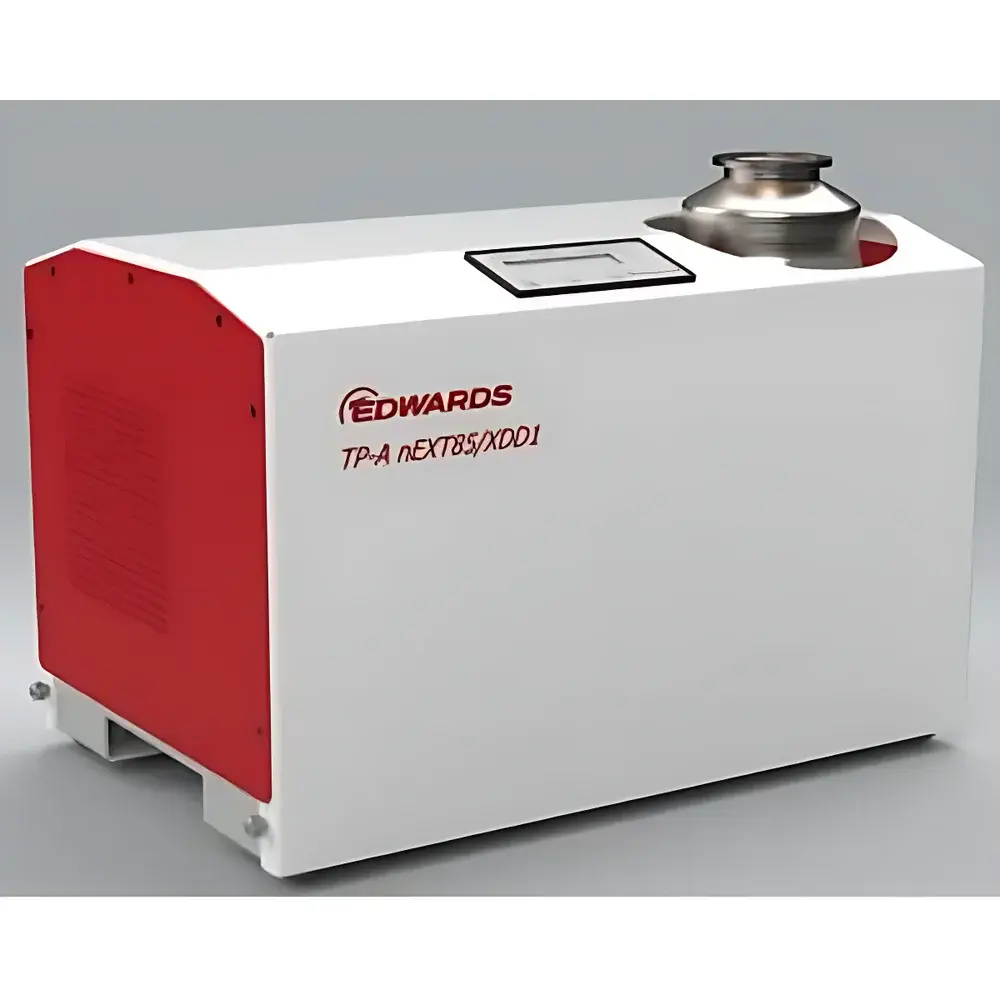
Edwards TP-A Desktop Molecular Pump System
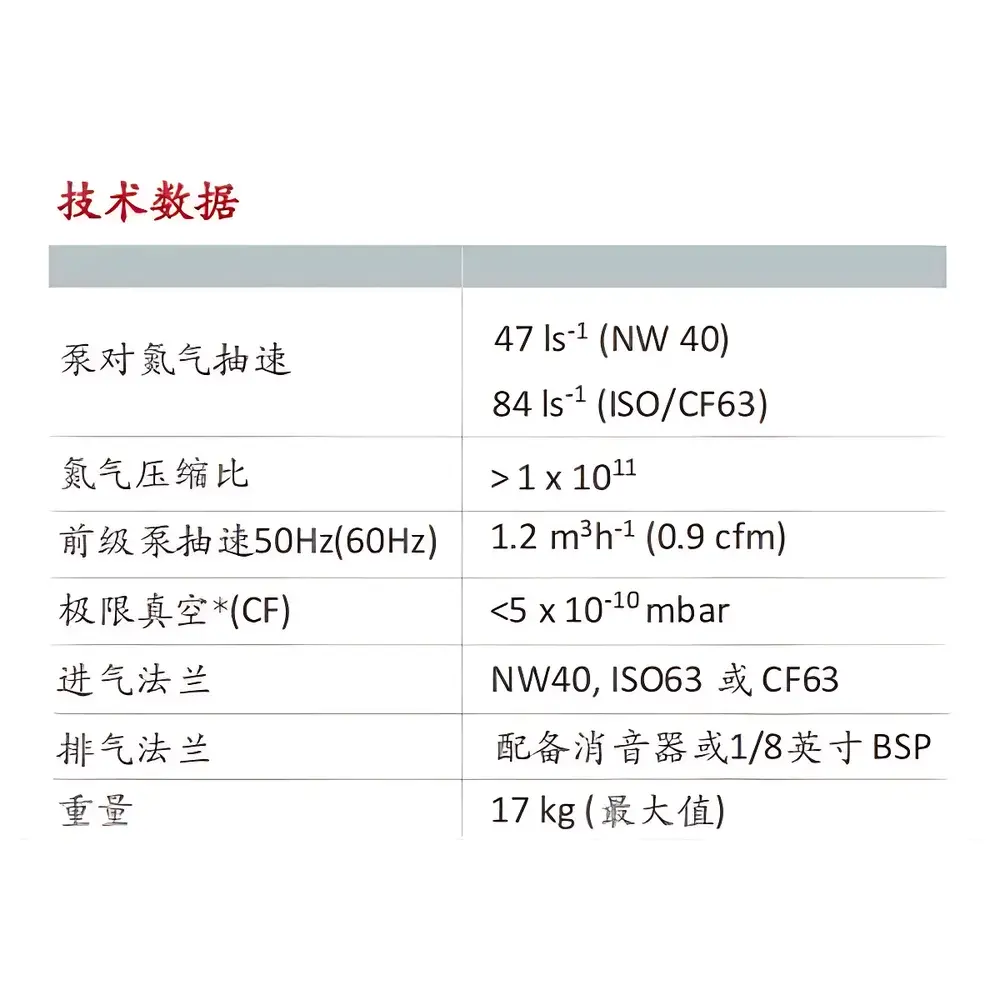
| Brand | Edwards Vacuum |
|---|---|
| Origin | United Kingdom |
| Model | TP-A |
| Pump Type | Oil-Free Turbomolecular Pump System |
| Base Pressure | ≤5 × 10⁻¹⁰ mbar |
| Pumping Speed (N₂) | 84 L/s |
| Dimensions (W × D × H) | 376 × 279 × 239 mm |
| Weight | 17 kg |
| Drive Power | 300 W |
| Forevacuum Requirement | Integrated Diaphragm Pump |
Overview
The Edwards TP-A Desktop Molecular Pump System is a compact, integrated ultra-high vacuum (UHV) solution engineered for demanding laboratory and R&D applications requiring clean, oil-free vacuum environments. Based on proven turbomolecular pumping technology, the TP-A combines a high-speed turbomolecular pump with a built-in diaphragm forepump in a single, space-efficient chassis. Its operation relies on momentum transfer: high-rotational-speed titanium blades (typically >90,000 rpm) collide with gas molecules, directing them toward the exhaust port—enabling efficient compression of light gases (e.g., H₂, He, N₂) while achieving base pressures down to ≤5 × 10⁻¹⁰ mbar under optimal conditions. Designed and manufactured by Edwards Vacuum—a UK-based global leader in vacuum science—the TP-A meets stringent engineering standards for vibration control, electromagnetic compatibility (EMC), and thermal stability, making it suitable for sensitive instrumentation such as surface analysis tools (XPS, AES), residual gas analyzers (RGAs), and low-energy electron beam systems.
Key Features
- Integrated architecture: Combines a high-efficiency turbomolecular pump and a chemically resistant diaphragm forepump in one self-contained unit—eliminating external plumbing, alignment complexity, and footprint overhead.
- Oil-free vacuum generation: No hydrocarbon backstreaming or lubricant contamination—critical for UHV processes involving thin-film deposition, mass spectrometry, or electron microscopy sample preparation.
- Intelligent motor control: Brushless DC drive with closed-loop speed regulation ensures stable rotational velocity across varying inlet pressures, enhancing long-term reproducibility and reducing bearing wear.
- Low-vibration design: Precision-balanced rotor assembly and elastomeric mounting minimize mechanical transmission—essential when coupled to vibration-sensitive detectors or interferometric setups.
- Compact form factor: 376 × 279 × 239 mm footprint enables benchtop deployment in fume hoods, gloveboxes, or modular vacuum chambers without dedicated floor space.
- Robust power management: 300 W nominal drive power supports rapid pump-down from atmosphere to high vacuum (<10⁻³ mbar) in under 15 minutes for typical 20–50 L chamber volumes.
Sample Compatibility & Compliance
The TP-A is compatible with standard ISO-KF 25/40 and CF 35/63 flanges (adapters available), supporting seamless integration into stainless steel or aluminum vacuum systems rated for UHV service. It is certified to CE, UKCA, and RoHS directives. While not intrinsically rated for explosive atmospheres, its diaphragm forepump uses PTFE-coated components and non-sparking motor windings—making it appropriate for use with inert, reactive, or mildly corrosive process gases (e.g., Ar, O₂, NH₃, CO₂) when operated within manufacturer-specified temperature and pressure limits. The system complies with ISO 21809-2 for vacuum integrity testing and supports GLP/GMP documentation workflows through optional analog voltage outputs (0–10 V) for pressure and speed monitoring.
Software & Data Management
The TP-A operates via front-panel LED interface with tactile push-button controls; no PC dependency is required for basic operation. For advanced diagnostics and remote supervision, Edwards offers optional USB-to-RS485 interface modules compatible with Edwards ActiveView™ software (Windows-based). This platform provides real-time pump status logging—including rotational speed, bearing temperature, foreline pressure, and error codes—with timestamped CSV export. Audit-trail functionality satisfies FDA 21 CFR Part 11 requirements when deployed in regulated QC/QA labs, enabling full traceability of vacuum events during material outgassing studies or calibration cycles.
Applications
- Surface science instrumentation: X-ray photoelectron spectroscopy (XPS), Auger electron spectroscopy (AES), and low-energy electron diffraction (LEED) systems requiring <10⁻⁹ mbar operating environments.
- Residual gas analysis: Coupling with quadrupole mass spectrometers (QMS) for leak detection, outgassing profiling, and partial pressure measurement in sealed vacuum devices.
- Thin-film research: Sputtering, evaporation, and atomic layer deposition (ALD) development where hydrocarbon-free vacuum prevents carbon contamination of optical or semiconductor layers.
- Electron optics: Supporting field emission scanning electron microscopes (FE-SEM) and electron beam lithography tools where ion pump supplementation is impractical.
- Academic UHV training: Used in university physics and materials science laboratories to demonstrate molecular flow regimes, conductance calculations, and pump-down kinetics.
FAQ
What forevacuum pressure is required for safe TP-A startup?
The integrated diaphragm pump must achieve ≤5 mbar at the turbomolecular pump’s inlet before acceleration begins—automatically enforced by the onboard controller.
Can the TP-A be used with aggressive halogenated gases?
No. Halogens (e.g., Cl₂, F₂) and strong oxidizers (e.g., O₃, NO₂) may degrade titanium rotor surfaces and PTFE seals; consult Edwards’ Chemical Compatibility Guide prior to use.
Is helium leak detection supported?
Yes—the TP-A’s high N₂ pumping speed correlates strongly with He throughput; when paired with a helium mass spectrometer leak detector (HMSLD), it delivers reliable sensitivity down to 1 × 10⁻¹² mbar·L/s.
Does the system include vibration isolation feet?
Yes—four adjustable silicone-damped leveling feet are factory-installed to decouple mechanical resonance from adjacent optical tables or precision balances.
What maintenance intervals are recommended?
Diaphragm pump oil-free operation requires only periodic inspection of inlet filters and replacement of diaphragm kits every 12 months under continuous duty; turbomolecular pump bearings are lifetime-lubricated per ISO 15243 standards.



