
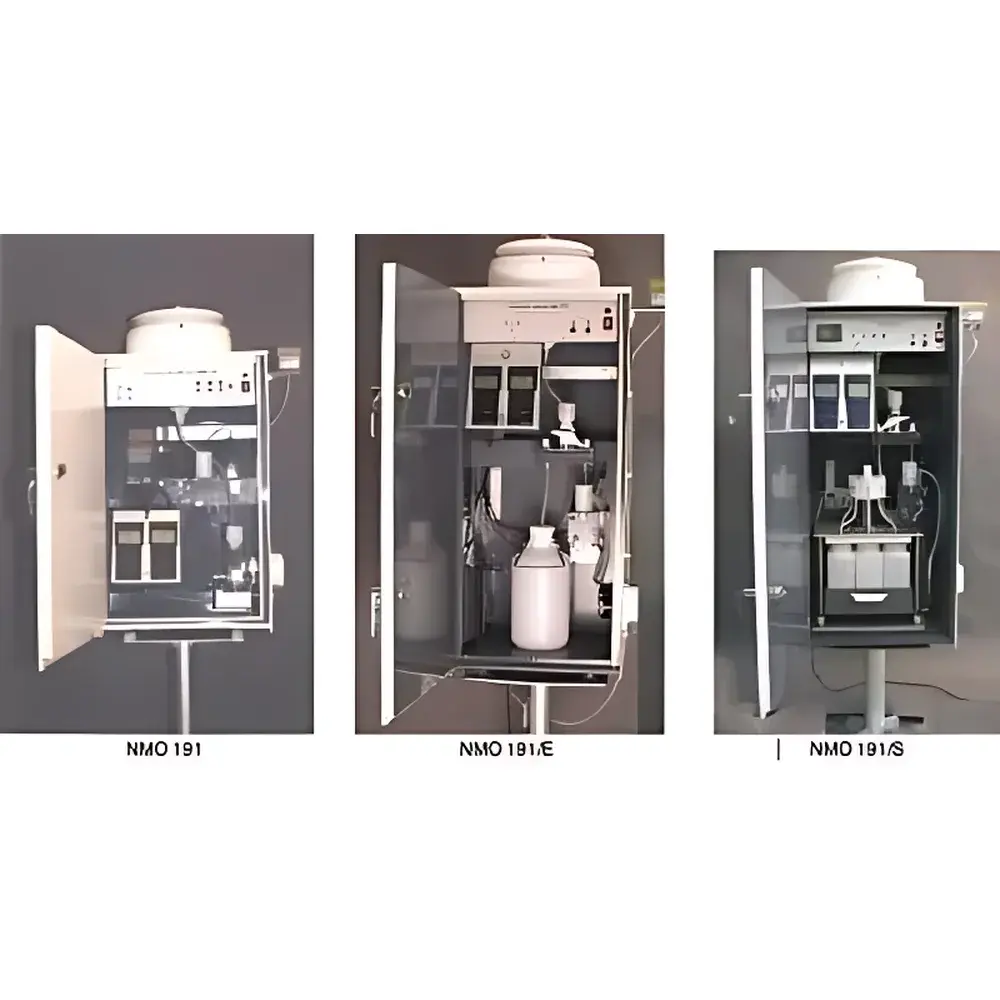
Eigenbrodt NMO191 Automated Precipitation Analyzer
| Brand | Eigenbrodt |
|---|---|
| Country of Origin | Germany |
| Model | NMO191 |
| Measurement Parameters | pH, Electrical Conductivity, Precipitation Intensity, Cumulative Precipitation Volume |
| Temperature-Controlled Measurement Chamber | 4–7 °C (active refrigeration with auto-defrost) |
| Collection Area | 500 cm² |
| Compliance | VDI 3870 (German Association of Engineers) |
| Enclosure | Double-walled insulated PVC housing |
| Sensor Interface | RS 85 precipitation sensor (standard), optional IRSS 88 or NRS 80 |
| Control System | SIEMENS® LOGO® programmable logic modules |
| Sample Handling Options | Single-bottle (5 L HD-PE), 8-day sequential (8 × 750 mL or 8 × 1000 mL HD-PE), with bottom-heated bottle tray |
| Materials | Chemically inert components throughout (HD-PE, borosilicate glass optional), corrosion-resistant fittings |
| Cooling System | FCKW-free plate-evaporator refrigeration unit with forced ventilation and particulate filter |
Overview
The Eigenbrodt NMO191 Automated Precipitation Analyzer is a field-deployable, ISO-compliant environmental monitoring system engineered for unattended, long-term characterization of atmospheric deposition chemistry. It operates on the principle of real-time, dual-parameter hydrometric analysis—simultaneously quantifying hydrogen ion activity (pH) and ionic strength (via electrical conductivity) in freshly collected precipitation as it enters the instrument. This synchronized measurement architecture enables direct inference of strong acid contribution (e.g., H₂SO₄, HNO₃) and total dissolved ionic load without post-collection sample handling—a critical requirement for capturing short-lived chemical transients associated with convective rainfall events or frontal passages. The system conforms to VDI 3870 guidelines for wet-only deposition sampling, including geometric specifications for funnel design, collection surface area (500 cm²), material compatibility, and thermal management. Its robust enclosure, chemically inert fluid path, and integrated meteorological interface make it suitable for deployment across diverse climatic zones—from alpine stations to coastal monitoring networks—under GLP-aligned operational protocols.
Key Features
- Simultaneous, in-line pH and electrical conductivity measurement within a thermostatically stabilized chamber (4–7 °C), minimizing temperature-induced drift and preserving sample integrity during analysis.
- VDI 3870-compliant polyethylene funnel with precisely defined 500 cm² effective collection area and aerodynamically optimized opening mechanism to suppress wind-induced undercatch and splash artifacts.
- Patented split-flow manifold directing precipitation into parallel paths: one to the analytical flow cell (0.5 mL volume), the other to storage bottles—ensuring representative subsampling without cross-contamination.
- FCKW-free refrigeration system with automatic defrost cycle and forced-air ventilation, maintaining stable cold-chain conditions even under sustained ambient temperatures exceeding 35 °C.
- Dual-heating architecture: independent heating elements for funnel rim, measurement chamber, outlet tubing, and (in S/KS configurations) sample bottle base—preventing freezing during winter operation while avoiding thermal stratification in stored samples.
- SIEMENS® LOGO® PLC-based control logic governing lid actuation, rotational sequencing (for multi-bottle systems), sensor triggering, and fault logging—supporting deterministic event-driven sampling aligned with precipitation onset/cessation signals from RS 85 or optional IRSS 88 sensors.
Sample Compatibility & Compliance
The NMO191 is constructed exclusively from chemically neutral materials: high-density polyethylene (HD-PE) for primary wetted surfaces, optionally upgradable to DURAN® borosilicate glass for funnel and sample containers where ultra-trace metal analysis is required. All seals, gaskets, and flow-path components comply with USP Class VI and FDA 21 CFR 177.1520 standards for aqueous environmental contact. The system meets the physical and procedural requirements of VDI 3870 for wet-only deposition samplers, including funnel geometry, evaporation suppression, and contamination mitigation strategies. While not certified to IEC 61326-1 for EMC immunity, its modular grounding scheme and shielded signal routing ensure reliable operation in remote telemetry environments. Data acquisition supports audit-ready timestamping and sensor calibration traceability—facilitating alignment with EPA Method 1620, ISO 10301, and EU Directive 2008/50/EC Annex IX reporting frameworks.
Software & Data Management
The NMO191 operates autonomously without embedded software; instead, it delivers analog (0–10 V / 4–20 mA) and digital (RS-232/485) outputs compatible with third-party SCADA platforms (e.g., Campbell Scientific CR1000X, Siemens Desigo CC, or custom LabVIEW-based DAQ). Optional handheld data loggers provide local storage of pH, conductivity, precipitation intensity, cumulative volume, and chamber temperature at user-defined intervals (1–60 min resolution). All measurement channels support two-point calibration verification logs, with EEPROM-stored calibration coefficients accessible via serial command. The SIEMENS® LOGO® controller retains event history—including lid open/close timestamps, refrigeration duty cycles, and sensor fault flags—for diagnostic review. When integrated into networked environmental observatories, the system supports MQTT or Modbus TCP gateways for ingestion into cloud-based LIMS or time-series databases compliant with FAIR data principles.
Applications
- Long-term trend analysis of acid deposition in national air quality monitoring networks (e.g., EMEP, NADP, or national UBA programs).
- Source apportionment studies linking precipitation chemistry to regional emission inventories via ion balance calculations (e.g., [Cl⁻] + [NO₃⁻] + 2[SO₄²⁻] vs. [Na⁺] + [NH₄⁺] + [K⁺] + [Ca²⁺] + [Mg²⁺]).
- Validation of atmospheric chemistry transport models (CTMs) requiring high-temporal-resolution wet scavenging inputs.
- Calibration and intercomparison of passive ion-exchange resin collectors (e.g., CREAM, CATCH) through concurrent event-based sampling.
- Climate–chemistry coupling research examining how changing storm dynamics influence solute export ratios in sensitive watersheds.
FAQ
What precipitation sensors are compatible with the NMO191?
The standard configuration includes the RS 85 tipping-bucket sensor. Optional alternatives include the IRSS 88 optical rain/snow sensor and the NRS 80 heated rain gauge for low-snowfall regions.
Can the NMO191 operate year-round in sub-zero environments?
Yes—integrated heating elements on the funnel, measurement chamber, and (in S/KS variants) sample bottle base prevent ice accumulation. The refrigeration system remains active below 0 °C to maintain the 4–7 °C analytical temperature window.
Is the system suitable for measuring snowmelt chemistry?
The NMO191 is designed for wet-only (rain-only) sampling per VDI 3870. For mixed-phase or dry deposition studies, Eigenbrodt offers complementary dry/wet/dust collectors (e.g., PE or DURAN® dry deposition samplers) that may be co-located.
How is calibration traceability maintained?
pH and conductivity sensors are calibrated using NIST-traceable buffer solutions (pH 4.01/7.00/10.01, KCl standards). Calibration dates, operator IDs, and deviation values are recorded manually or via external logger; the LOGO® controller stores actuation timestamps for full procedural auditability.
Does the NMO191 meet FDA 21 CFR Part 11 requirements?
As a field environmental monitor—not a regulated pharmaceutical or clinical device—the NMO191 does not implement electronic signature or audit-trail features per Part 11. However, its deterministic control logic and time-stamped output streams support integration into validated laboratory information management systems (LIMS) that do comply.







