
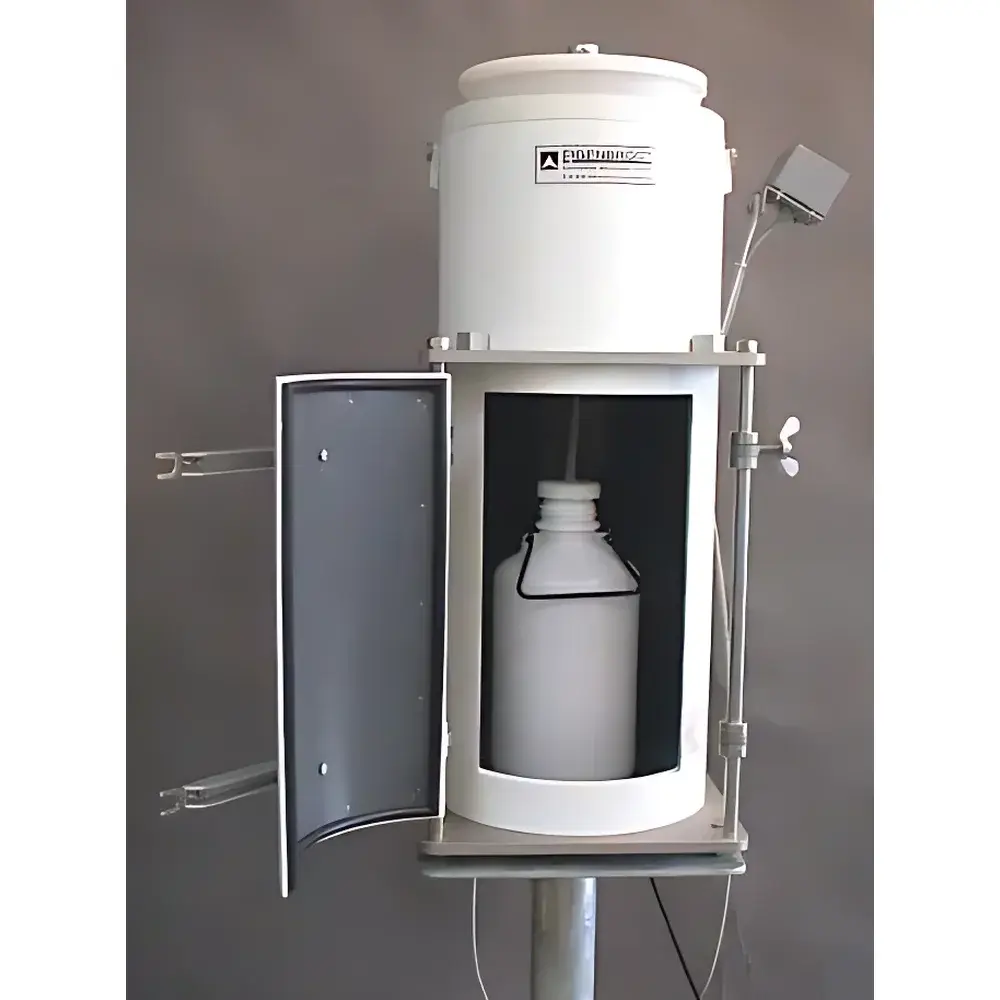
Eigenbrodt UNS 130D/E Automatic Precipitation Sampler
| Brand | Eigenbrodt |
|---|---|
| Origin | Germany |
| Model | UNS 130D/E |
| Collection Area | 500 cm² |
| Precipitation Sensor | RS 85 (binary yes/no output) |
| Power Supply | 230 VAC, 50 Hz, max. 250 VA |
| DC Heater Supply | 24 V DC, 2 × 30 W |
| Funnel Cover Drive Motor | 24 V DC, 50 W |
| Overall Height (with base) | 1500 mm |
| Dimensions (H × L × W) | 800 × 470 × 350 mm |
| Sampler Weight | 46 kg |
| Base Weight | 17 kg |
| Standard Configuration | Thick-walled PVC housing, HD-PE funnel, 5 L HD-PE sample bottle, lockable aluminum control cabinet with electronics and drive unit, thermostatically controlled heating system, RS 85 precipitation sensor |
Overview
The Eigenbrodt UNS 130D/E is a field-deployable, microprocessor-controlled automatic precipitation sampler engineered for high-reliability environmental monitoring in remote or constrained installations—including research vessels, mountain observatories, offshore platforms, and tall-tower networks. It operates on a binary precipitation detection principle: the integrated RS 85 precipitation sensor triggers real-time actuation of the funnel cover upon rain/snow onset, initiating collection without manual intervention. The system adheres to VDI 3870 guidelines—Germany’s authoritative standard for precipitation sampling design—ensuring geometrically defined collection geometry (500 cm² active area), chemically inert wet-path materials (HD-PE funnel, PTFE-compatible tubing, optional quartz or Duran® glass components), and aerodynamically optimized cover motion to minimize wind-induced undercatch. Unlike passive collectors, the UNS 130D/E incorporates active thermal management: dual 24 V DC, 30 W heating elements maintain sample temperature stability during freezing conditions, preventing ice accumulation in the funnel and transfer line while preserving sample integrity for subsequent ion chromatography, trace metal, or isotopic analysis.
Key Features
- VDI 3870–compliant 500 cm² collection surface with aerodynamically profiled HD-PE funnel and precision-engineered cover actuation mechanism
- Binary RS 85 precipitation sensor with configurable delay logic to distinguish transient dew/fog events from true precipitation
- Thermostatically regulated heating system (24 V DC, 2 × 30 W) integrated into both funnel base and sample bottle chamber for winter operation
- Modular sample container architecture: Type D supports two 1.5 L HD-PE bottles via plug-in modules; Type E accommodates a single 5 L HD-PE bottle with direct funnel-to-bottle hose coupling
- Chemically neutral wet-path construction—no metal contact with precipitation; all fluid-contact surfaces certified for low leachability per DIN EN ISO 17294-2
- Lockable, corrosion-resistant aluminum electronics cabinet housing microcontroller, motor driver, and power conversion circuitry
- Compact footprint (470 × 350 mm base) and low center of gravity enable stable mounting on non-dedicated infrastructure (e.g., ship railings, tower brackets)
Sample Compatibility & Compliance
The UNS 130D/E is designed for compatibility with downstream analytical workflows requiring strict contamination control. Standard HD-PE bottles meet ASTM D4327 requirements for ion chromatography sample storage. Optional Duran® borosilicate glass and fused quartz funnels satisfy USP <661.1> and ISO 10993-12 criteria for trace-element–sensitive applications (e.g., Pb, Cd, Hg speciation). All electrical components comply with IEC 61326-1 (EMC) and IEC 61000-6-2/6-4. The system supports GLP-aligned data integrity when paired with the optional LCD timer and miniature data logger (recording timestamped start/stop events, heater status, and motor cycles). While not intrinsically rated for hazardous locations, its IP55-rated enclosure ensures operational reliability in outdoor environments per IEC 60529.
Software & Data Management
The UNS 130D/E operates autonomously via embedded firmware with no host PC dependency. Event logging includes precipitation initiation/termination timestamps, cumulative heater-on duration, and motor actuation count—accessible via front-panel LCD or serial RS-232 interface (optional adapter). Raw logs export as ASCII CSV for integration into LIMS or custom QA/QC dashboards. When deployed with the optional optoelectronic IRSS88 sensor upgrade, the system provides analog intensity feedback enabling rudimentary precipitation rate estimation—useful for correlation with co-located weather stations. Firmware updates are performed via USB-to-serial bridge; configuration parameters (e.g., heater setpoint, cover delay time, bottle fullness timeout) are retained across power cycles per IEC 60730 Class B safety requirements.
Applications
- Long-term atmospheric deposition monitoring in EMEP, GAW, and national air quality networks
- Isotopic hydrology studies (δ²H, δ¹⁸O) requiring uncontaminated bulk precipitation archives
- Acid deposition assessment under UNECE CLRTAP protocols
- Trace metal flux quantification in sensitive ecosystems (alpine, marine, forested)
- Calibration and validation of satellite-based precipitation products (e.g., GPM, IMERG)
- Source apportionment of anthropogenic vs. natural aerosol contributions via anion/cation ratio analysis
FAQ
What distinguishes the UNS 130D from the UNS 130E configuration?
The Type D variant uses a modular dual-bottle system (2 × 1.5 L) with quick-release plug-in adapters, enabling sequential sampling or parallel collection for replicate analysis. The Type E employs a single 5 L bottle with direct funnel coupling—optimized for high-volume rainfall events and simplified post-collection handling.
Can the system operate unattended for extended periods?
Yes. With standard 5 L capacity and typical temperate-climate precipitation frequency, deployment durations exceed 3–4 weeks without servicing. Optional 10 L HD-PE bottles extend this to >6 weeks. Battery backup (not included) can be integrated via the 24 V DC auxiliary port for short-term grid outage resilience.
Is the heating system programmable for temperature setpoint?
No—the heater operates in on/off mode governed by internal thermostat calibrated to ~4 °C above ambient. This design prioritizes energy efficiency and frost prevention over precise temperature control, aligning with VDI 3870 recommendations for precipitation samplers.
Does the RS 85 sensor require periodic recalibration?
No. The RS 85 is a solid-state capacitive sensor with no consumable parts; it undergoes factory calibration traceable to PTB (Physikalisch-Technische Bundesanstalt) standards. Annual functional verification against known water droplet exposure is recommended per ISO/IEC 17025 internal audit protocols.
Are replacement parts and technical documentation available in English?
Yes. Eigenbrodt provides full English-language operating manuals, spare parts catalogs (including exploded diagrams), and firmware release notes through authorized distributors. Critical wear items—funnel gaskets, motor brushes, and sensor housings—are stocked globally with ≤10 business day lead time.
Related Products







