
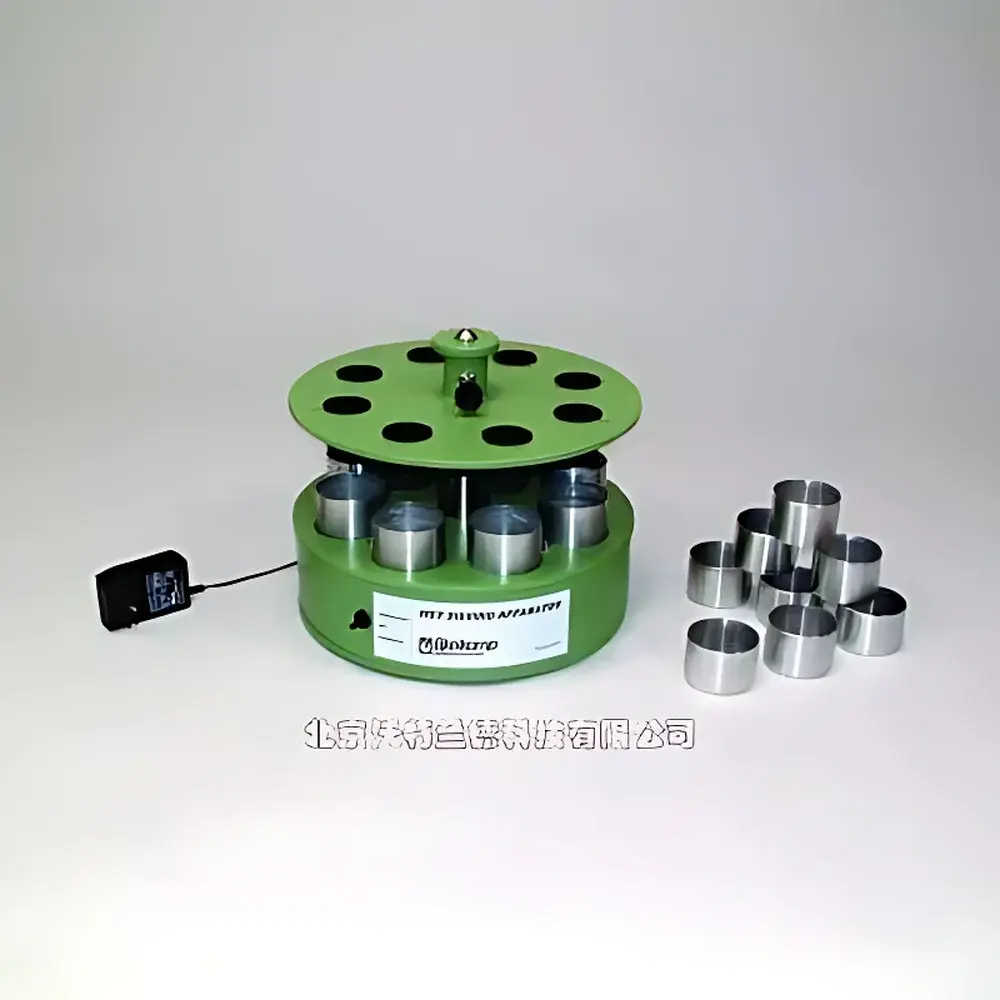
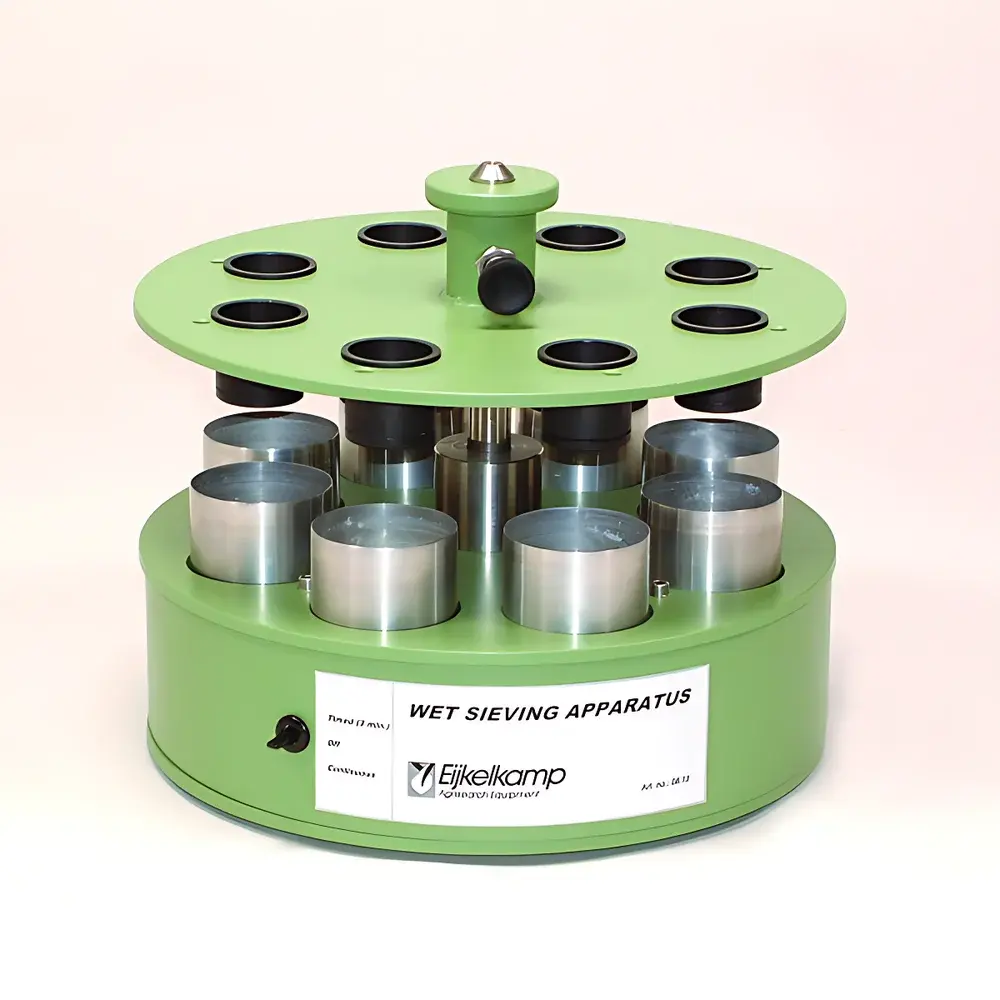
Eijkelkamp 08.13 Soil Water-Stable Aggregates Analyzer
| Brand | Eijkelkamp |
|---|---|
| Model | 08.13 |
| Power Supply | 90–264 VAC input (worldwide compatible) with interchangeable plugs |
| Motor | 12/24 VDC |
| Sieve Assembly | 8-position aluminum sieve holder with standardized 39 × 39 mm sieves (0.250 mm aperture, 10.2 cm² active area) |
| Sample Container | Aluminum canisters (62.5 × 44 mm) |
| Operating Principle | Wet-sieving under controlled vertical oscillation |
| Compliance | Designed for ASTM D6913, ISO 10930, and USDA-NRCS soil structure protocols |
Overview
The Eijkelkamp 08.13 Soil Water-Stable Aggregates Analyzer is a precision-engineered laboratory instrument designed to quantify the proportion of water-stable aggregates in mineral and organic soils using standardized wet-sieving methodology. It operates on the fundamental principle that structurally intact soil aggregates resist disintegration upon rapid immersion in water, whereas weak or unstable aggregates dissociate under hydrostatic and mechanical stress. This measurement directly reflects the degree of binding between soil particles—mediated by clay-humus complexes, iron/aluminum oxides, polysaccharides, and fungal hyphae—and serves as a robust proxy for long-term soil structural integrity. Unlike dry-sieving methods, which assess only mechanical stability, the 08.13 system evaluates *functional* stability under conditions simulating natural rainfall infiltration and ponding events. Its design aligns with internationally recognized frameworks for soil health assessment, including the FAO’s Soil Health Assessment Protocol and the EU’s Joint Research Centre (JRC) guidelines for aggregate stability reporting.
Key Features
- Eight-position aluminum sieve holder with precisely machined 0.250 mm aperture sieves (39 × 39 mm active area), ensuring uniform sample exposure and reproducible hydraulic shear conditions.
- Integrated vertical oscillation mechanism driven by a sealed 12/24 VDC motor, delivering consistent stroke amplitude and frequency—engineered to meet the 30-cycle-per-minute requirement specified in ASTM D6913 Section 7.3.
- Dual-mode sieve holder positioning: fully adjustable and lockable at both “leakage” (for controlled drainage during post-sieving settling) and “bottom” (for precise water-level management across all canisters simultaneously).
- Modular aluminum sample canisters (62.5 × 44 mm) with standardized geometry facilitate repeatable sample mass loading (typically 10–20 g air-dried soil per canister) and minimize inter-canister variance.
- Universal AC power adapter (90–264 VAC input) with region-specific plug options enables deployment in field laboratories, ISO 17025-accredited testing facilities, and multi-country research networks without voltage conversion hardware.
- Corrosion-resistant anodized aluminum construction and IP54-rated electrical components ensure operational reliability in high-humidity environments typical of soil processing labs.
Sample Compatibility & Compliance
The 08.13 analyzer accommodates a broad range of soil textures—from sandy loams to heavy clays—and is validated for use with organic-rich substrates (e.g., peat-amended topsoils, compost blends, and biochar-amended profiles). It supports sequential wet-sieving protocols per ISO 10930:2012 (Soil quality — Determination of water-stable aggregates by wet sieving) and ASTM D6913 – 22 (Standard Test Methods for Particle-Size Distribution of Soil). Data generated are traceable to NIST-traceable calibration procedures for sieve mesh certification and gravimetric mass determination. The instrument’s mechanical repeatability (< ±1.2% RSD for replicate aggregate recovery across eight positions) satisfies GLP-compliant data recording requirements when paired with certified analytical balances and documented SOPs.
Software & Data Management
While the 08.13 operates as a standalone electromechanical platform, its experimental outputs integrate seamlessly into digital soil data workflows. Aggregate mass fractions—calculated as the ratio of retained material on each sieve tier to total dry soil mass—are recorded manually or via LIMS-compatible spreadsheets. For laboratories operating under FDA 21 CFR Part 11 or ISO/IEC 17025, users may implement electronic lab notebooks (ELNs) with audit trails to log operator identity, sieve lot numbers, environmental conditions (temperature/humidity), and balance calibration status alongside each run. Eijkelkamp provides full technical documentation—including maintenance logs, spare parts schematics, and metrological verification checklists—to support internal validation and external accreditation audits.
Applications
- Long-term agronomic trials evaluating tillage system impacts (no-till vs. conventional plowing) on macroaggregate persistence.
- Assessment of cover crop root architecture effects on microaggregate stabilization in vineyard and orchard soils.
- Regulatory compliance testing for land reclamation projects under EPA Region 10 or EU Soil Thematic Strategy reporting mandates.
- Climate resilience studies correlating water-stable aggregate content with saturated hydraulic conductivity and antecedent moisture thresholds.
- Validation of soil amendments (e.g., polyacrylamide, lignosulfonates, or microbial inoculants) in controlled-environment mesocosms.
FAQ
What standards does the 08.13 comply with for regulatory reporting?
It conforms to ASTM D6913, ISO 10930, and USDA-NRCS National Soil Survey Handbook Part 618, supporting submissions to environmental agencies requiring method-validated aggregate stability data.
Can the instrument be used with pre-wetted or field-moist soils?
No—the standard protocol requires air-dried, gently crushed soil samples (≤ 8 mm) to eliminate confounding effects from initial water content; field-moist analysis requires parallel gravimetric moisture correction.
Is calibration required before each test series?
Sieve mesh certification must be verified annually per ISO 10930 Annex A; mechanical oscillation frequency should be checked quarterly using a calibrated tachometer.
How is cross-contamination between samples prevented?
Each aluminum canister and sieve is cleaned ultrasonically in deionized water and dried at 105°C for 1 hour between runs; blank runs with reference quartz sand are recommended every 10 samples.
Does Eijkelkamp supply certified reference materials for method validation?
Yes—traceable soil reference materials (SRMs) with certified aggregate distribution profiles (NIST SRM 2710a, 2711a) are available through authorized distributors for routine performance verification.
Related Products







