
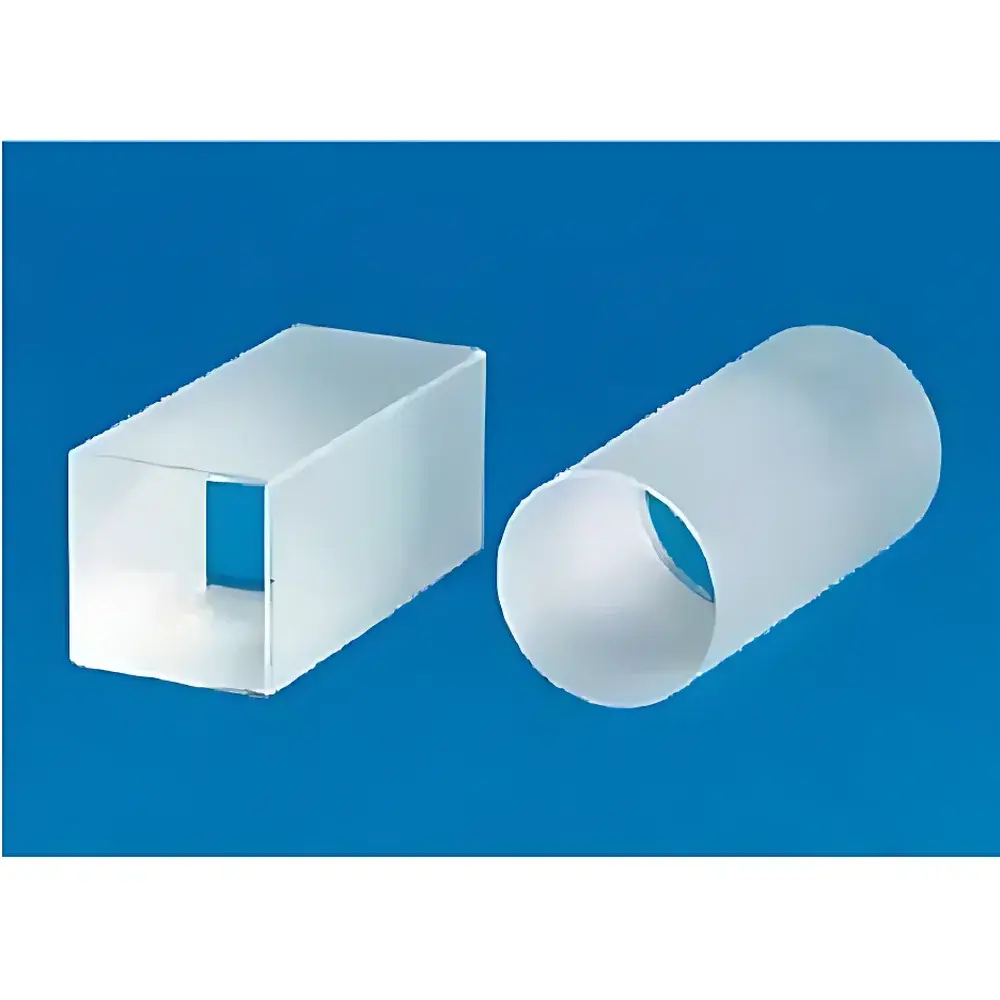
EKSMA KDP & DKDP Potassium Dihydrogen Phosphate Nonlinear Optical Crystals
| Brand | EKSMA |
|---|---|
| Crystal Type | KDP (KH₂PO₄) and DKDP (KD₂PO₄) |
| Cut Type | Type I or Type II phase-matching |
| Standard Dimensions | Ø9 × 20 mm, Ø12 × 24 mm |
| Deuteration Level (DKDP) | >96% D |
| AR Coating | Optional dielectric antireflection coating per wavelength |
| Electrode Options | Optional Au or Ag metallic electrode deposition |
| Half-Wave Voltage (Vλ/2) | 3.4 kV @ 1064 nm |
| UV Transmission Range | Down to ~200 nm (KDP) |
| Phase-Matching Angles (RT) | Type I SHG @ 1064 nm = 36.6°, Type II SHG = 53.7°, Type II THG = 59.3°, Type I 4th HG (532 → 266 nm) = 90° (non-critical) |
Overview
EKSMA OPTICS KDP (potassium dihydrogen phosphate, KH₂PO₄) and DKDP (deuterated potassium dihydrogen phosphate, KD₂PO₄) crystals are high-purity, single-domain nonlinear optical (NLO) materials engineered for precision frequency conversion and electro-optic modulation in high-energy pulsed laser systems. Based on the orthorhombic crystal structure and non-centrosymmetric lattice symmetry, both KDP and DKDP enable efficient second-harmonic generation (SHG), third-harmonic generation (THG), fourth-harmonic generation (FHG), sum-frequency generation (SFG), difference-frequency generation (DFG), and optical parametric processes via the χ⁽²⁾ nonlinear susceptibility tensor. Their broad transparency range (200–1500 nm), low absorption in the deep-UV, excellent damage threshold (>10 J/cm² at 1064 nm, 10 ns), and controllable birefringence make them indispensable components in Nd:YAG, Ti:sapphire, and other solid-state laser architectures operating at low repetition rates (<100 Hz) and high peak power.
Key Features
- High optical homogeneity and wavefront distortion < λ/8 over aperture (measured at 633 nm)
- Phase-matching flexibility: Type I and Type II configurations available with precise angular tolerance (±0.1°) for SHG, THG, and FHG
- Deuteration level >96% for DKDP ensures thermal stability and reduced walk-off in high-average-power applications
- Standard stock sizes include Ø9 × 20 mm and Ø12 × 24 mm; custom apertures up to Ø80 mm supported with full orientation verification (X-ray Laue)
- Optional metallized electrodes (Au or Ag) deposited via thermal evaporation for integrated Pockels cell fabrication
- Dielectric antireflection coatings available for specific wavelengths (e.g., 1064 nm, 532 nm, 355 nm, 266 nm) with R < 0.2% per surface
- Non-critical phase matching (NCPM) achievable at 90° for 4ω generation (532 → 266 nm), eliminating angular sensitivity in ultrafast systems
Sample Compatibility & Compliance
KDP and DKDP crystals comply with international standards for optical material certification, including ISO 10110-3 (surface imperfections), ISO 10110-7 (laser damage threshold reporting), and MIL-O-13830A scratch-dig specifications. All crystals undergo full spectral transmission verification (200–1500 nm), refractive index mapping, and birefringence profiling prior to shipment. For regulated environments—such as laser safety laboratories or medical device manufacturing—certificates of conformance (CoC), material traceability reports, and batch-specific test data are provided upon request. While not classified as controlled substances under ITAR or EAR, export documentation aligns with EU dual-use regulation (EC No. 428/2009) where applicable.
Software & Data Management
EKSMA provides a comprehensive technical datasheet package including Sellmeier coefficients, temperature-dependent phase-matching curves, group velocity mismatch (GVM) values, and acceptance bandwidth calculations for common pump wavelengths (e.g., 1064 nm, 800 nm). These parameters are compatible with standard NLO design tools such as SNLO (ASD Inc.), MATLAB-based phase-matching solvers, and commercial ray-tracing platforms (Zemax OpticStudio, CODE V). No proprietary software is required; all optical performance data is delivered in CSV and PDF formats with SI-unit consistency and uncertainty annotations per ISO/IEC 17025 guidelines. Audit-ready calibration records and measurement protocols support GLP/GMP-aligned quality management systems.
Applications
- High-energy harmonic generation: SHG (1064 → 532 nm), THG (1064 → 355 nm), and FHG (532 → 266 nm) in Q-switched and mode-locked Nd:YAG lasers
- Ultrafast Ti:sapphire laser systems: Broadband SHG for pulse characterization (autocorrelators) and continuum generation; KDP’s large spectral acceptance (~2.4× wider than BBO at 800 nm) minimizes temporal pulse distortion
- Electro-optic modulation: High-voltage Pockels cells for cavity dumping, Q-switching, and polarization gating; DKDP offers superior thermal stability vs. KTP in high-repetition-rate amplifiers
- UV light sources: Deep-UV generation down to 200 nm for photochemistry, semiconductor inspection, and synchrotron beamline conditioning
- Large-aperture laser fusion drivers: Ø80 mm KDP slabs used in multi-beam inertial confinement fusion facilities requiring uniform phase front preservation and minimal depolarization
FAQ
What is the primary difference between KDP and DKDP in terms of phase-matching performance?
DKDP exhibits reduced thermal dephasing and lower group velocity mismatch compared to KDP due to isotopic mass effects from deuteration, making it preferred for high-average-power or thermally sensitive harmonic generation setups.
Can EKSMA supply KDP/DKDP crystals with custom AR coatings for 266 nm operation?
Yes—multi-layer dielectric coatings optimized for 266 nm (R 5 J/cm², 20 ns) are available with full spectral reflectance curve and environmental durability testing (per MIL-C-48497A).
Is X-ray Laue orientation verification included for custom-cut crystals?
Yes—every custom-order crystal includes certified Laue diffraction report with orientation error ≤ ±0.05°, referenced to crystallographic axes (X, Y, Z) and phase-matching plane.
How does KDP compare to BBO for 800 nm SHG in femtosecond Ti:sapphire systems?
KDP offers ~2.4× broader spectral acceptance and significantly lower group velocity mismatch than BBO at 800 nm, enabling cleaner autocorrelation traces and higher conversion efficiency for pulses <100 fs without compression compensation.
Do you provide mounting fixtures or holders for DKDP Pockels cells?
Standard kinematic mounts (aluminum or Invar) with HV feedthrough compatibility (up to 10 kV DC) are available as optional accessories; mechanical drawings and thermal expansion coefficients are supplied for integration into OEM laser cavities.





