
EKSMA Nd:YAG Laser Rear Mirror
| Brand | EKSMA |
|---|---|
| Origin | Imported (Lithuania) |
| Manufacturer Type | Authorized Distributor |
| Product Category | Optical Instrument Component |
| Model | Nd:YAG Laser Rear Mirrors |
| Substrate Material | UV-Fused Silica (UVFS) |
| Diameter × Thickness | 25.4 mm × 6 mm |
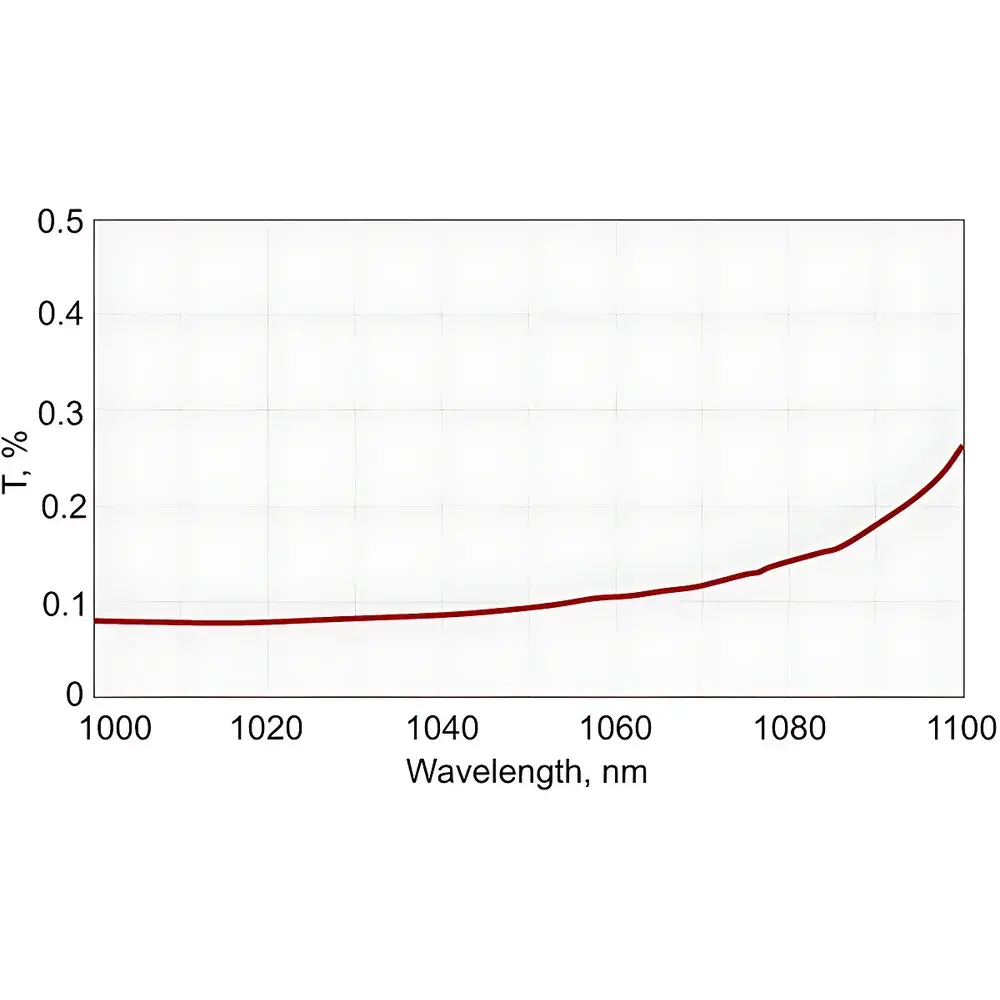
| Reflectivity @ 1064 nm | R > 99.8% |
| Coating Type | Dielectric High-Reflective (HR) |
| Laser Damage Threshold | ≥ 500 MW/cm² (10 ns, 10 Hz, 1064 nm) |
| Surface Flatness | λ/10 @ 633 nm |
| Surface Quality | 10–5 scratch-dig |
| Clear Aperture | ≥ 90% of diameter |
Overview
The EKSMA Nd:YAG Laser Rear Mirror is a precision dielectric high-reflection (HR) optic engineered for integration into the resonant cavity of solid-state Nd:YAG laser systems operating at the fundamental wavelength of 1064 nm. Designed in strict accordance with cavity stability and thermal management requirements, this rear mirror serves as the high-reflectance end mirror—typically paired with an output coupler—to define longitudinal mode structure and maximize intracavity photon density. Its optical architecture leverages multilayer dielectric thin-film deposition on ultra-low-expansion UV-fused silica (UVFS) substrate, ensuring minimal absorption (< 0.05%), negligible thermal lensing under high-average-power operation, and long-term spectral stability across environmental fluctuations. Unlike metallic coatings, the broadband-dielectric HR stack delivers polarization-insensitive reflectance with exceptional phase fidelity—critical for Q-switched pulse build-up, mode-locking synchronization, and TEM00 beam preservation.
Key Features
- High-reflectivity dielectric coating optimized for 1064 nm: R > 99.8% at normal incidence, with < ±0.2% reflectance uniformity across clear aperture
- UV-fused silica (UVFS) substrate offering coefficient of thermal expansion (CTE) < 0.55 × 10⁻⁶ /°C and transmission > 99.5% from 190–2100 nm
- λ/10 surface flatness (measured at 633 nm HeNe wavelength) and 10–5 scratch-dig surface quality per MIL-PRF-13830B
- Laser-induced damage threshold (LIDT) certified to ≥ 500 MW/cm² (10 ns pulse width, 10 Hz repetition rate, 1064 nm), validated per ISO 21254–1
- Controlled wedge < 3 arcsec to suppress parasitic etalon effects in multi-pass or regenerative amplifier configurations
- AR-coated back surface (R < 0.25% @ 1064 nm) minimizes residual cavity feedback and ghost reflections
Sample Compatibility & Compliance
This rear mirror is compatible with standard Nd:YAG rod geometries (e.g., Ø3–Ø6 mm × 75–150 mm) and supports both flashlamp-pumped and diode-pumped architectures. It meets dimensional and metrological requirements for alignment within commercial laser cavities from manufacturers including Quantel, Continuum, Litron, and Spectra-Physics. The optic complies with ISO 10110–7 (surface imperfections), ISO 14997 (laser damage testing), and RoHS Directive 2011/65/EU. Documentation includes full spectral reflectance curve (350–1100 nm), interferometric surface map, and LIDT test report traceable to accredited calibration labs. For regulated environments—including ISO 13485-certified medical laser manufacturing or FDA 21 CFR Part 11–governed research facilities—batch-specific certificates of conformance and material traceability are available upon request.
Software & Data Management
While the mirror itself is a passive optical component, EKSMA provides downloadable technical documentation via its secure customer portal, including spectral performance files (.csv), ZYGO interferogram exports (.zmf), and coating design reports (.txt). All data files are timestamped, digitally signed, and archived for ≥ 10 years in compliance with GLP audit requirements. Integration support is offered for optical simulation workflows: coating stack parameters are exportable to CODE V, Zemax OpticStudio, and FRED via standard thin-film layer definitions (n/k vs. λ). No proprietary software installation or cloud dependency is required—data remains fully portable and vendor-agnostic.
Applications
- Resonator end mirrors in Q-switched Nd:YAG lasers for LIBS, laser-induced breakdown spectroscopy, and time-resolved fluorescence
- Cavity optics in high-repetition-rate (>1 kHz) DPSS lasers used in micromachining and semiconductor inspection
- Master oscillator power amplifier (MOPA) systems requiring low-loss, high-fidelity wavefront preservation
- Ultrafast amplifier chains (e.g., chirped-pulse amplification) where group delay dispersion (GDD) control is critical
- Calibration-grade reference mirrors in metrology setups compliant with ISO 10110–5 and VDI/VDE 2634 Part 2
FAQ
Is this mirror suitable for frequency-doubled (532 nm) or tripled (355 nm) Nd:YAG operation?
No—this specific variant is optimized exclusively for 1064 nm HR performance. EKSMA offers separate HR mirrors for harmonic wavelengths with tailored coating designs and substrate AR treatments.
Can the mirror be mounted in kinematic fixtures without inducing stress birefringence?
Yes—UVFS’s low CTE and high homogeneity enable stable mounting using low-stress flexure or indium foil interfaces; detailed mounting recommendations are provided in the mechanical drawing package.
What is the maximum average power density this mirror can sustain continuously?
Under forced-air cooling and optimal beam homogenization (M² < 1.1), it maintains performance up to 500 W/cm² average power density without measurable thermal drift over 8-hour operational cycles.
Are custom diameters, thicknesses, or curvature options available?
Yes—EKSMA supports OEM customization including concave/convex variants (ROC = ±50 mm to ±∞), alternative substrates (CaF₂, sapphire), and multi-wavelength HR stacks (e.g., 1064/532/355 nm tri-band); lead time and MOQ apply.





