
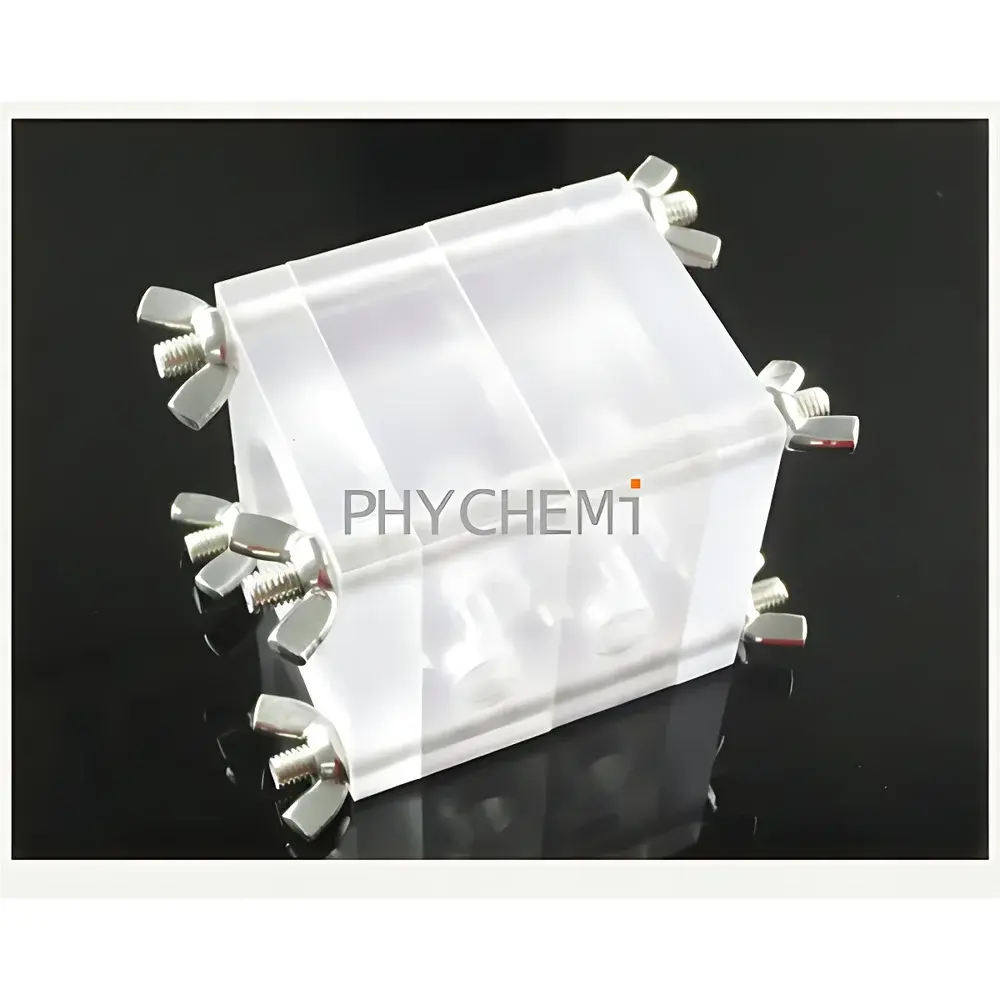
El-Mul Technologies PHCYHEMI MFC Sterilizable Microbial Fuel Cell Reactor
| Brand | El-Mul Technologies |
|---|---|
| Origin | Hubei, China |
| Manufacturer Type | Authorized Distributor |
| Country of Origin | China |
| Model | PHCYHEMI MFC |
| Price Range | USD 2,800 – 7,000 (FOB) |
| Working Volume | Microliter-to-milliliter scale (customizable) |
| Construction Material | Chemically resistant borosilicate glass body with FDA-compliant silicone/EPDM gaskets and stainless steel 316 end caps |
| Operating Pressure | Low-pressure (≤ 0.5 bar gauge), ambient to 121 °C |
Overview
The El-Mul Technologies PHCYHEMI MFC Sterilizable Microbial Fuel Cell Reactor is a purpose-built, benchtop electrochemical bioreactor engineered for controlled, reproducible investigation of extracellular electron transfer (EET) mechanisms in exoelectrogenic microorganisms. Designed around a dual-chamber configuration—comprising an anodic chamber for anaerobic biofilm development and a cathodic chamber for terminal electron acceptor reduction—the reactor operates on fundamental principles of microbial electrosynthesis and bioelectrocatalysis. Its architecture supports both potentiostatic and galvanostatic operation when interfaced with standard bipotentiostats or electrochemical workstations. The system enables quantitative measurement of current density, Coulombic efficiency, substrate degradation kinetics, and biofilm electroactivity under sterile, chemically defined conditions—critical for advancing fundamental microbiology, wastewater-based energy recovery, and biosensor development.
Key Features
- Sterilization-ready construction: Fully autoclavable at 121 °C, 15 psi for ≥20 minutes without seal degradation or dimensional drift.
- Modular, tool-free disassembly: Precision-machined flange interfaces and compression-sealed gasket joints allow rapid separation of anode/cathode compartments, electrode holders, and inlet/outlet manifolds.
- Customizable working volume: Standard configurations support 2–10 mL total volume; custom geometries available from 500 µL to 50 mL to accommodate high-surface-area anodes or low-biomass inocula.
- Chemically inert wetted path: Borosilicate glass body ensures compatibility with acidic, alkaline, and organic electrolyte media (pH 2–12); EPDM or platinum-cured silicone gaskets resist swelling in common redox mediators (e.g., ferricyanide, neutral red).
- Low-pressure operational envelope: Designed for atmospheric or slight positive/negative head pressure (±0.3 bar), eliminating need for external pressure regulation while maintaining gas-tight integrity during H2/N2 sparging or O2-limited catholyte operation.
- Electrode integration flexibility: Standard 6-mm diameter ports accommodate carbon cloth, graphite rod, or 3D-printed conductive polymer anodes; cathode options include Pt/C, Fe–N–C, or air-breathing gas diffusion electrodes.
Sample Compatibility & Compliance
The PHCYHEMI MFC reactor accommodates diverse biological matrices including pure cultures (e.g., Shewanella oneidensis, Geobacter sulfurreducens), mixed consortia from activated sludge or sediment, and synthetic wastewater analogs (acetate, lactate, glucose). All materials contacting process fluids comply with USP Class VI and ISO 10993-5 cytotoxicity standards. The design conforms to GLP-aligned documentation requirements for electrochemical bioreactor validation, supporting traceable calibration logs, batch-specific sterilization records, and material certificates of conformance (CoC). While not certified to IEC 61000-6-3 or UL 61010-1 as a standalone instrument, the reactor meets mechanical safety prerequisites for integration into ISO/IEC 17025-accredited laboratories performing ASTM D8226-20 (Standard Guide for Electrochemical Testing of Microbial Fuel Cells) and ISO 13843:2021 (Water quality — Determination of electroactive biomass activity).
Software & Data Management
The reactor itself is hardware-only and does not include embedded firmware or proprietary software. It is fully interoperable with industry-standard electrochemical platforms—including BioLogic SP-300, PalmSens EmStat GO, and CH Instruments 660E—as well as data acquisition systems using LabVIEW, Python (via PyVISA), or MATLAB Instrument Control Toolbox. Users may implement automated logging of voltage, current, pH, and temperature (when paired with optional PT100 or DS18B20 probes) in accordance with 21 CFR Part 11-compliant audit trails when deployed within validated LIMS or ELN environments. Raw time-series electrochemical data export follows IEEE 1596.3-compliant ASCII formats (.csv, .txt) with metadata headers specifying timestamp, channel ID, unit, and calibration coefficients.
Applications
- Quantitative assessment of electron transfer kinetics in genetically modified exoelectrogens.
- Long-term stability testing of bioanodes under continuous-flow or fed-batch operation.
- Evaluation of cathode catalysts for oxygen reduction reaction (ORR) in neutral-pH environments.
- Development of real-time BOD biosensors using electrochemically active biofilms.
- Teaching modules for bioelectrochemistry, environmental engineering, and synthetic biology laboratory courses.
- Pre-screening of microbial consortia for wastewater treatment pilot-scale MFC deployment.
FAQ
Can the reactor be used with corrosive electrolytes such as ferricyanide or sulfuric acid solutions?
Yes—borosilicate glass and 316 stainless steel components are resistant to ≤1 M K3[Fe(CN)6] and ≤0.1 M H2SO4. Extended exposure to strong oxidizers requires periodic gasket inspection.
Is the reactor compatible with commercial potentiostats that support two-electrode or three-electrode configurations?
Yes—standardized 2-mm banana jack ports and isolated chamber grounding enable seamless integration with both two-electrode (cell voltage) and three-electrode (working/reference/counter) setups.
Does El-Mul provide validation documentation for autoclave cycles?
Upon request, El-Mul supplies a sterilization protocol document including temperature ramp profiles, dwell times, and post-sterilization leak-test methodology per ISO 11140-1 Annex B.
What is the typical lead time for custom-volume reactors?
Standard units ship within 10 business days; custom volumes require 3–4 weeks for machining, assembly, and pressure-integrity verification.
Are replacement gaskets and electrode holders available as spare parts?
Yes—gasket kits (EPDM and silicone variants), carbon cloth anode mounts, and cathode current collector plates are stocked and orderable separately with item-specific part numbers.



