
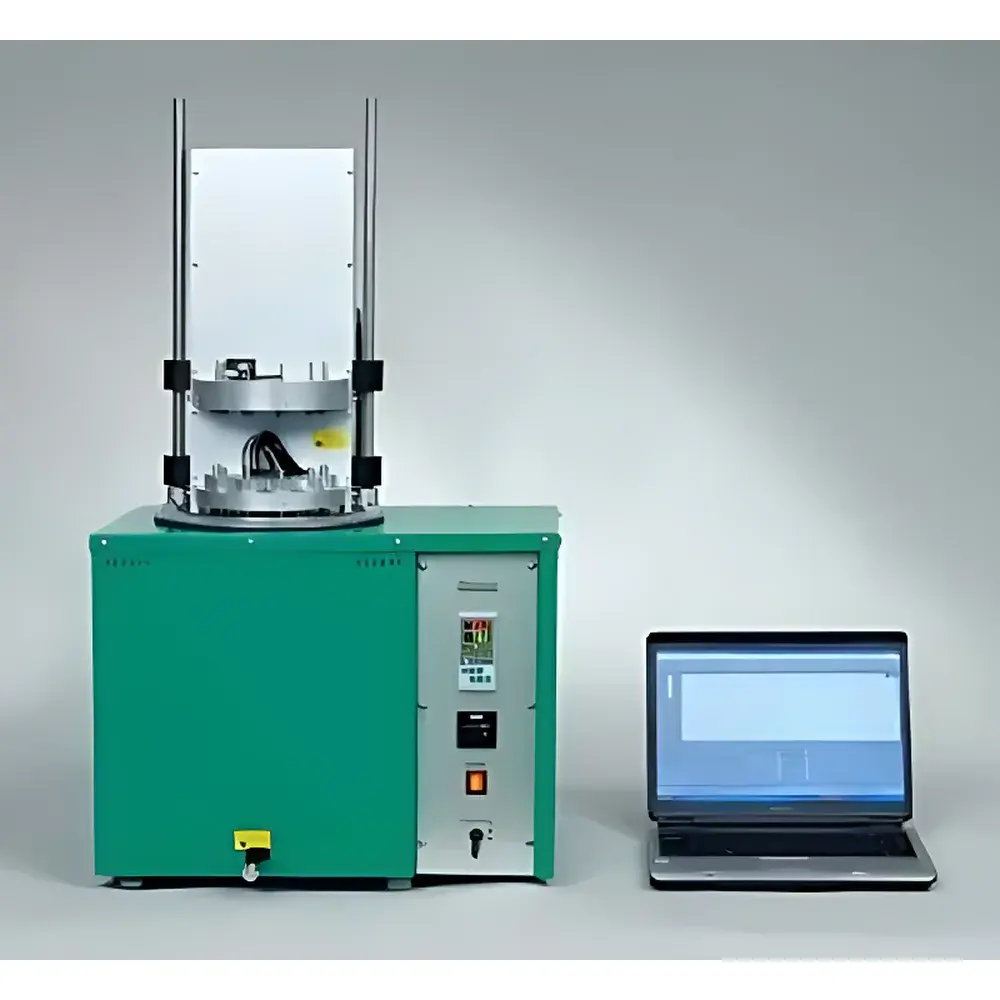
Elastocon ET 02II Cryogenic Gimm Test Instrument
| Brand | Elastocon |
|---|---|
| Origin | Sweden |
| Model | ET 02II |
| Standards Compliance | ISO 1432, ASTM D1053 |
| Test Stations | 6 independent automated stations |
| Temperature Control | Computer-regulated ramp (–70 °C to +100 °C, optional LN₂ cooling) |
| Output Parameters | RM2, RM5, RM10, RM100 torsional rigidity indices |
| Data Presentation | Real-time graphical curves + tabular export |
| Software | Windows-based control & analysis suite with audit trail capability |
Overview
The Elastocon ET 02II Cryogenic Gimm Test Instrument is a precision-engineered system designed for the standardized determination of low-temperature torsional rigidity in vulcanized rubber and thermoplastic elastomers. It implements the Gimm test principle — a dynamic torsional deflection method where a cylindrical specimen is subjected to controlled angular displacement under defined thermal conditions, and the resulting torque response is measured to quantify material stiffness as a function of temperature. This method directly correlates with low-temperature flexibility, cold crack resistance, and serviceability of elastomeric components in automotive, aerospace, and sealing applications. The instrument operates fully in accordance with ISO 1432:2015 (“Rubber — Determination of low-temperature stiffness — Gimm test”) and ASTM D1053 – 22 (“Standard Test Methods for Rubber Property—Stiffening at Low Temperatures”), ensuring regulatory acceptability in global quality assurance and R&D environments.
Key Features
- Six independent, parallel test stations enable high-throughput comparative evaluation of multiple specimens or compound variants under identical thermal profiles.
- Computer-controlled temperature ramping with ±0.3 °C stability across the operational range (–70 °C to +100 °C); optional integrated liquid nitrogen (LN₂) cooling module extends low-temperature capability and improves thermal equilibration time.
- Motor-driven torsional actuation with closed-loop angular position feedback ensures precise, repeatable application of twist angles (typically 2°, 5°, 10°, and 100°) per ISO/ASTM protocols.
- High-resolution torque transducers (0.001 mN·m resolution) capture dynamic response during both static hold and ramp phases, supporting calculation of RM2, RM5, RM10, and RM100 — normalized torsional modulus values expressed in millinewton-meters per degree (mN·m/°).
- Modular mechanical architecture with stainless-steel test chambers and corrosion-resistant fixtures ensures long-term dimensional stability and compliance with GLP laboratory infrastructure requirements.
Sample Compatibility & Compliance
The ET 02II accommodates standard cylindrical test specimens (diameter 6.0 ± 0.1 mm, length 25.0 ± 0.5 mm) prepared per ISO 1432 Annex A or ASTM D1053 Section 7. It supports both unvulcanized and vulcanized elastomer formulations, including NBR, EPDM, silicone, TPU, and thermoplastic vulcanizates (TPVs). All hardware and firmware are validated for conformance with ISO/IEC 17025:2017 general requirements for testing laboratories. Data acquisition and reporting modules support 21 CFR Part 11-compliant electronic signatures, user access levels, and immutable audit trails — essential for pharmaceutical-grade elastomer qualification and FDA-submitted analytical method validation packages.
Software & Data Management
The proprietary ET-Control software (v4.2+, Windows 10/11 compatible) provides full instrument orchestration: automated sequence programming, real-time multi-channel temperature/torque visualization, and post-test calculation of all required rigidity indices. Raw data (time-stamped torque vs. angle vs. temperature) is stored in .csv and vendor-neutral .tdms formats. Export functions include PDF reports with embedded metadata (operator ID, calibration certificate ID, environmental log), Excel-compatible summaries, and direct integration with LIMS via OPC UA or REST API. Calibration verification routines are traceable to NIST-certified torque and temperature standards; calibration intervals are logged and configurable per internal QA policy.
Applications
- Low-temperature performance screening of automotive weatherstrips, hose compounds, and bushings prior to climatic chamber validation.
- Formulation development of cold-resistant elastomers for arctic-grade seals and cryogenic gaskets.
- Quality control release testing of incoming raw materials and production batches against contractual RM100 limits.
- Failure analysis of field-return components exhibiting brittle fracture below specified service temperatures.
- Supporting ASTM D2137 and ISO 2231 low-temperature brittleness assessments through correlative rigidity trending.
FAQ
What sample dimensions are required for ISO 1432 compliance?
Standard specimens must be cylindrical with a diameter of 6.0 ± 0.1 mm and length of 25.0 ± 0.5 mm, cut perpendicular to extrusion or molding direction.
Can the ET 02II perform tests below –60 °C without liquid nitrogen?
No — mechanical refrigeration alone achieves a minimum of –60 °C; sub–60 °C operation requires the optional LN₂ cooling system.
Is the RM100 value calculated from extrapolated data or direct measurement?
RM100 is derived from direct torque measurement at 100° twist angle under stabilized thermal conditions — no interpolation or extrapolation is applied.
Does the system support multi-user permissions and electronic record retention for FDA audits?
Yes — software includes role-based access control (RBAC), electronic signatures, and audit-trail-enabled data archiving compliant with 21 CFR Part 11 Subpart B.
How frequently must torque transducers be recalibrated?
Annual recalibration is recommended; however, the system supports in-house verification using certified reference torque standards before each shift or test series.



