
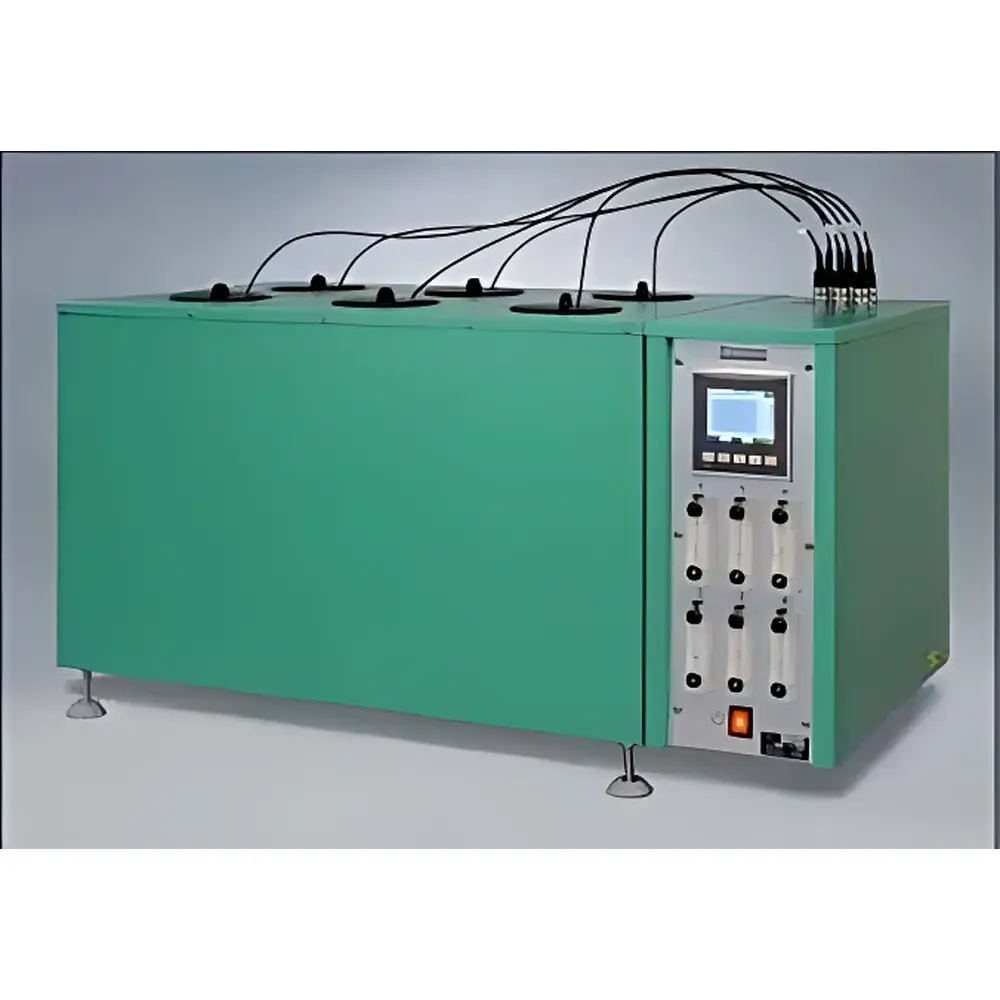
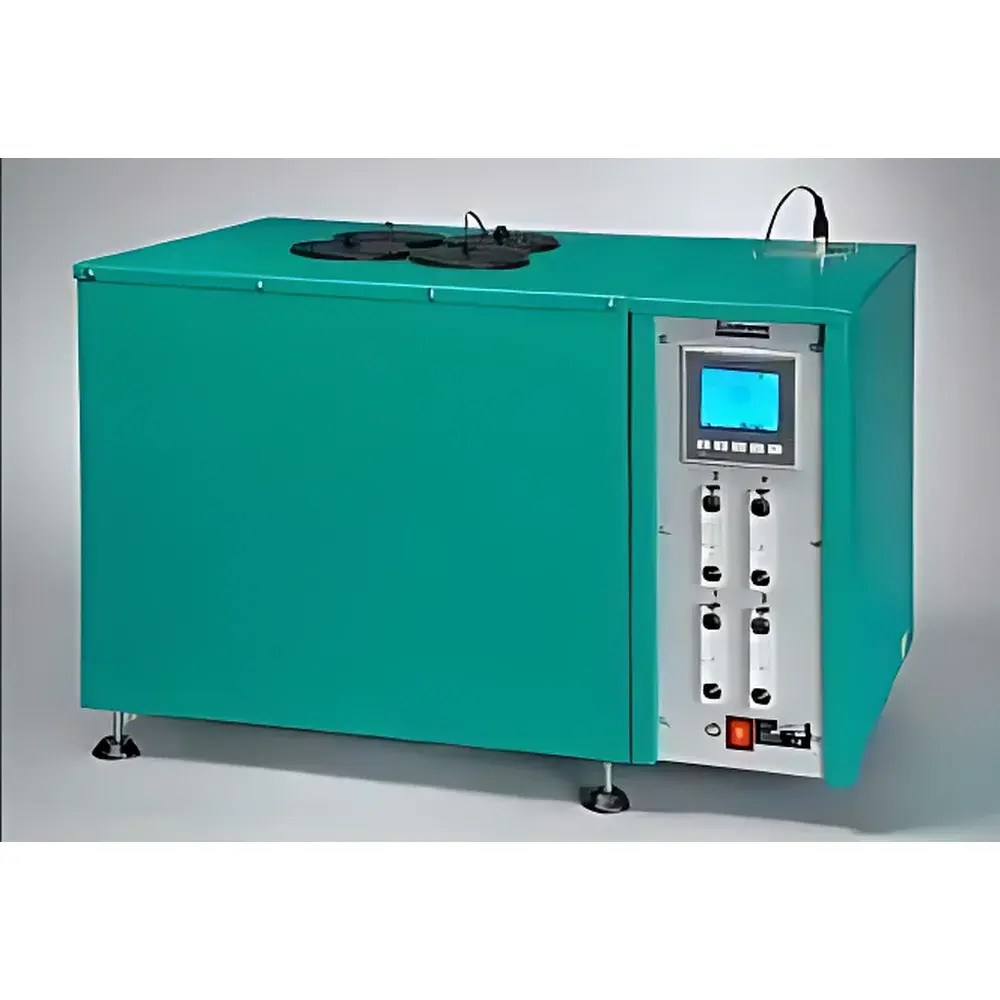
Elastocon EB 01-II High-Temperature Aging Test Chamber
| Brand | Elastocon |
|---|---|
| Origin | Sweden |
| Model | EB 01-II |
| Max Operating Temperature | 300 °C |
| Chamber Configuration | 4 identical-temperature zones |
| Sample Capacity | 24 standard specimens per chamber |
| Temperature Uniformity | ±0.5 °C |
| Heating Method | Channelled aluminum block preheating |
| Airflow | Natural convection, low-velocity, no forced circulation |
| Compliance | IEC 60811-1-2, ISO 188, ASTM D573 |
| Software Interface | PC-connected, wireless data acquisition via laser-guided arm and digital calipers |
Overview
The Elastocon EB 01-II is a precision-engineered high-temperature aging test chamber designed specifically for accelerated thermal aging of elastomeric and polymeric materials—particularly cable insulation and jacketing compounds—under strictly controlled, standards-compliant conditions. Based on the fundamental principle of oxidative degradation kinetics, the EB 01-II maintains stable thermal environments where material property changes (e.g., tensile strength loss, elongation reduction, hardness shift) are induced reproducibly over defined exposure durations. Its architecture follows the core requirements of IEC 60811-1-2 (formerly IEC 811) and ISO 188 for rubber and plastic electrical insulating materials, ensuring traceable, inter-laboratory comparable results. Unlike conventional ovens with turbulent airflow, the EB 01-II operates via natural convection only, eliminating localized hot/cold spots and minimizing thermal stress gradients across specimens. This design supports accurate Arrhenius-based lifetime prediction modeling in quality control and R&D laboratories.
Key Features
- Four independently isolated but identically temperature-controlled chambers—enabling parallel testing of multiple material batches or formulations under identical thermal conditions.
- Dual redundant temperature sensing system: one sensor regulates chamber setpoint; a second, calibrated sensor is positioned adjacent to specimen holders to monitor actual sample-zone temperature—fulfilling ISO 188 Annex A and IEC 60811-1-2 Clause 8.2 requirements for proximity verification.
- Aluminum block heating architecture with internal air channels ensures rapid thermal equilibration and exceptional stability—achieving ≤ ±0.5 °C uniformity across all active zones during steady-state operation at up to 300 °C.
- Top-access loading port minimizes thermal disturbance: specimens are inserted vertically through an insulated aperture without opening the main door, preventing ambient air intrusion and maintaining thermal integrity throughout test cycles.
- Servo-driven specimen clamping mechanism eliminates mechanical vibration or positional drift during extended exposures—critical for dimensional stability during post-aging mechanical evaluation.
- Laser-guided movable arm enables precise alignment of wireless digital calipers and extensometers, supporting automated post-test measurement synchronization with laboratory information management systems (LIMS).
Sample Compatibility & Compliance
The EB 01-II accommodates standard dumbbell- or ring-shaped specimens per ISO 37, ISO 188, and IEC 60811-1-2 specifications. Each chamber holds up to 24 specimens on stainless-steel racks with non-reactive polymer-coated fixtures. The absence of internal fans and reliance on passive air exchange ensure compliance with “still-air” aging protocols mandated by ASTM D573, ISO 188 Method A, and IEC 60811-1-2. All units undergo factory calibration against NIST-traceable reference thermometers and include a full certificate of conformity. Optional IQ/OQ documentation packages support GMP/GLP-regulated environments, including 21 CFR Part 11–compliant electronic signatures and audit trail generation when paired with validated Elastocon software.
Software & Data Management
Elastocon’s proprietary aging control software provides real-time monitoring of chamber temperature profiles, elapsed exposure time, and event logging (e.g., door access, setpoint changes). Measurement data from wireless calipers and tensile testers is transmitted via Bluetooth 5.0 and automatically mapped to preconfigured Excel-based templates aligned with ISO 188 Annex B and IEC 60811-1-2 reporting structures. Raw datasets—including timestamps, sensor IDs, and operator annotations—are stored in encrypted SQLite databases with SHA-256 hashing. Export options include CSV, PDF reports with embedded metadata, and direct LIMS integration via HL7 or REST API adapters. Audit trail functionality records all user actions, parameter modifications, and system events with immutable timestamps—meeting FDA and EU Annex 11 expectations for data integrity.
Applications
- Accelerated aging of cross-linked polyethylene (XLPE), ethylene propylene rubber (EPR), and thermoplastic elastomers used in power and communication cables.
- Validation of thermal endurance class (e.g., 90 °C, 105 °C, 125 °C, 150 °C) per IEC 60554-2 and UL 1581 Section 1200.
- Comparative oxidation resistance screening during polymer formulation development.
- Quality assurance testing for incoming raw materials and finished goods in wire & cable manufacturing.
- Supporting long-term aging studies required for IEEE 98 and ICEA T-28-533 certification submissions.
FAQ
Does the EB 01-II meet IEC 60811-1-2 requirements for “still-air” aging conditions?
Yes—the chamber uses zero forced convection and maintains air exchange rates below 0.5 volume changes per hour, satisfying Clause 8.1 of IEC 60811-1-2.
Can the four chambers operate at different temperatures simultaneously?
No—the EB 01-II features identical-temperature zoning; for independent multi-zone control, consider the EB 19 (4 zones) or EB 20 (6 zones).
Is calibration documentation included with shipment?
Each unit ships with a factory calibration certificate covering all four chambers and both sensor types, traceable to Swedish National Metrology Institute (RISE) standards.
What is the recommended maintenance interval for temperature sensor validation?
Elastocon recommends annual verification using a portable dry-block calibrator with ±0.1 °C uncertainty, documented per ISO/IEC 17025 procedures.
Can test data be exported directly into statistical process control (SPC) platforms?
Yes—CSV exports include ISO-aligned column headers and metadata tags compatible with Minitab, JMP, and SPC software suites.
Related Products



