
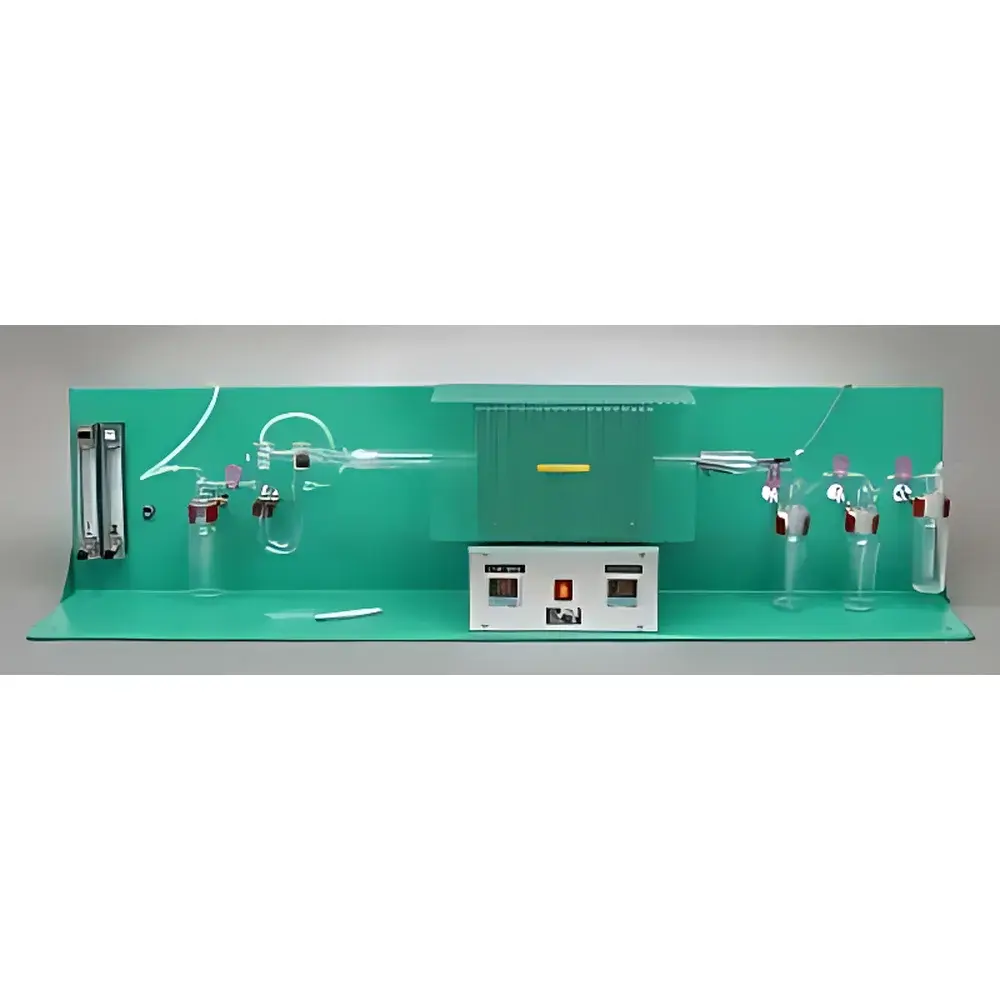
ELASTOCON ES 14 Tube Furnace for Polymer and Carbon Black Analysis
| Brand | ELASTOCON |
|---|---|
| Origin | Sweden |
| Manufacturer Type | Authorized Distributor |
| Origin Category | Imported |
| Model | ES 14 |
| Quotation | Upon Request |
| Temperature Range | 100–900 °C |
| Temperature Stability | ±10 °C |
| Thermocouple Types | Type N (controller), Type K (max temp sensor) |
| Tube Material | Fused quartz (quartz glass) |
| Heating Zone Dimensions | Ø25 × 200 mm |
| Overall Dimensions (W×D×H) | 350 × 275 × 355 mm |
| Net Weight | 22 kg |
| Voltage | 220–240 V, 1-phase, 50 Hz |
| Power Consumption | 500 W |
| Gas Flow Rate | 0.1–2 L/min |
| Included Accessories | Digital temperature controller, overtemperature safety limiter, drying tube, flowmeter, wash bottle, five fused quartz crucibles |
| Compliance | Designed for ISO 247, ISO 1408, ASTM D297, ASTM D1603 |
Overview
The ELASTOCON ES 14 Tube Furnace is a precision-engineered thermal analysis instrument specifically designed for standardized quantitative determination of carbon black content and ash residue in elastomeric and polymeric materials. It operates on the principle of controlled oxidative pyrolysis under regulated inert or oxidizing gas flow—enabling gravimetric analysis according to internationally recognized test protocols. The furnace employs a horizontal fused quartz tube configuration, ensuring uniform thermal distribution across a defined 200 mm heating zone and minimizing thermal gradients that could compromise analytical reproducibility. Its architecture supports both open-tube combustion (for ash determination per ISO 247) and controlled-air pyrolysis (for carbon black quantification per ISO 1408 and ASTM D297), with precise regulation of gas composition, flow rate, and dwell time critical to method fidelity.
Key Features
- Fused quartz reaction tube (Ø25 mm × 500 mm total length) with 200 mm active heating zone—chemically inert, thermally stable up to 900 °C, and resistant to halogenated byproducts generated during polymer decomposition.
- Dual thermocouple system: Type N thermocouple integrated into the digital temperature controller for process regulation; redundant Type K thermocouple for independent high-temperature monitoring and overtemperature cutoff at 950 °C.
- Integrated gas delivery subsystem including calibrated flowmeter (range 0.1–2 L/min), drying tube (filled with anhydrous calcium chloride or silica gel), and wash bottle—ensuring consistent moisture removal and gas purity prior to entering the reaction zone.
- Robust stainless steel housing with powder-coated steel frame and borosilicate glass viewing port—designed for laboratory durability and operator visibility without thermal shielding compromise.
- Energy-efficient 500 W resistive heating element with PID-controlled power modulation—minimizing overshoot and supporting stable operation within ±10 °C of setpoint across the full 100–900 °C range.
- Supplied with five high-purity fused quartz crucibles (each ~30 mL capacity)—certified low in metallic impurities to prevent interference in trace ash analysis.
Sample Compatibility & Compliance
The ES 14 is validated for use with vulcanized rubber compounds, thermoplastic elastomers, polyolefin-based plastics (e.g., PE, PP), and carbon-black-reinforced composites. Its geometry and thermal profile comply with the dimensional and procedural constraints specified in ISO 247 (rubber ash), ISO 1408 (rubber carbon black), ASTM D297 (rubber—carbon black and ash), and ASTM D1603 (carbon black in olefin plastics). The furnace’s gas flow control and crucible positioning meet the requirements for reproducible volatilization kinetics and complete oxidation of organic matrix without splattering or incomplete residue formation. All components contacting sample or effluent gases are non-reactive and do not contribute measurable ash—supporting GLP-aligned documentation and audit readiness.
Software & Data Management
The ES 14 operates via a dedicated digital temperature controller with manual setpoint adjustment and real-time display of actual temperature. While the base unit does not include PC connectivity or data logging firmware, its analog output signal (0–10 V or 4–20 mA, configurable) is compatible with external chart recorders, PLCs, or SCADA systems used in quality control laboratories operating under FDA 21 CFR Part 11 or ISO/IEC 17025 frameworks. Users may integrate third-party data acquisition modules to capture time-stamped temperature profiles, gas flow logs, and operator annotations—enabling full traceability for regulatory submissions or internal method validation reports.
Applications
- Quantitative carbon black content determination in tire treads, conveyor belts, and industrial rubber goods per ISO 1408 and ASTM D297.
- Residual ash analysis of rubber compounds for filler verification and contamination screening (ISO 247).
- Method development and validation for polymer degradation studies requiring controlled pyrolysis atmospheres.
- QC testing of carbon-loaded polyethylene pipes and cable sheathing materials (ASTM D1603).
- Supporting R&D workflows in compounding labs where batch-to-batch consistency of reinforcing filler loading must be verified gravimetrically.
FAQ
What standards does the ES 14 support out-of-the-box?
It is configured and validated for ISO 247, ISO 1408, ASTM D297, and ASTM D1603—no hardware modification is required.
Can the furnace be used under nitrogen or argon atmosphere?
Yes—the gas inlet accepts any dry, non-corrosive gas; inert atmosphere operation is supported with appropriate flow calibration and purge timing.
Is the quartz tube replaceable, and what is its typical service life?
The fused quartz tube is a field-replaceable component; under proper thermal cycling and mechanical handling, expected lifetime exceeds 500 cycles at ≤850 °C.
Does the system include calibration documentation?
A factory calibration certificate for the temperature controller and flowmeter is provided; users are responsible for periodic in-house verification per ISO/IEC 17025 or internal SOPs.
What maintenance is recommended for long-term accuracy?
Quarterly inspection of thermocouple integrity, flowmeter zero drift, and quartz tube surface etching; annual recalibration of controller against NIST-traceable reference sources is advised.





