
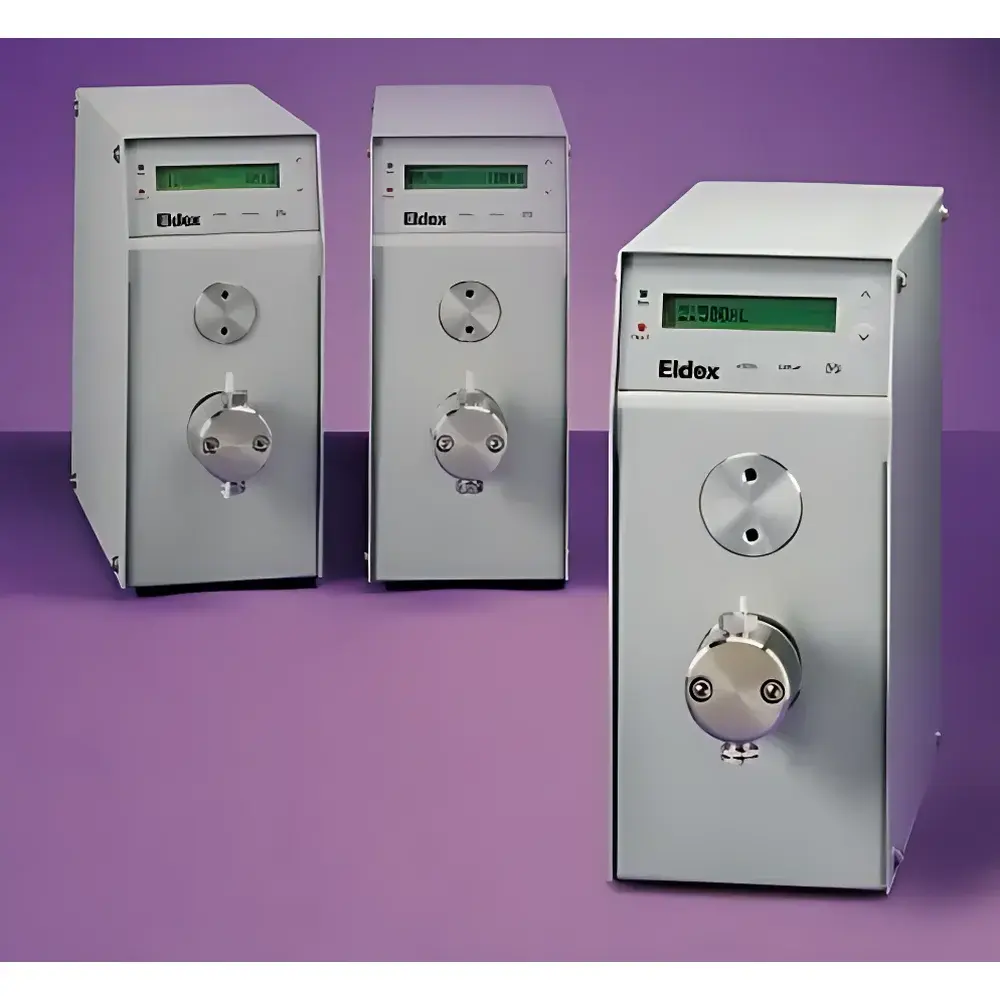
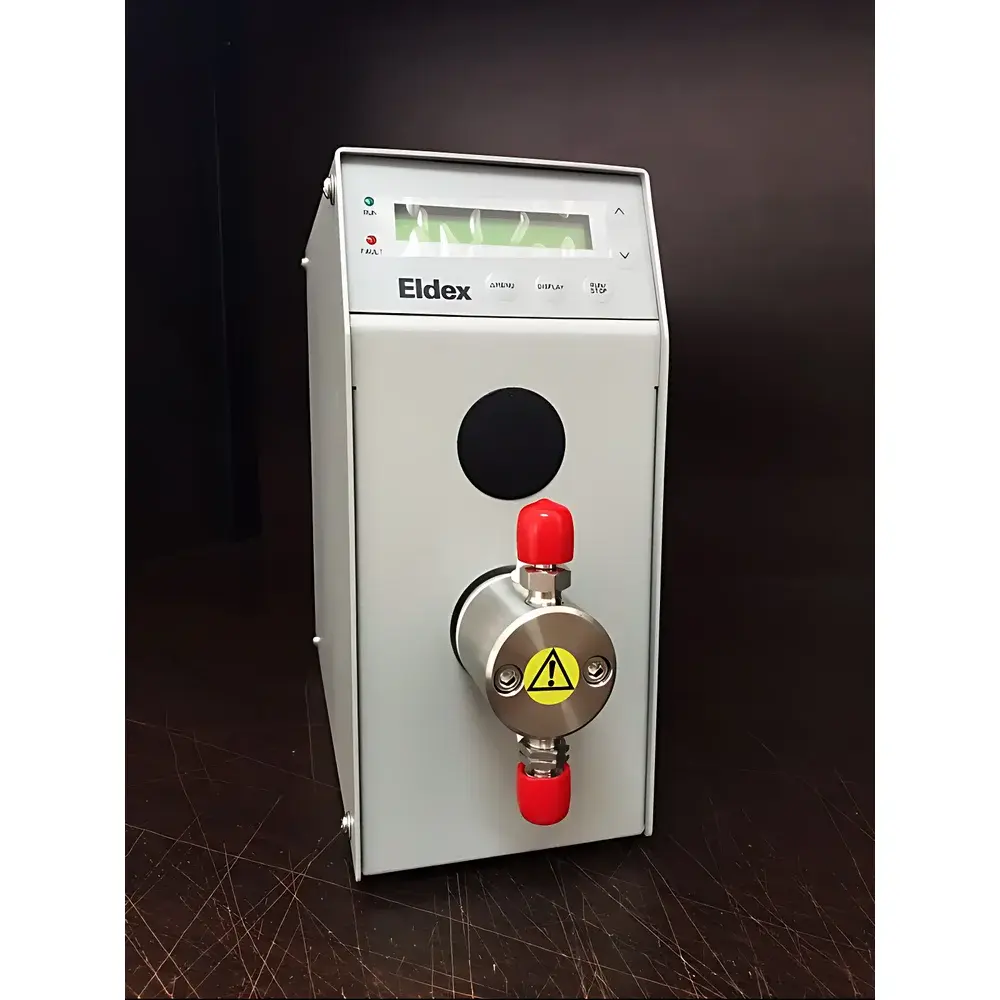
Eldex Optos 3HM High-Pressure Constant Flow Piston Pump
| Brand | Eldex |
|---|---|
| Model | 3HM |
| Max Flow Rate | 10 mL/min |
| Max Pressure | 6000 psi (414 bar) |
| Fluid Viscosity Range | up to 500 cP |
| Temperature Range | up to 120 °C |
| Repeatability | ±0.3% |
| Inlet/Outlet | 1/8" Swagelok |
| Power Supply | 100–230 VAC, 50/60 Hz, 80 W |
| Dimensions (W×H×D) | 10 × 23 × 24 cm |
| Weight | 5.3 kg (standard), 6.4 kg (with pulse dampener) |
| Control Interface | Analog (0–5 V, 4–20 mA), RS232 |
| Piston Material | Polyethylene (PE) |
| Plunger Tip | Sapphire |
| Housing Material | 316 Stainless Steel |
| Integrated Piston Wash System | Yes (20% methanol in deionized water) |
Overview
The Eldex Optos 3HM is a high-precision, high-pressure constant flow piston pump engineered for demanding laboratory and analytical applications requiring stable, pulse-minimized fluid delivery under elevated pressure conditions. Based on positive displacement volumetric pumping principles, the 3HM utilizes a sapphire-tipped plunger actuated by a high-resolution stepper motor, ensuring consistent volumetric displacement per stroke and minimal flow pulsation. Its robust 316 stainless steel housing provides corrosion resistance and mechanical stability, while the polyethylene (PE) piston and integrated piston wash system enable reliable operation with aggressive solvents and viscous media up to 500 cP. Designed for continuous duty cycles in HPLC, preparative chromatography, microfluidic systems, and chemical synthesis reactors, the 3HM delivers calibrated flow rates from 0.04 to 80 mL/min (model-dependent range; nominal operating range at full pressure is 0.04–10 mL/min at 6000 psi) with ±0.3% repeatability—meeting stringent requirements for method reproducibility in regulated environments.
Key Features
- High-pressure capability: Rated for continuous operation up to 6000 psi (414 bar), suitable for ultra-high-performance liquid chromatography (UHPLC) and high-backpressure reactor feed applications.
- Sapphire plunger tip and PE piston: Deliver exceptional wear resistance and chemical compatibility with organic solvents, acids, and bases—minimizing seal degradation and extending service intervals.
- Integrated piston wash system: Automatically flushes residual crystalline deposits from the piston seal interface using a 20% methanol/deionized water solution, significantly reducing maintenance frequency and improving long-term accuracy.
- Low-pulsation flow profile: Achieved via precision stepper motor control and optional pulse dampener (6.4 kg configuration), enabling stable delivery for sensitive detection systems and gradient mixing.
- Dual-mode control architecture: Supports local operation via intuitive front-panel LCD interface (flow/pressure display, RUN/STOP, setpoint adjustment) and remote programmability via analog signals (0–5 V DC or 4–20 mA) and ASCII-based RS232 commands.
- Thermal resilience: Certified for continuous fluid handling up to 120 °C, supporting high-temperature reaction monitoring and hot-injection protocols.
Sample Compatibility & Compliance
The 3HM accommodates a broad spectrum of process fluids—including aqueous buffers, acetonitrile, methanol, THF, DMSO, and moderately viscous polymer solutions—without compromising flow integrity. Its wetted materials (316 SS, PE, sapphire, PTFE seals) comply with USP Class VI biocompatibility standards and exhibit low extractables per ASTM D4292. The pump’s mechanical design conforms to IEC 61010-1 safety requirements for laboratory equipment. While not inherently 21 CFR Part 11 compliant, its RS232 interface supports integration into validated systems where electronic audit trails, user access controls, and data integrity safeguards are implemented at the supervisory software layer (e.g., LabVIEW, custom SCADA). Calibration traceability aligns with ISO/IEC 17025 practices when performed using NIST-traceable flow meters and pressure transducers.
Software & Data Management
The 3HM operates as a stand-alone instrument or as a networked peripheral within automated workflows. Its RS232 protocol supports bidirectional communication for real-time status reporting (actual flow, pressure, fault codes) and dynamic parameter updates (flow setpoint, ramp profiles, dwell times). When integrated with third-party control platforms, the pump enables synchronized operation with detectors, fraction collectors, and temperature controllers. For GLP/GMP environments, raw operational logs—including timestamps, setpoints, and error events—can be captured externally and archived with metadata for audit readiness. No proprietary software is required; ASCII command sets are fully documented in the technical manual for seamless API development.
Applications
- HPLC and UHPLC mobile phase delivery, especially in methods requiring >400 bar backpressure.
- Preparative chromatography feed systems for scale-up purification of APIs and natural products.
- Controlled reagent addition in continuous-flow chemical synthesis reactors.
- Calibration fluid delivery in gravimetric and turbine-based flow meter validation rigs.
- Microreactor and organ-on-chip perfusion systems requiring precise, low-shear dosing.
- High-temperature solvent delivery in accelerated aging studies and catalytic testing.
FAQ
What is the maximum allowable viscosity for continuous operation?
The 3HM maintains rated pressure and repeatability with fluids up to 500 cP at temperatures ≤60 °C. For viscosities above 200 cP, reduced maximum flow rates and extended priming times are recommended.
Can the pump be used with corrosive solvents such as concentrated hydrochloric acid?
While the 316 SS housing and sapphire tip provide strong general corrosion resistance, prolonged exposure to halogenated acids is not advised. For such applications, consult Eldex’s chemical compatibility guide and consider optional PEEK-wetted variants (e.g., 2LIP model).
Is pulse dampening available as a factory-installed option?
Yes—the pulse-dampened configuration (6.4 kg unit) includes an integrated passive accumulator and is designated in ordering codes ending with “P” (e.g., 3HMP).
Does the pump support gradient programming?
No—gradient formation requires external blending hardware. However, the 3HM can be synchronized with multi-pump gradient controllers via RS232 handshaking signals.
What maintenance schedule is recommended for routine operation?
Piston wash cycles should be executed after each solvent change or every 8 operational hours. Seal replacement is typically required every 6–12 months under continuous use, depending on fluid aggressiveness and operating pressure.



