
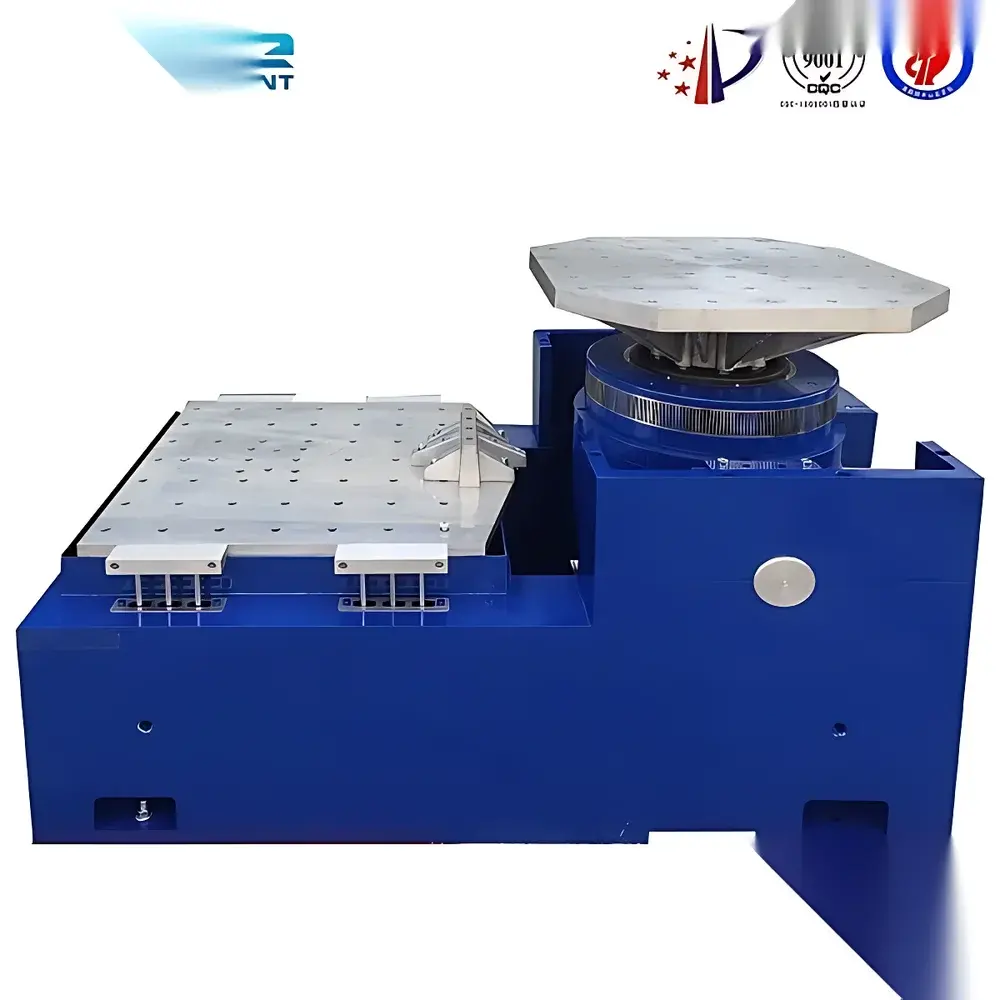
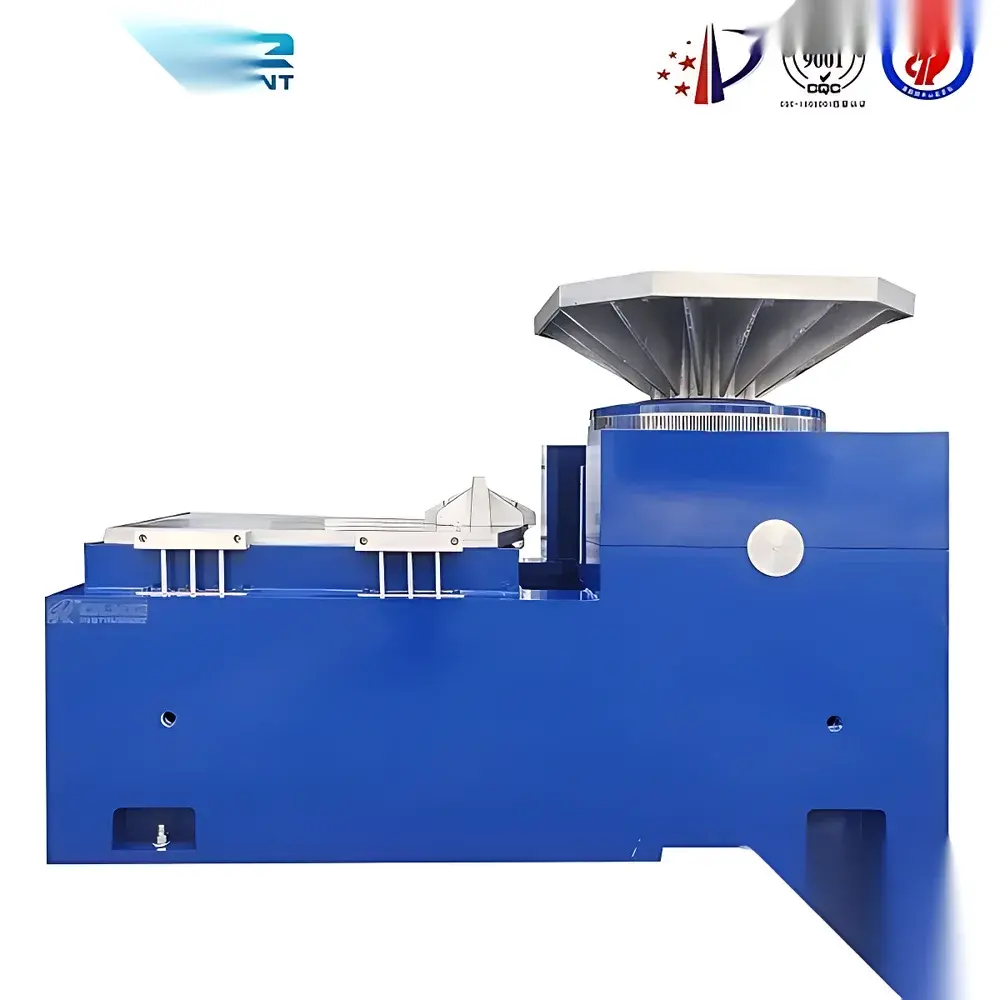
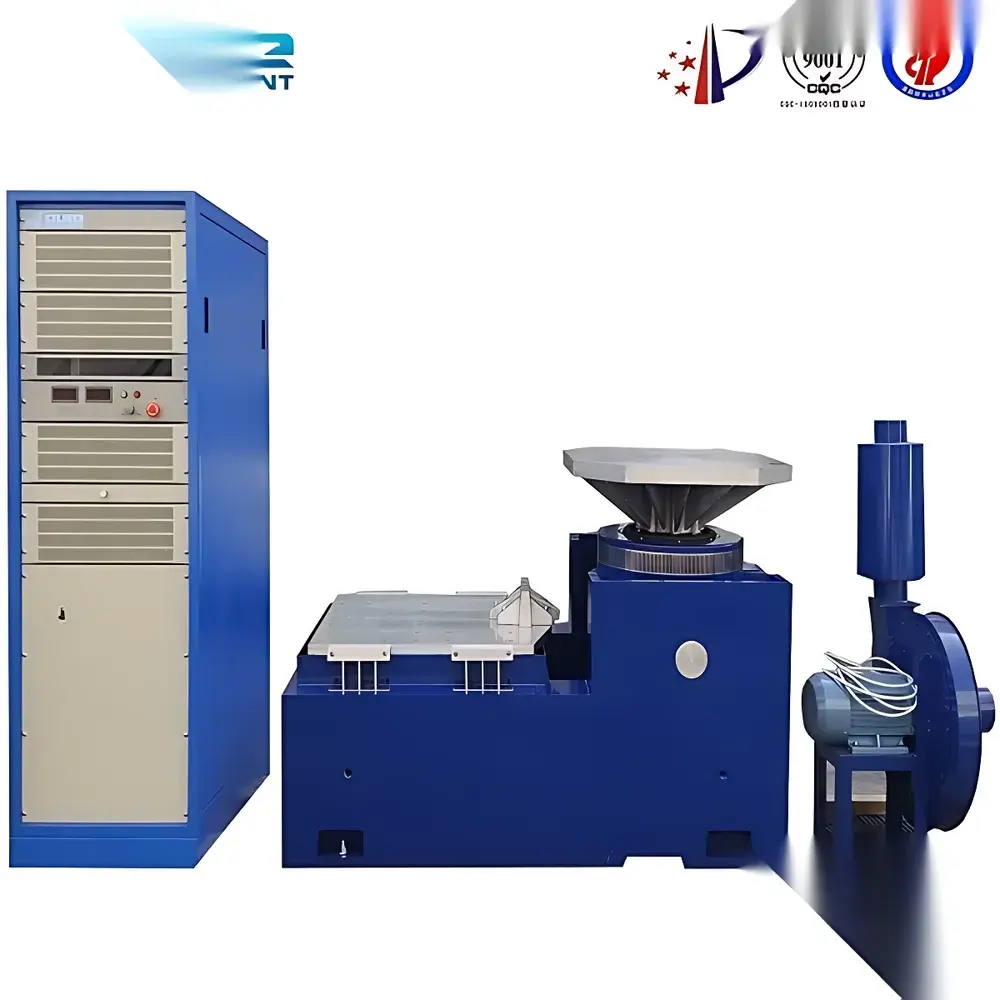
Electromagnetic High-Frequency Vibration Shaker System
| Brand | OEM / Custom-Built |
|---|---|
| Origin | Imported |
| Manufacturer Type | Authorized Distributor |
| Price | USD 21,500 (FOB) |
| Table Surface | 500 × 500 mm |
| Axis Configuration | Vertical + Horizontal Dual-Axis |
| Max. Payload | 50 kg |
| Frequency Range | 1–200 Hz |
| Adjustable Frequency Range | 1–200 Hz (continuous, stepless) |
| Sweep Mode | Programmable linear or logarithmic sweep between user-defined upper/lower limits (e.g., 10–60 Hz, duration 1 min) |
| Peak-to-Peak Displacement (unloaded) | 0–5 mm (amplitude varies with frequency |
| Timing Resolution | 1 s |
| Max. Timing Duration | 99 h 99 m 99 s |
| Drive Power | 2.2 kW |
| Input Voltage | 220 V ±10% AC, 50/60 Hz |
| Max. Current Draw | 5 A |
| Control Architecture | Decoupled controller-shaker design with isolated signal/power paths |
| Compliance | IEC 60068-2-6, ISO 10816-1, ASTM D999, MIL-STD-810H (vibration sections) |
Overview
The Electromagnetic High-Frequency Vibration Shaker System is a precision-engineered dual-axis electrodynamic shaker platform designed for laboratory-grade mechanical stress testing, product reliability validation, and modal analysis across aerospace, automotive, electronics, and packaging industries. Operating on the principle of Lorentz force actuation—where controlled current through voice-coil windings interacts with a permanent magnetic field to generate reproducible inertial excitation—the system delivers high-fidelity sinusoidal, random, and swept-sine waveforms across its full 1–200 Hz bandwidth. Its rigid 500 × 500 mm aluminum alloy table supports up to 50 kg payload while maintaining low harmonic distortion (<3% THD at 100 Hz, 2 g peak) and high transmissibility linearity. The decoupled architecture—physically separating the shaker body from the digital controller—minimizes electromagnetic interference (EMI), ensures signal integrity during long-duration tests, and meets stringent EMC requirements per CISPR 11 Class B.
Key Features
- Dual-axis excitation capability: Independent vertical and horizontal vibration modes enabled via orthogonal actuator mounting and synchronized real-time control firmware.
- Programmable sweep functionality: Linear and logarithmic sweep profiles with fully configurable start/stop frequencies, dwell times, and direction reversal logic (e.g., 10→60→10 Hz loop).
- Closed-loop amplitude regulation: Real-time displacement feedback via integrated non-contact eddy-current sensors enables consistent peak-to-peak displacement (0–5 mm) across the entire frequency range—even under variable load conditions.
- Energy-optimized controller design: Switch-mode power supply and adaptive current limiting reduce average power consumption by ≥60% versus conventional linear-amplifier-based systems, supporting continuous operation within standard 220 V / 5 A circuits.
- Modular mounting interface: Perimeter array of M6 threaded holes (25 mm pitch) enables rapid fixture integration without custom tooling; compatible with industry-standard slip tables and isolation bases.
- Plug-and-play installation: No structural anchoring or floor reinforcement required; operational on standard concrete slabs or raised lab flooring (vibration transmission <0.1 g at 2 m distance, per ISO 2631-2).
Sample Compatibility & Compliance
The system accommodates test specimens ranging from PCB assemblies and MEMS sensors to automotive ECUs and medical device enclosures. Payload distribution must remain within ±15 mm of table center to maintain axis orthogonality and minimize rocking moments. All hardware and firmware comply with IEC 60068-2-6 (sinusoidal vibration), ISO 10816-1 (machinery vibration severity), and ASTM D999 (shipping container testing). For regulated environments, optional audit-trail logging and user-access controls align with FDA 21 CFR Part 11 requirements when paired with validated PC-based acquisition software.
Software & Data Management
Supplied with Windows-compatible Vibration Control Suite v4.x, featuring intuitive graphical setup wizards for sweep, resonance search, and fatigue life estimation. The software supports IEEE 1588 PTP time synchronization, raw waveform export in HDF5 and CSV formats, and automated report generation compliant with GLP/GMP documentation standards. Optional MATLAB® and Python SDKs enable custom algorithm integration—including PSD shaping, SRS synthesis, and real-time FFT monitoring at 102.4 kHz sampling rate.
Applications
- Environmental stress screening (ESS) of electronic assemblies prior to burn-in.
- Vibration fatigue assessment of solder joints per IPC-J-STD-002 and JEDEC JESD22-B103.
- Resonance frequency mapping and damping ratio extraction for structural dynamics modeling.
- Package integrity validation under simulated transport conditions (ASTM D4169, ISTA 3A).
- Calibration traceability for accelerometers and force transducers per ISO 16063-21.
FAQ
What safety certifications does the shaker system carry?
It conforms to IEC 61000-6-2 (immunity) and IEC 61000-6-4 (emission), with CE marking and RoHS 3 compliance documented in the supplied Declaration of Conformity.
Can the system perform random vibration testing?
Yes—when configured with optional Random Control Module (RCM-200), it generates Gaussian-distributed acceleration spectra per ISO 10816-4 and MIL-STD-810H Method 514.7.
Is remote operation supported?
Ethernet (TCP/IP) and USB 2.0 interfaces enable full remote control, status monitoring, and firmware updates via secure TLS-encrypted connections.
What maintenance is required for long-term calibration stability?
Annual verification using NIST-traceable laser vibrometer and reference accelerometer is recommended; no routine lubrication or coil replacement is needed due to brushless electromagnetic actuation.
Does the controller support third-party DAQ integration?
Yes—IEEE 488.2 (GPIB), USBTMC, and Modbus TCP protocols are natively supported for synchronization with external data acquisition systems.



