
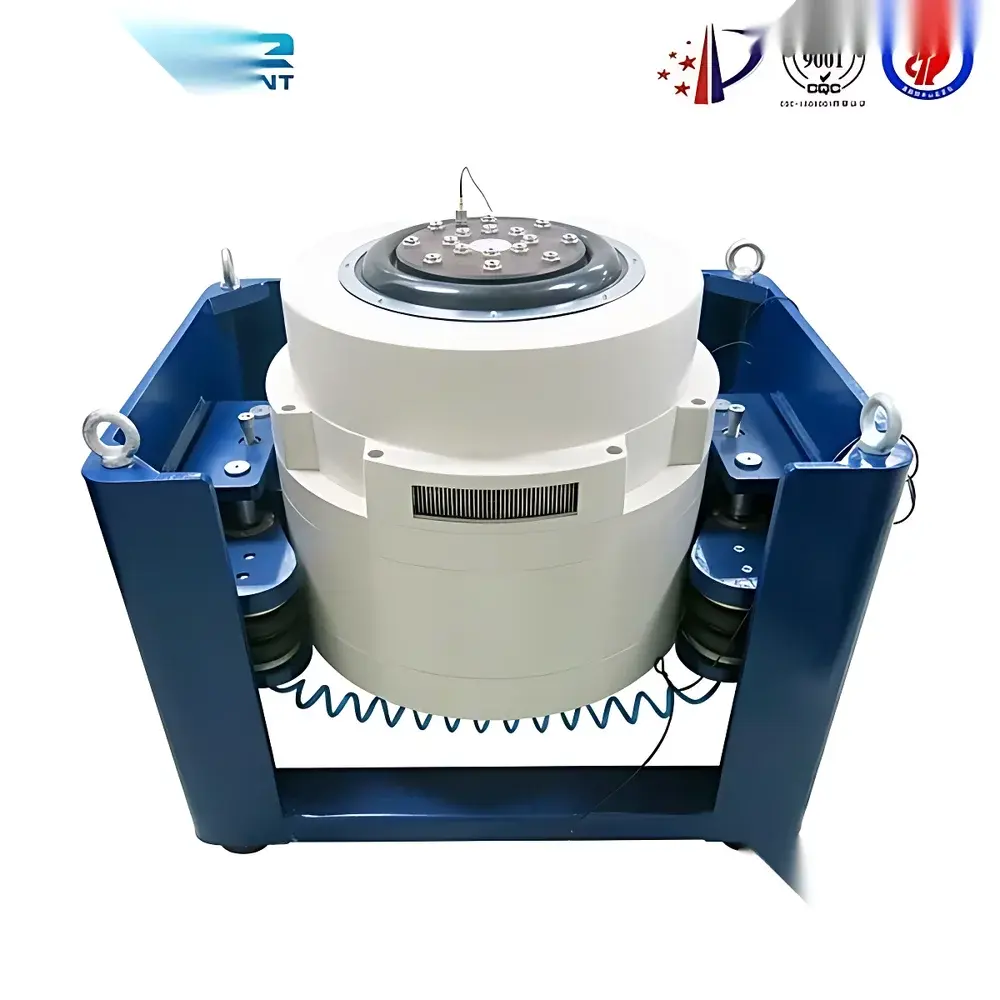
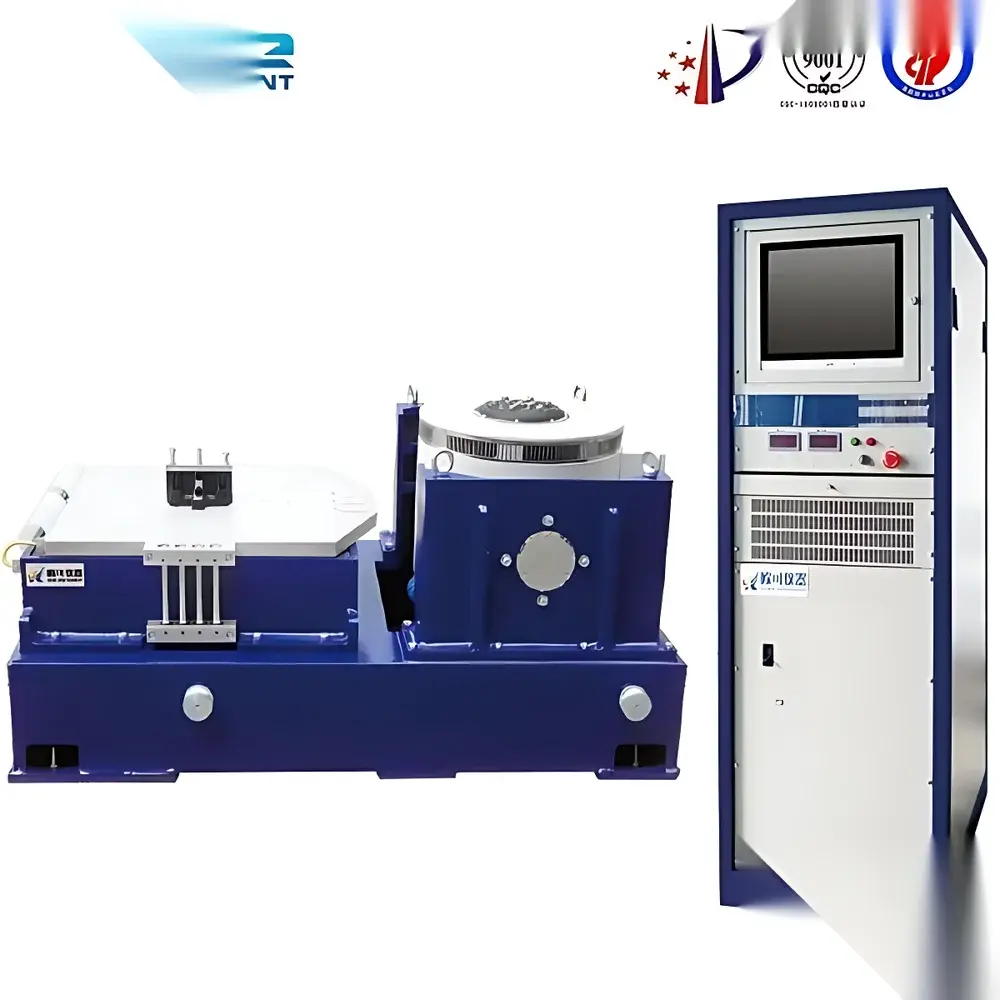
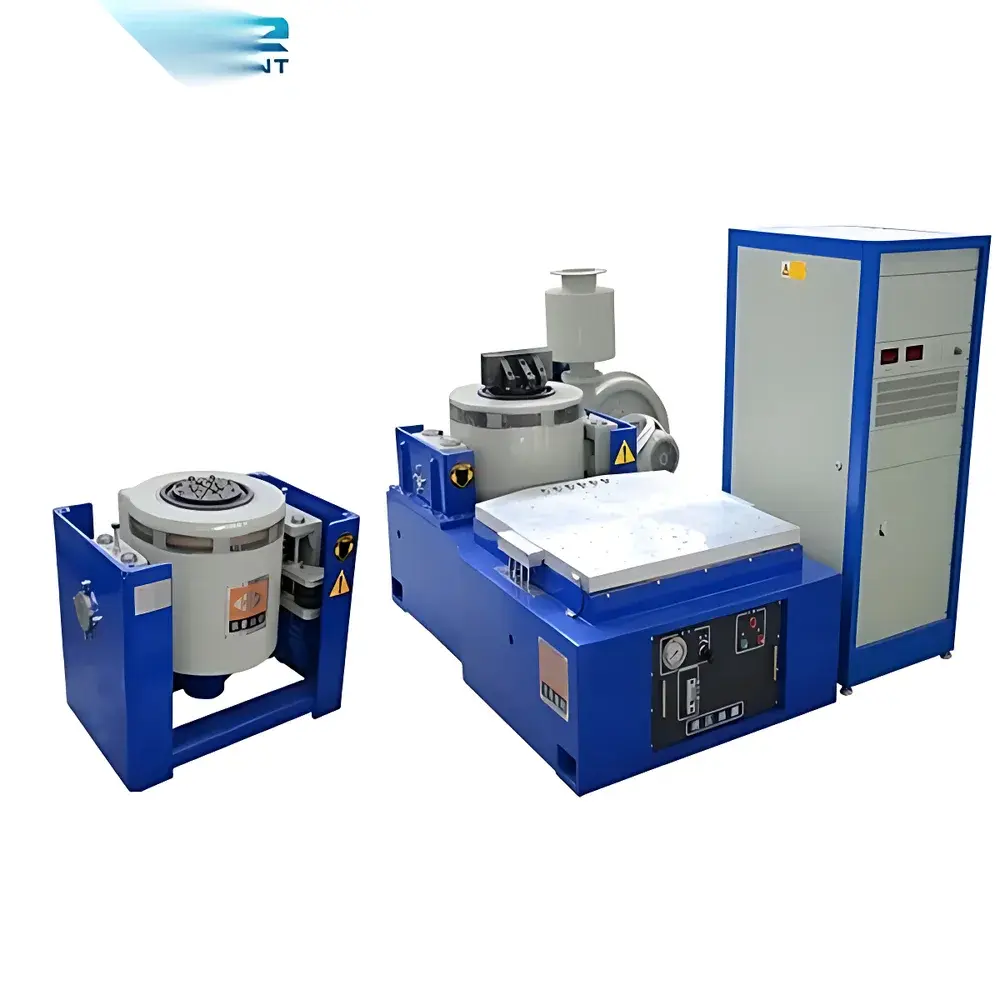
Electromagnetic Vertical-Horizontal Vibration Shaker System (1–200 Hz)
| Brand | Other Brands |
|---|---|
| Origin | Imported |
| Manufacturer Type | Authorized Distributor |
| Power Rating | 4.2 kW |
| Max Acceleration | 10 g |
| Frequency Range | 1–200 Hz (display resolution: 0.01 Hz, accuracy: ±0.1 Hz) |
| Adjustable Peak-to-Peak Displacement | 0–4 mm |
| Test Load Capacity | 40 kg |
| Table Dimensions (L×W×H) | 450 × 450 × 46 mm |
| Vibration Axes | Vertical and Horizontal |
| Waveform | Sine Only |
| Control Modes | Fixed-frequency, Sweep (up/down frequency + dwell time), Programmable (30 segments, each with user-defined frequency/time), Amplitude Modulation, Timer-based Termination |
| Magnetic Shielding | Magnesium-alloy table surface for electromagnetic field isolation |
| Input Voltage | 380 V ±10% AC, 3-phase |
| Compliance | GB/T 5170.14–1985, GB/T 10593.1–1989, GB/T 2423.10–1995 |
Overview
The Electromagnetic Vertical-Horizontal Vibration Shaker System is a precision-engineered electrodynamic shaker designed for standardized environmental vibration testing of electronic components, automotive modules, aerospace subassemblies, and industrial control units. Operating on the principle of Lorentz force actuation, the system generates controlled sinusoidal motion across a broad frequency spectrum (1–200 Hz) with high fidelity and minimal harmonic distortion. Its dual-axis capability—supporting both vertical and horizontal excitation—enables realistic simulation of multi-directional mechanical stress encountered during transportation, operational use, or qualification under regulatory environmental test profiles. The magnesium-alloy tabletop provides intrinsic magnetic shielding, ensuring electromagnetic compatibility (EMC) integrity during concurrent EMI/EMS testing or when evaluating magnetically sensitive devices such as Hall-effect sensors, MEMS accelerometers, or optical encoders.
Key Features
- Programmable multi-segment control: Up to 30 independent test segments per profile, each configurable with target frequency, dwell time, and amplitude—enabling complex duty-cycle replication (e.g., road-profile simulation, aircraft taxi-vibration sequences).
- High-fidelity sweep functionality: Linear and logarithmic sweep modes with fully adjustable upper/lower frequency bounds and sweep rate (Hz/min), compliant with ISO 10816 and IEC 60068-2-6 test requirements.
- Real-time waveform monitoring: Onboard digital oscilloscope interface displays live acceleration, displacement, and velocity waveforms—traceable to NIST-traceable calibration standards.
- Robust mechanical architecture: Rigid cast-iron base frame with low-resonance design ensures minimal structural coupling and stable performance at maximum rated load (40 kg).
- Integrated safety interlocks: Over-temperature, over-current, and displacement limit detection with automatic shutdown and fault logging in accordance with IEC 61000-4-27 and EN 61000-6-4.
Sample Compatibility & Compliance
The shaker accommodates samples up to 40 kg mounted on its 450 × 450 mm magnesium-alloy platform, which minimizes eddy-current interference and supports non-magnetic fixturing solutions. It meets national and international standards for vibration test equipment validation, including GB/T 5170.14–1985 (calibration methodology for sine vibration testers), GB/T 2423.10–1995 (test method Fc: vibration, sinusoidal), and GB/T 10593.1–1989 (vibration measurement procedures). While not certified to ASTM D999 or MIL-STD-810H out-of-the-box, the system is fully configurable to execute test protocols aligned with those specifications when paired with validated controller firmware and third-party calibration certificates.
Software & Data Management
The system operates via a Windows-based real-time control application supporting IEEE 1588 Precision Time Protocol (PTP) synchronization for multi-shaker coordination. All test parameters—including frequency sweeps, programmable profiles, and timer-based termination—are stored in encrypted binary logs with embedded metadata (operator ID, timestamp, calibration due date). Audit trails comply with GLP and GMP documentation requirements, including electronic signature support per FDA 21 CFR Part 11 when deployed with validated domain-authenticated network configuration. Raw acceleration data is exportable in CSV, UFF58, and MATLAB .mat formats for post-processing in MATLAB, Python (SciPy), or commercial FEA tools.
Applications
This vibration shaker is routinely deployed in QC laboratories for incoming inspection of PCB assemblies, in R&D departments for modal analysis of lightweight enclosures, and in certification labs conducting pre-compliance screening against IEC 60068-2-6 and automotive OEM specifications (e.g., GM W3177, Ford EMC-CS-2009.1). Typical use cases include resonance search and dwell testing, fatigue life estimation of solder joints, verification of mounting bracket stiffness, and validation of shock-and-vibration isolation systems. Its 10 g peak acceleration and 4 mm p-p displacement range make it suitable for both low-frequency endurance testing (e.g., shipping simulation at 5–10 Hz) and high-frequency resonance characterization (e.g., fan blade harmonics at 120–180 Hz).
FAQ
What is the maximum payload capacity for simultaneous vertical and horizontal excitation?
The rated 40 kg load applies to single-axis operation. For dual-axis synchronized testing, consult the dynamic load derating curve provided in the technical manual; typical derating is 25% at full amplitude above 80 Hz.
Does the system support closed-loop acceleration control?
Yes—when equipped with an externally mounted IEPE accelerometer and configured with optional feedback loop firmware, the controller maintains acceleration setpoints within ±0.2 dB across the 1–200 Hz band.
Is third-party calibration traceable to national metrology institutes available?
Calibration services with CNAS-accredited certificates (traceable to NIM, China) are offered as an add-on option; annual recalibration is recommended per ISO/IEC 17025 guidelines.
Can the magnesium table be replaced with an aluminum or steel alternative?
No—the magnesium alloy (AZ31B) is integral to the magnetic shielding specification; substitution voids EMC compliance and invalidates factory calibration.
What communication interfaces are supported for remote integration?
Standard Ethernet (TCP/IP), RS-232, and optional GPIB or EtherCAT interfaces enable integration into automated test stands and MES environments.



