
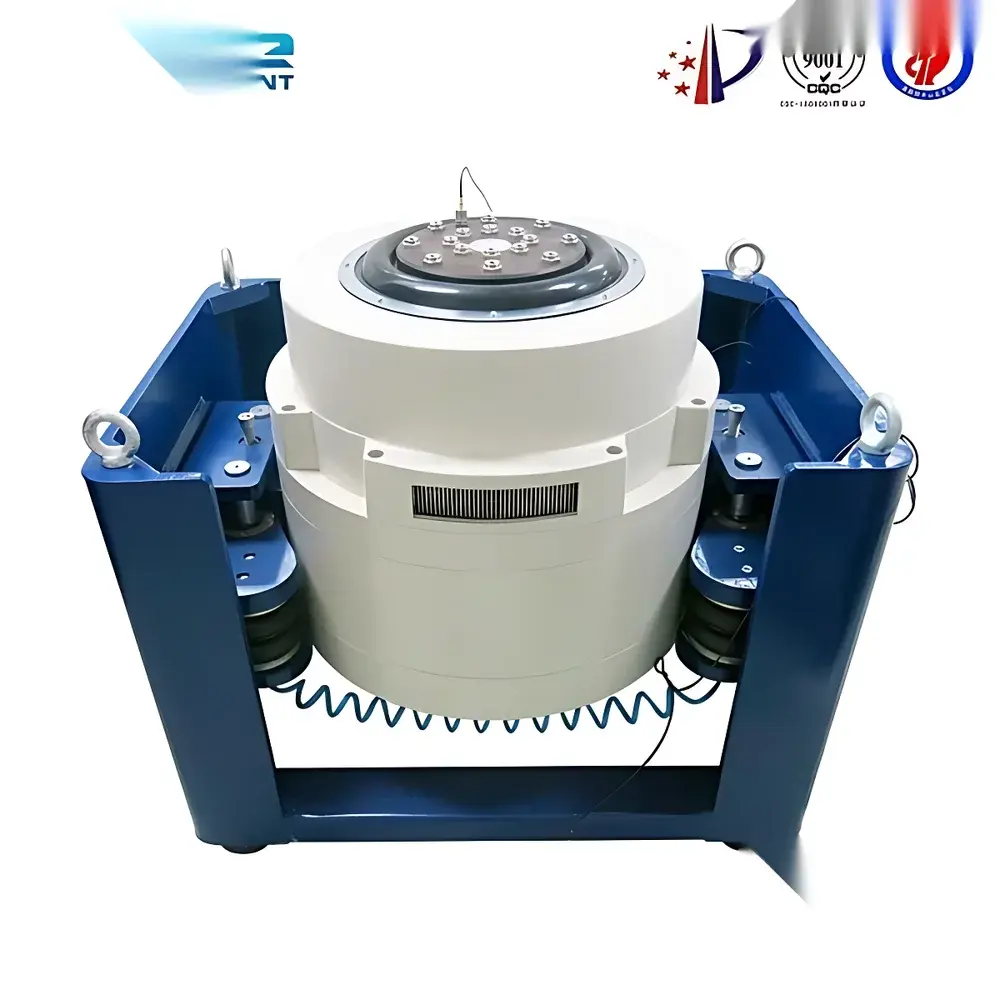
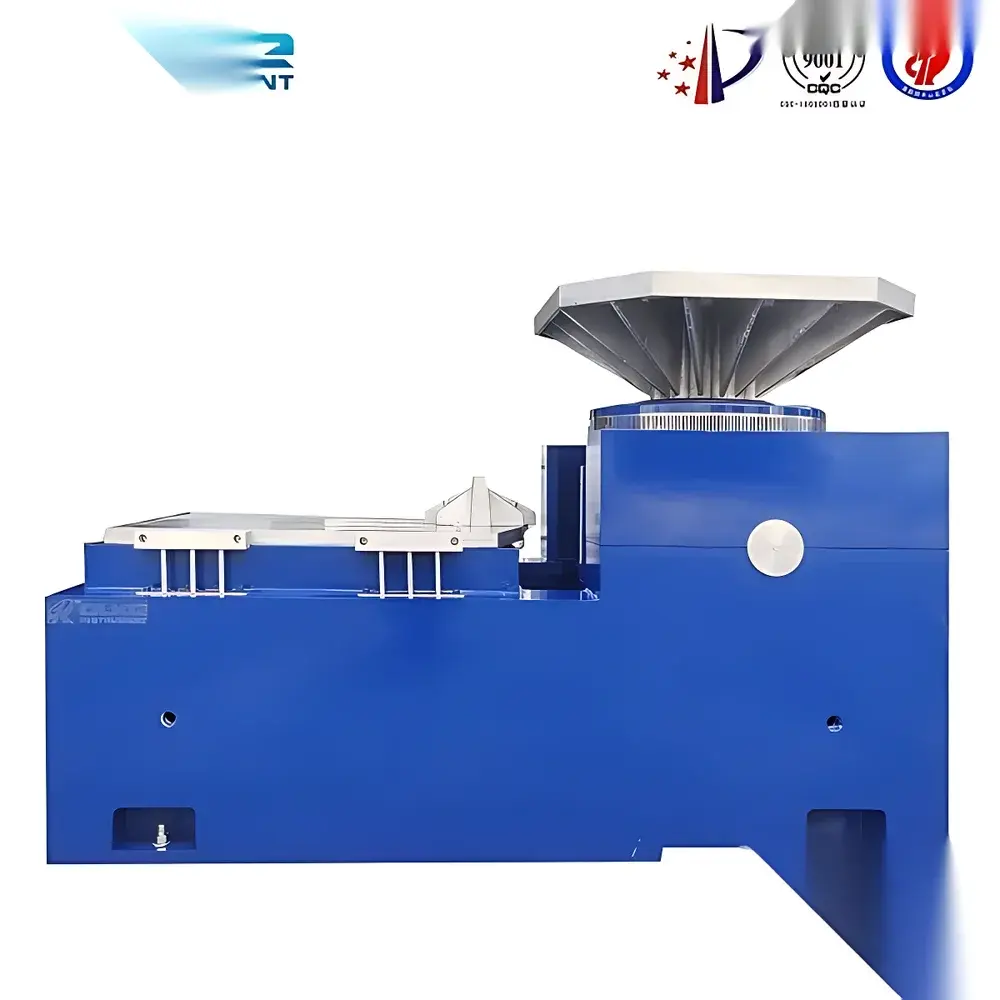
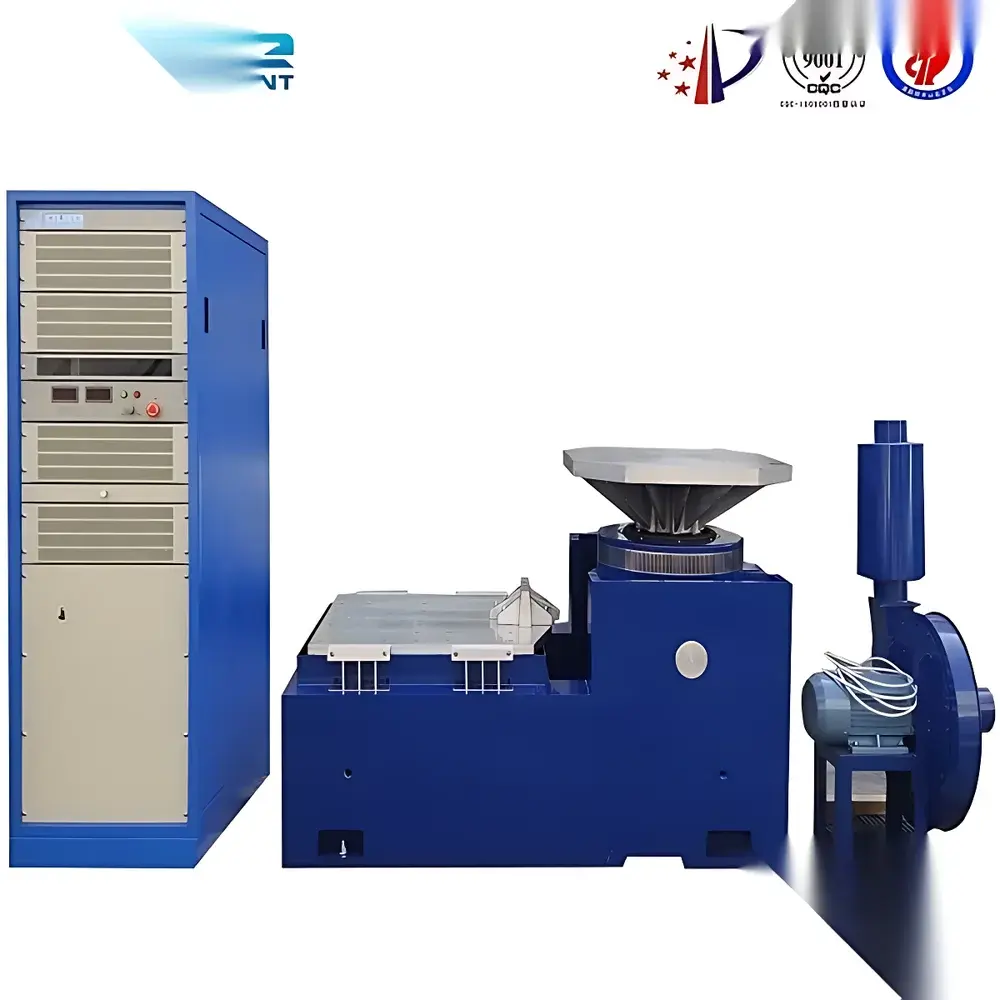
Electromagnetic Vertical-Horizontal Vibration Shaker System (1–200 Hz)
| Brand | OEM |
|---|---|
| Origin | Imported |
| Manufacturer Type | Authorized Distributor |
| Price | USD 13,800 (FOB) |
| Max Load Capacity | 40 kg |
| Table Dimensions (L×W×H) | 450 × 450 × 46 mm |
| Vibration Axes | Vertical & Horizontal |
| Frequency Range | 1–200 Hz (adjustable to 0.01 Hz resolution) |
| Acceleration Range | 10–750 m/s² |
| Peak-to-Peak Amplitude | 0–4 mm (continuously adjustable) |
| Waveform | Sinusoidal |
| Control Modes | Sine, Swept-Sine (up/down sweep), Programmable (30-segment, frequency/time per segment, loopable) |
| Power Input | 380 V ±10%, 4.2 kW |
| Magnetic Shielding | Magnesium-alloy tabletop for effective electromagnetic field isolation |
| Cooling | Integrated low-noise forced-air cooling system |
| Compliance | Designed to support ISO 10816-1, ISO 2041, ASTM D999, IEC 60068-2-6, and MIL-STD-810H vibration test profiles |
Overview
The Electromagnetic Vertical-Horizontal Vibration Shaker System (1–200 Hz) is a precision-engineered electrodynamic shaker platform designed for laboratory-grade mechanical shock and sinusoidal vibration testing of components, assemblies, and packaged goods. Operating on the principle of Lorentz force actuation—where current-carryed coils interact with a permanent magnetic field—the system delivers high-fidelity, repeatable acceleration profiles across its full operational bandwidth. Its dual-axis capability enables sequential or independent vertical and horizontal excitation, supporting standardized qualification protocols for electronics, automotive modules, aerospace subassemblies, and medical devices. The system is not a generic “shaking table” but a calibrated instrumentation-grade test apparatus, traceable to national metrology standards, with real-time feedback control architecture ensuring phase coherence, amplitude linearity, and spectral purity per ANSI/ISO harmonic distortion specifications.
Key Features
- Electrodynamic actuator with high-force-to-mass ratio and low moving mass armature, optimized for wide-bandwidth fidelity (1–200 Hz) and minimal harmonic distortion (<5% THD at rated load)
- Dual-axis configurable design: vertically oriented shaker base with optional horizontal slide table; both axes share identical control architecture and dynamic range
- 30-segment programmable controller with non-volatile memory, enabling complex multi-step test sequences (e.g., dwell → sweep → dwell → random burst) with user-defined frequency, amplitude, duration, and acceleration ramp rates per segment
- Digital PID-controlled frequency synthesis with 0.01 Hz display resolution and ±0.1 Hz long-term stability under thermal drift conditions
- Magnesium-alloy tabletop (450 × 450 × 46 mm) providing >40 dB magnetic field attenuation at 1 kHz, critical for EMI-sensitive DUTs such as MEMS sensors, RF modules, and MRI-compatible hardware
- Integrated anti-interference circuitry—including shielded cabling, optical isolation on I/O lines, and filtered power conditioning—to maintain signal integrity in electrically noisy lab environments
- Real-time waveform monitoring via embedded oscilloscope function; time-domain displacement, velocity, and acceleration traces exportable in CSV or MATLAB-compatible formats
- Passive vibration isolation base with elastomeric damping mounts, eliminating need for floor anchoring while maintaining <0.5 µm residual motion at idle
Sample Compatibility & Compliance
The shaker accommodates test specimens up to 40 kg with center-of-gravity height ≤150 mm above the table surface. Fixture interface conforms to ISO 5344 (threaded mounting holes: M6 × 1.0, 100 mm grid pattern). The system supports test execution per internationally recognized standards including ISO 10816-1 (vibration severity assessment), ISO 2041 (vibration and shock—vocabulary), ASTM D999 (shipping container vibration testing), IEC 60068-2-6 (sinusoidal vibration), and MIL-STD-810H Method 514.8 (vibration exposure). All control firmware includes audit-trail logging compliant with GLP and FDA 21 CFR Part 11 requirements when operated with validated software configuration.
Software & Data Management
The system ships with Windows-based control software featuring intuitive GUI for test setup, live parameter monitoring, and post-test analysis. Software modules include FFT spectrum analyzer, transmissibility calculation, resonance search algorithm, and pass/fail threshold overlay against reference spectra. Raw data streams are timestamped and stored with metadata (operator ID, DUT ID, environmental conditions) in SQLite databases. Export options include IEEE-compliant .tdms, CSV, and HDF5 formats. Optional API integration (TCP/IP or USB CDC) enables automated test sequencing within LabVIEW, Python (PyVISA), or MATLAB environments.
Applications
- Qualification testing of PCBAs and solder joint reliability under resonant excitation
- Pre-shipment validation of consumer electronics packaging per ISTA 3A and ASTM D4169
- Vibration fatigue analysis of automotive ECUs, connectors, and sensor housings
- Resonance mapping and modal survey preparation for structural dynamics modeling
- Accelerated life testing of battery packs, where mechanical stress induces micro-fracture propagation in electrode layers
- EMC pre-compliance screening—verifying mechanical stability of shielding enclosures during simultaneous RF + vibration stress
FAQ
What is the maximum payload for horizontal-axis operation?
The rated 40 kg capacity applies to both vertical and horizontal configurations; however, for horizontal testing, center-of-gravity height must be ≤75 mm to ensure stability and avoid overturning moments.
Does the system include calibration certification?
Yes—each unit ships with a NIST-traceable factory calibration report covering acceleration sensitivity (mV/g), frequency response flatness (±0.5 dB from 5–150 Hz), and linearity error (<±1% FS). Annual recalibration services are available.
Can the shaker perform random vibration profiles?
This model is optimized for deterministic (sine, swept-sine, programmable) waveforms. For random vibration (PSD-based), a separate controller upgrade with dedicated DSP hardware is required.
Is remote operation supported over Ethernet?
Yes—standard Ethernet (RJ45) port enables full remote control, real-time data streaming, and firmware updates via secure TLS-encrypted connection.
What maintenance intervals are recommended?
Visual inspection every 200 operating hours; coil resistance and suspension compliance verification annually; bearing lubrication and thermal paste replacement every 3 years under continuous use.
Related Products



