
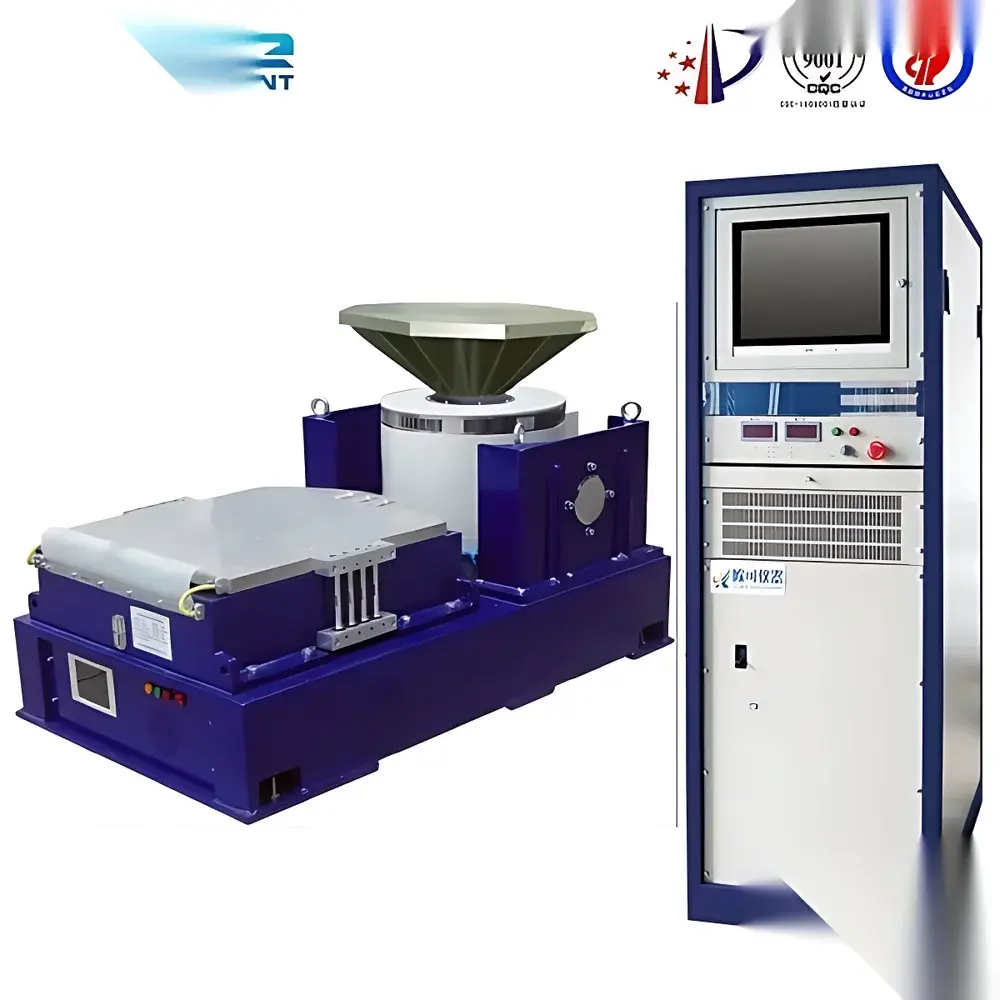
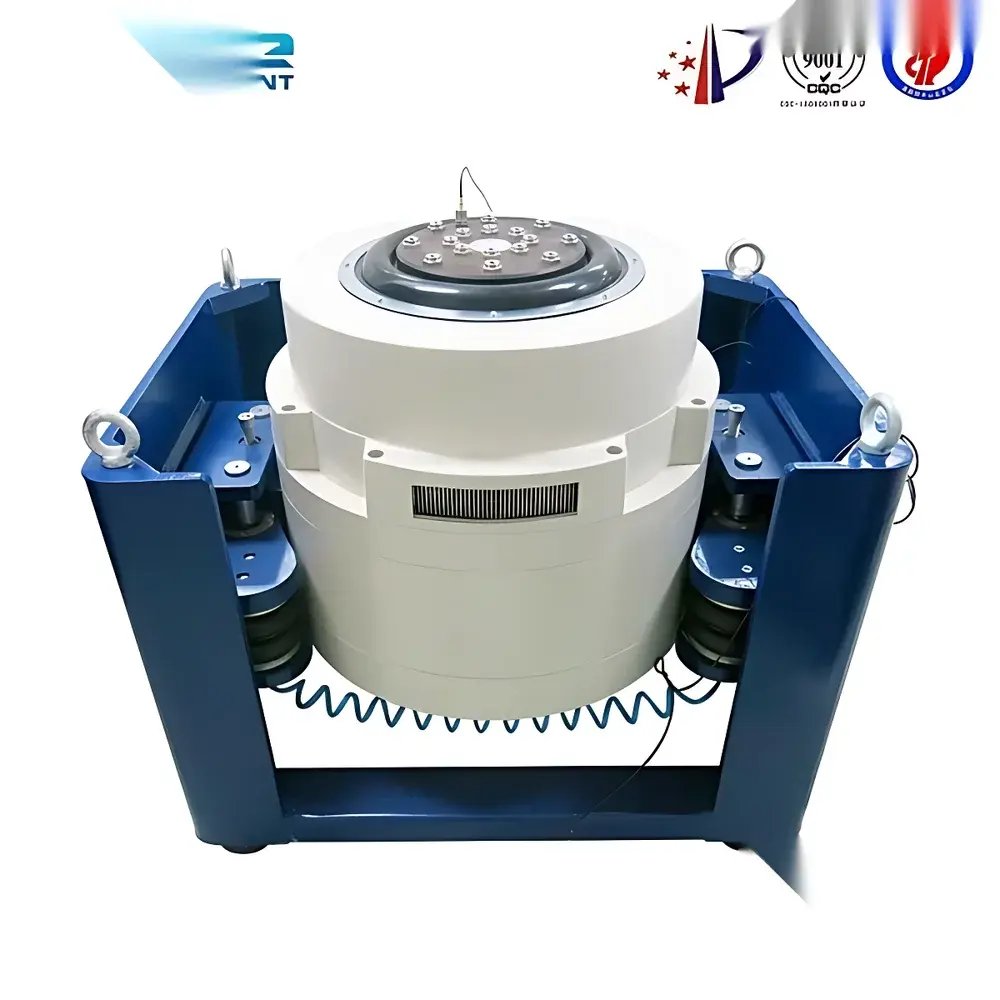
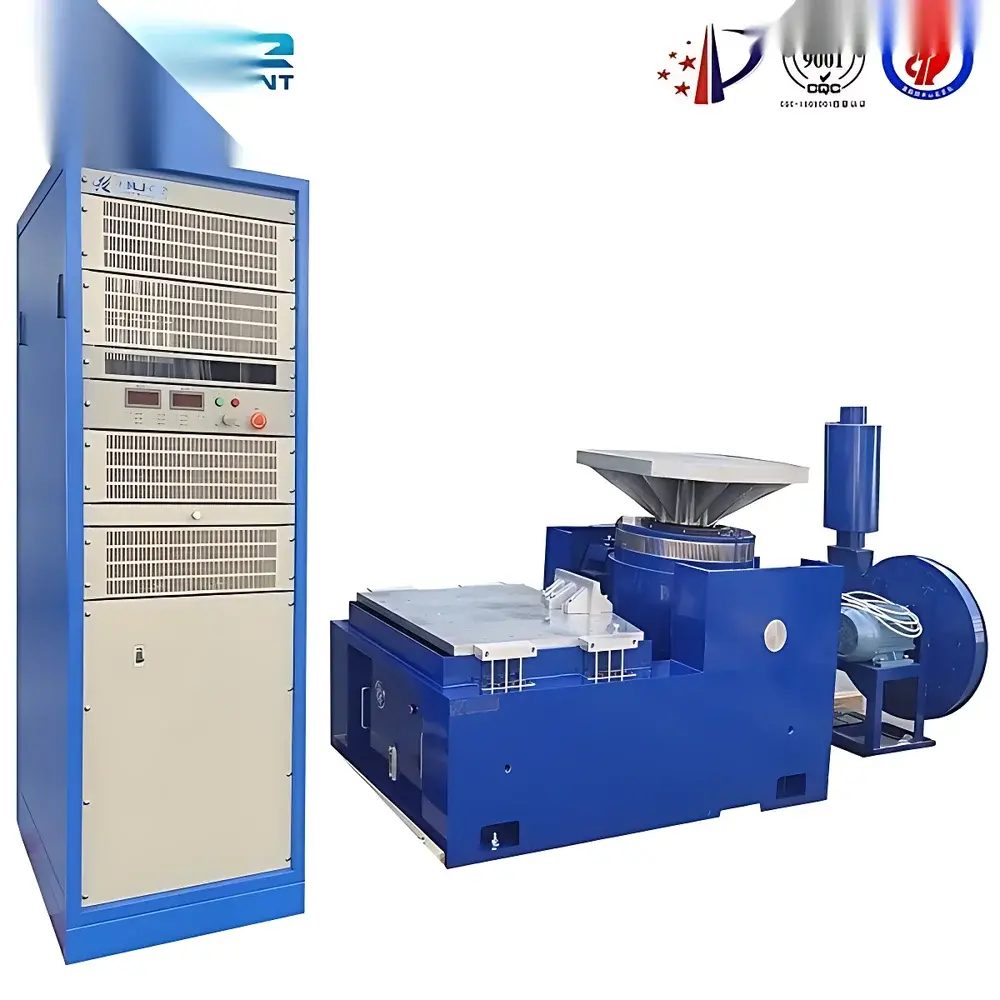
Electromagnetic Vertical Vibration Testing System
| Key | Brand: OEM/Third-Party Manufacturer |
|---|---|
| Origin | Imported |
| Supplier Type | Authorized Distributor |
| Max Load Capacity | 25–100 kg (configurable) |
| Frequency Range | 0.5–5000 Hz (±0.1% accuracy) |
| Displacement Peak-to-Peak | 0–5 mm |
| Max Acceleration | <20 g |
| Vibration Axis | Vertical (optional horizontal) |
| Waveform | Sinusoidal |
| Control Resolution | 0.01 Hz display, ±0.1 Hz precision |
| Timing Range | 0–9999 h/m/s (programmable) |
| Table Size | 350 × 350 mm (customizable) |
| Power Supply | AC 220 V / 380 V, 50 Hz |
| Compliance | GB/T 2423.10 |
Overview
The Electromagnetic Vertical Vibration Testing System is a precision-engineered electrodynamic shaker designed for controlled sinusoidal vibration stimulus in laboratory and industrial qualification environments. Based on electromagnetic force generation (Lorentz principle), it delivers repeatable, low-distortion acceleration profiles across a broad frequency spectrum—enabling rigorous mechanical stress evaluation of components and assemblies under simulated transport, operational, and environmental conditions. Unlike hydraulic or servo-mechanical exciters, this system offers high dynamic linearity, minimal thermal drift, and zero oil contamination risk—making it especially suitable for cleanroom-compatible applications, electronics reliability testing, and pre-compliance screening per international environmental stress standards.
Key Features
- Four-point synchronous electromagnetic excitation ensures uniform modal energy distribution across the 350 × 350 mm stainless-steel test table—minimizing nodal distortion and improving test repeatability.
- Programmable sweep and fixed-frequency modes support both resonant dwell and broadband profile testing; users can define multi-segment schedules (e.g., 10 Hz → 30 Hz → 10 Hz cyclic sweep, or sequential fixed-frequency holds with independent duration per step).
- Real-time amplitude prediction algorithm embedded in the controller enables rapid, non-iterative amplitude calibration—reducing setup time without compromising traceability.
- Digitally regulated current drive with active EMI suppression circuitry eliminates electromagnetic interference to external instrumentation and prevents static buildup on the table surface—critical for sensitive semiconductor packaging and MEMS device validation.
- High-resolution frequency control (display resolution: 0.01 Hz; accuracy: ±0.1 Hz) and programmable timing (0–9999 hours/minutes/seconds) support long-duration fatigue studies and accelerated life-cycle testing protocols.
- Selectable load capacity variants (25 kg, 50 kg, 75 kg, 100 kg) accommodate diverse DUT footprints and mass distributions while maintaining rated performance within specified stroke and acceleration limits.
Sample Compatibility & Compliance
This system accommodates rigid and semi-rigid specimens up to 100 kg—including printed circuit boards (PCBs), automotive ECUs, medical device housings, aerospace avionics modules, and consumer electronics enclosures. Its vertical-only or vertical + horizontal dual-axis configuration allows alignment with real-world loading vectors. The system conforms to GB/T 2423.10 (equivalent to IEC 60068-2-6) for sinusoidal vibration testing. While not certified to ISO 17025 as a standalone metrology instrument, its closed-loop feedback architecture supports GLP/GMP-aligned test documentation when integrated with compliant data acquisition systems. Optional mounting adapters and fixture design guidance are provided to maintain modal integrity during fixture-DUT coupling.
Software & Data Management
The system operates via an embedded real-time controller with USB/Ethernet interface and companion PC software supporting test definition, live monitoring, waveform logging, and post-test spectral analysis (FFT-based). All test parameters—including frequency, amplitude, duration, sweep rate, and dwell points—are stored with timestamped audit trails. Export formats include CSV and MATLAB-compatible .mat files. For regulated environments, optional 21 CFR Part 11 compliance packages provide electronic signature capability, user role-based access control, and immutable test record archiving—facilitating FDA, ISO 13485, or IATF 16949 audit readiness.
Applications
- Pre-shipment vibration qualification of automotive sensors and infotainment modules per ISO 16750-3.
- Resonance search and fatigue endurance assessment of PCB assemblies under thermal-vibration combined stress.
- Structural integrity verification of handheld medical devices subjected to repeated handling-induced shock and vibration.
- Design validation of MEMS accelerometers and gyroscopes using controlled low-g, high-frequency excitation.
- Material damping characterization through forced oscillation response at varying frequencies and amplitudes.
- Supplier qualification testing per customer-specific test plans (e.g., Apple Spec. 12345, Bosch VDA 238-101).
FAQ
What is the maximum usable frequency range for a 100 kg payload?
At full rated load (100 kg), the system maintains linear performance up to 2000 Hz. Extended-range models (up to 5000 Hz) are optimized for loads ≤50 kg to preserve displacement and acceleration fidelity.
Can the system generate random or shock waveforms?
No—this model is configured exclusively for sinusoidal excitation. Random vibration and classical shock testing require separate hardware configurations with dedicated controllers and amplifiers.
Is third-party calibration certification available?
Yes—traceable calibration reports per ISO/IEC 17025 are offered by accredited laboratories upon request, covering acceleration sensitivity, frequency response flatness, and displacement linearity across the operating band.
How is thermal stability maintained during extended tests?
The voice coil assembly incorporates forced-air cooling and temperature-sensing feedback to limit coil temperature rise to <35 °C above ambient over continuous 8-hour operation at 75% of max acceleration rating.
Does the system support remote operation and integration into automated test cells?
Yes—standard Ethernet TCP/IP and Modbus TCP protocols enable seamless integration with PLCs, MES platforms, and LabVIEW-based test orchestration systems.



