
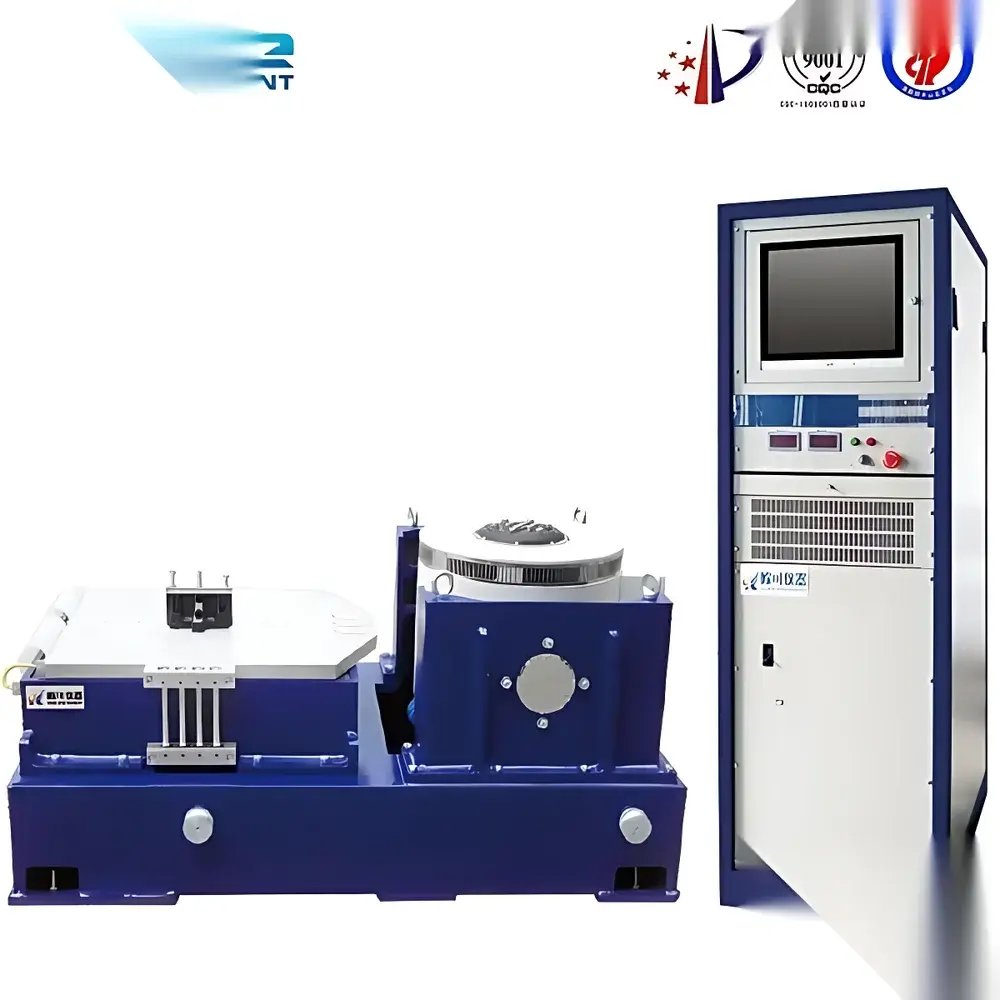
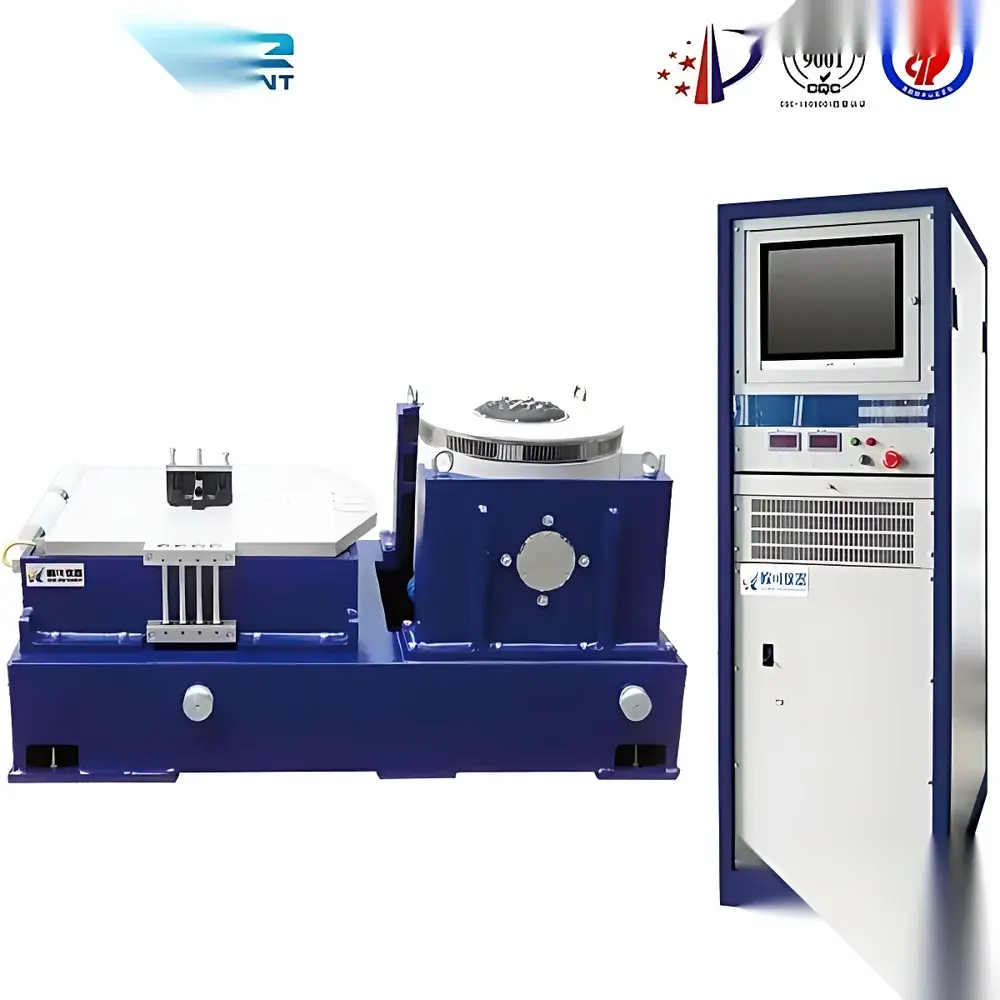
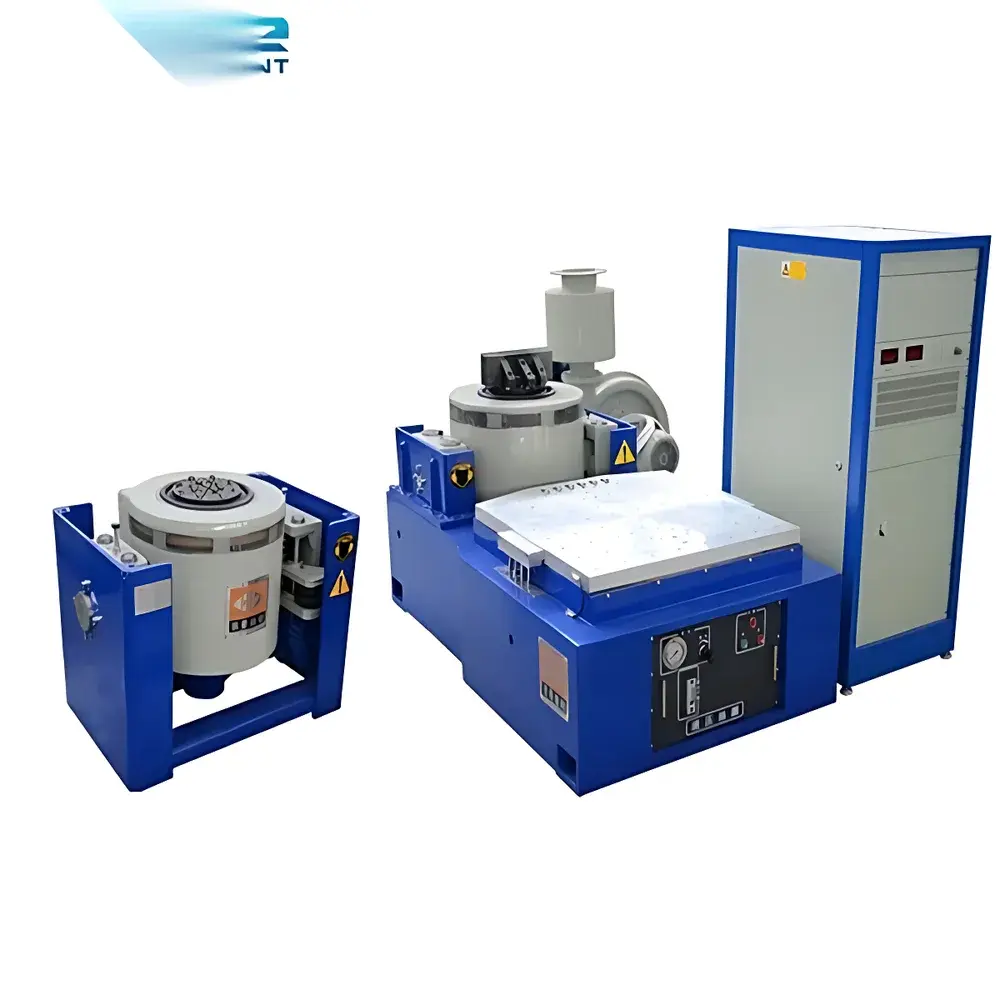
Electromagnetic Vibration Testing System
| Brand | Other Brands |
|---|---|
| Origin | Imported |
| Manufacturer Type | General Distributor |
| Frequency Range | 5–3000 Hz |
| Rated Sinusoidal Force | 14.2 kN |
| Rated Random Force (rms) | 14.2 kN rms |
| Max Acceleration | 784.98 m/s² |
| Max Velocity | 2.00 m/s |
| Max Displacement (p-p) | 51 mm |
| Payload Capacity | 300 kg |
| Moving Mass | 18 kg |
| Table Diameter | Ø280 mm |
| Allowable Eccentric Moment | 300 N·m |
| Amplifier Output Power | 20 kVA |
| System Power Requirement | 28 kVA |
| Compliance | GB/T 2423.1–2001, GB/T 2423.2–2001, GB/T 2423.3–1993, GB/T 2423.10–1999, JJG 190–1997 |
Overview
The Electromagnetic Vibration Testing System is a high-performance electrodynamic shaker platform engineered for rigorous environmental simulation and mechanical stress validation across aerospace, defense, electronics, automotive, and materials science applications. Based on the principle of Lorentz force actuation—where controlled current through voice-coil windings interacts with a static magnetic field to generate precise, repeatable inertial excitation—the system delivers broadband dynamic motion profiles essential for qualification testing per international reliability standards. Its design emphasizes structural rigidity, thermal stability, and electromagnetic field containment to ensure minimal distortion and high reproducibility in both sine, random, shock, and combined environment (e.g., vibration + temperature) test modes. The system is intended for integration into certified test laboratories operating under ISO/IEC 17025-accredited quality management frameworks.
Key Features
- High-force electrodynamic shaker with 14.2 kN rated sinusoidal and random (rms) output, enabling full-spectrum excitation from 5 Hz to 3000 Hz
- Robust moving mass architecture (18 kg) and optimized magnetic circuit design for enhanced force-to-weight ratio and low harmonic distortion
- Large-diameter Ø280 mm aluminum table with precision-machined mounting surface and ±0.02 mm flatness tolerance for secure fixture integration
- Thermally managed power amplifier (20 kVA output, switch-mode topology) delivering stable, low-noise drive signals with fast transient response
- Structural base rated for 300 kg payload and 300 N·m allowable eccentric moment—validated for off-center mass distribution without resonance coupling
- Comprehensive safety interlocks including over-temperature, over-current, over-acceleration, and table-limit sensing with hardware-level shutdown
Sample Compatibility & Compliance
This vibration testing system accommodates a broad range of physical specimens—from compact PCB assemblies and MEMS sensors to full-scale avionics enclosures and automotive control units—provided they conform to the 300 kg mass limit and center-of-gravity constraints. Fixturing solutions (not included) must maintain modal decoupling and avoid introducing spurious resonances below 3000 Hz. The system complies with key national and industry-specific test standards, including GB/T 2423.1–2001 (cold), GB/T 2423.2–2001 (dry heat), GB/T 2423.3–1993 (damp heat, cyclic), GB/T 2423.10–1999 (vibration, sinusoidal), and JJG 190–1997 (verification regulation for electrodynamic vibration testers). While not pre-certified to IEC 60068 or MIL-STD-810H out-of-the-box, its performance envelope and control fidelity support full traceable execution of those protocols when operated with calibrated transducers and validated test profiles.
Software & Data Management
The system interfaces with industry-standard real-time vibration control software (e.g., Vibration Research VR9500 or similar third-party platforms) supporting closed-loop control via accelerometers, force transducers, and laser Doppler vibrometers. Software capabilities include spectrum editing, profile synthesis, fatigue damage spectrum (FDS) generation, and real-time FFT analysis up to 6400 lines resolution. All test data—including time histories, PSDs, SRS, and controller logs—are timestamped and exportable in universal formats (e.g., UFF58, MATLAB .mat, CSV). Audit trails, user access controls, and electronic signature support align with GLP and GMP documentation requirements; optional 21 CFR Part 11 compliance packages are available for regulated pharmaceutical or medical device validation workflows.
Applications
- Aerospace component qualification per DO-160 Section 8 (vibration) and NASA-HDBK-7005
- Automotive ECU and sensor durability testing per ISO 16750-3 and GMW3172
- Electronics reliability screening for solder joint fatigue, connector integrity, and micro-crack propagation
- Materials characterization under dynamic loading, including viscoelastic damping assessment and resonant frequency mapping
- Calibration and verification of accelerometers, force sensors, and structural health monitoring systems
- Research-grade modal analysis and forced-response studies in academic and national laboratory settings
FAQ
What is the maximum usable frequency range for closed-loop random vibration control?
The system maintains amplitude and phase fidelity up to 3000 Hz in closed-loop random mode, subject to proper transducer bandwidth, fixture dynamics, and controller sampling rate configuration.
Can this shaker be integrated with thermal chambers for combined environmental testing?
Yes—when equipped with a compatible slip-ring assembly and extended-stroke armature, it supports vertical or horizontal chamber integration for simultaneous vibration–temperature testing, provided thermal gradients remain within ±2°C and chamber port sealing preserves electromagnetic shielding.
Is the power amplifier air-cooled or liquid-cooled?
The standard 20 kVA amplifier uses forced-air cooling with redundant fans and thermal cutoffs; liquid-cooled variants are available upon request for continuous high-duty-cycle operation.
Does the system include calibration certificates traceable to national standards?
Factory calibration reports (acceleration, velocity, displacement) traceable to CNAS-accredited metrology labs are supplied; on-site ISO/IEC 17025 calibration services can be arranged separately.
What maintenance intervals are recommended for long-term reliability?
Preventive maintenance—including coil gap inspection, suspension elastomer assessment, and amplifier capacitor health screening—is advised every 12 months or 2000 operational hours, whichever occurs first.



