
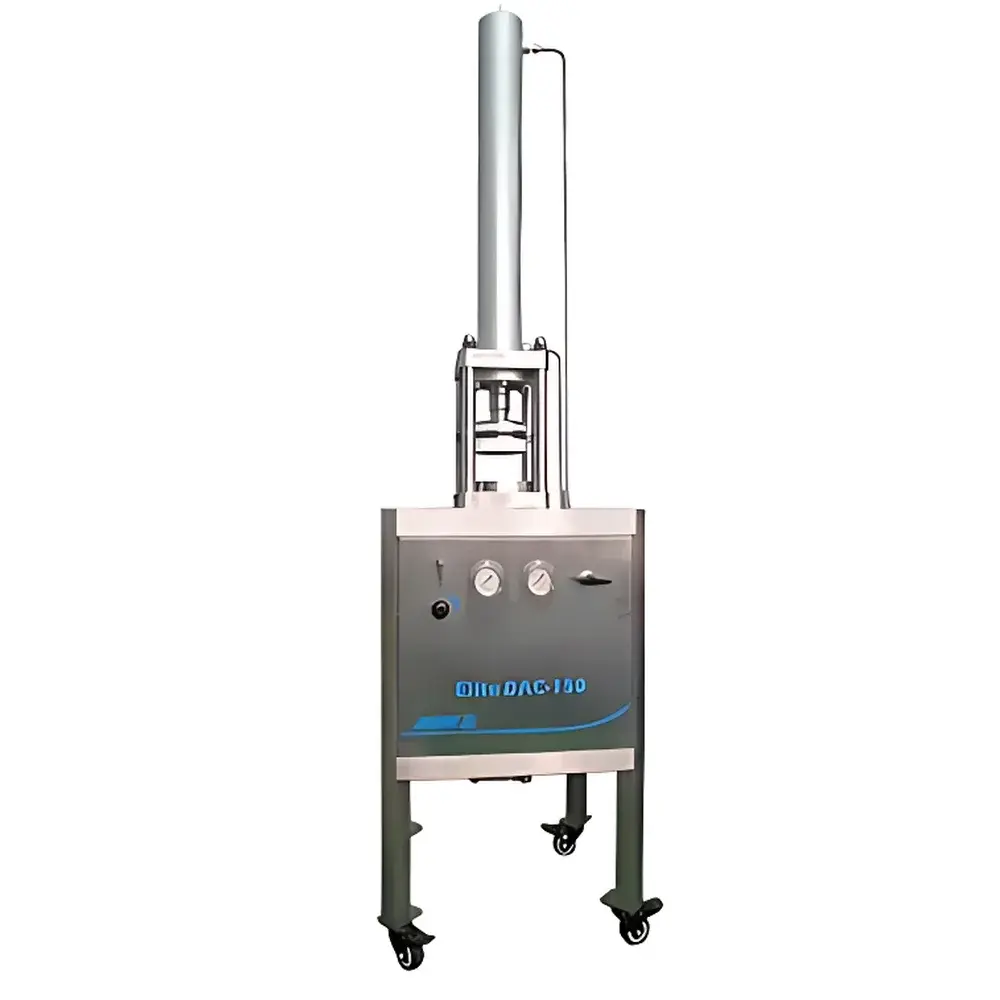
Elite DAC-150 Dynamic Axial Compression Column
| Brand | Elite |
|---|---|
| Origin | Liaoning, China |
| Manufacturer Type | OEM Manufacturer |
| Regional Classification | Domestic (China) |
| Model | Elite DAC-150 |
| Application Level | Laboratory & Pilot-Scale |
| Instrument Type | High-Pressure Preparative Liquid Chromatography System |
| Column Internal Diameter | 150 mm (customizable) |
| Bed Height Range | 0–400 mm |
| Column Tube Material | ASTM A269 TP316L Stainless Steel |
| Maximum Operating Pressure | 20 MPa |
| Plate Count (for C18, 10 µm) | ≥40,000 N/m |
| Asymmetry Factor (As) | 0.9–1.2 |
| Drive Mechanism | Pneumatic-Hydraulic Actuation |
| Compliance | Designed to meet GMP design principles for pharmaceutical process development |
Overview
The Elite DAC-150 Dynamic Axial Compression Column is a high-performance, pilot-scale preparative chromatography system engineered for reproducible, scalable separation of thermolabile and structurally complex molecules. It operates on the principle of dynamic axial compression—where a pneumatically assisted hydraulic piston applies uniform, real-time pressure to the chromatographic bed during both packing and elution phases—thereby eliminating radial channeling, minimizing bed deformation, and maintaining column integrity over hundreds of runs. Unlike static-packed or flanged columns, the DAC-150 actively compensates for bed settling during operation, ensuring consistent flow distribution, minimal band broadening, and superior resolution across variable load conditions. Its architecture supports method transfer from analytical to preparative scale with linear scalability—critical for process validation in pharmaceutical development and natural product isolation.
Key Features
- Dynamic axial compression mechanism with integrated pneumatic-hydraulic actuation system, delivering precise, programmable piston force control (0–20 MPa) and real-time bed compaction feedback.
- Monolithic 316L stainless steel column tube with electropolished interior surface (Ra ≤ 0.4 µm), compliant with ASME BPE-2021 surface finish requirements for biopharmaceutical applications.
- Modular piston assembly featuring dual-lip polymeric seals and self-aligning guide rings—validated for >500 consecutive compression cycles without leakage or extrusion under sustained 15 MPa operation.
- Tool-free column disassembly design enabling rapid bed replacement and cleaning-in-place (CIP) compatibility with NaOH, ethanol, and acetonitrile-based solvents.
- Integrated pressure transducers at inlet, outlet, and piston chamber—providing full hydraulic profile monitoring for GLP/GMP-compliant data traceability.
Sample Compatibility & Compliance
The DAC-150 accommodates a broad range of stationary phases—including silica-based reversed-phase (C4, C8, C18), polymeric resins (e.g., Toyopearl, Source), ion-exchange media, and size-exclusion matrices—across particle sizes from 5 µm to 30 µm. It supports loading capacities up to 50 g per run for small-molecule APIs and 5–10 g for monoclonal antibody fragments under standard gradient conditions. The system adheres to fundamental design elements aligned with ICH Q5A(R2), USP , and ISO 13485:2016 for equipment used in pharmaceutical manufacturing environments. While not certified as “GMP-ready” out-of-the-box, its mechanical construction, material certifications (EN 10204 3.1), and documentation package support qualification activities per FDA 21 CFR Part 211 and EU Annex 15.
Software & Data Management
The DAC-150 operates in conjunction with Elite’s proprietary PrepChrom Control Suite v4.2—a Windows-based platform supporting method import/export (XML schema), real-time pressure/flow/UV trace overlay, and audit-trail-enabled parameter logging. All operational events—including piston position, compression force, bed height change, and pressure spikes—are timestamped and stored in encrypted SQLite databases compliant with FDA 21 CFR Part 11 requirements for electronic records. Raw data exports are available in CSV and ASCII formats; optional integration with LIMS via OPC UA protocol enables centralized batch record management.
Applications
- Preparative purification of synthetic peptides and oligonucleotides requiring narrow peak asymmetry (As 0.9–1.2) and minimal tailing.
- Isolation of bioactive terpenoids, flavonoids, and alkaloids from botanical extracts—leveraging high plate counts (>40,000 N/m) for baseline resolution of structural analogs.
- Process development of biosimilar mAbs, including domain-specific fragmentation and aggregate removal using SEC-DAC configurations.
- Scale-up studies bridging analytical HPLC (e.g., 4.6 × 150 mm) to pilot production (DAC-150), validated through retention time, resolution (Rs), and capacity factor (k’) correlation analysis.
- Continuous chromatography mode implementation when paired with Elite’s multi-column switching valve manifold (optional).
FAQ
What is the maximum recommended operating pressure for routine use?
The DAC-150 is rated for continuous operation up to 15 MPa; 20 MPa represents the safety-tested burst limit and should only be approached during qualification testing.
Can the column be retrofitted with alternative piston materials for aggressive solvents?
Yes—standard Viton seals may be replaced with Kalrez® 6375 or Chemraz® equivalents upon request; full material compatibility reports are provided with custom configurations.
Is column re-packing possible without disassembling the entire system?
Yes—the top flange and piston assembly can be removed independently, allowing full bed access while retaining base hardware and fluidic connections.
Does Elite provide IQ/OQ documentation packages?
Yes—factory-verified Installation Qualification (IQ) and Operational Qualification (OQ) protocols are available as optional deliverables, aligned with ASTM E2500-13 and ISO/IEC 17025:2017 frameworks.
How is bed height calibrated prior to each run?
An integrated linear variable differential transformer (LVDT) measures piston displacement relative to a zero-reference point established during initial commissioning; calibration is verified annually using traceable micrometer standards.




