
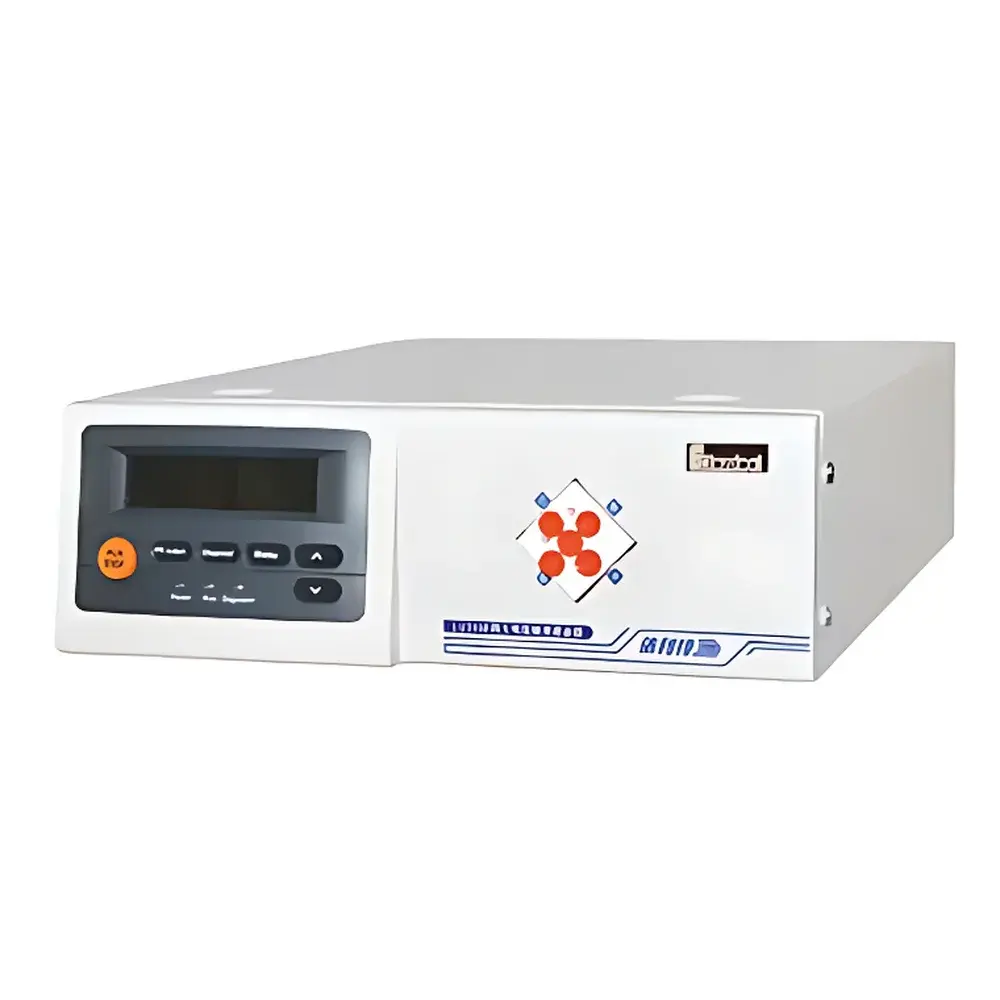
Elite LU3100 Quaternary Low-Pressure Gradient Mixer
| Brand | Elite |
|---|---|
| Origin | Liaoning, China |
| Manufacturer Type | Manufacturer |
| Product Origin | Domestic (China) |
| Model | LU3100 Quaternary |
| Quotation | Upon Request |
| Flow Range | 0.001–10.000 mL/min (settable in 0.1% increments) |
| Gradient Accuracy | ≤ ±2.0% |
| Mixing Volume | 500 µL |
| Power Supply/Power Consumption | AC 220 V ±10%, 50 Hz / 30 W |
| Dimensions/Weight | 420 × 300 × 115 mm (L×W×H) / 4 kg |
| Vacuum Degassing | Integrated with external DG3110 quaternary degasser |
Overview
The Elite LU3100 Quaternary Low-Pressure Gradient Mixer is an engineered fluidic module designed for integration with high-performance liquid chromatography (HPLC) systems to convert isocratic single-pump configurations into fully functional quaternary low-pressure gradient systems. Operating on the principle of precise volumetric proportioning prior to the high-pressure pump, the LU3100 enables dynamic, programmable blending of up to four independent mobile phase solvents—enabling method development, robust gradient optimization, and routine analytical flexibility without hardware modification of the main pump. Its low-pressure mixing architecture eliminates the need for multiple high-pressure pumps while maintaining compatibility with standard HPLC detectors, autosamplers, and column ovens. The mixer is particularly suited for laboratories performing pharmaceutical QC, environmental analysis, food safety testing, and academic research where solvent versatility, reproducible gradient formation, and system modularity are critical.
Key Features
- Imported quaternary proportional solenoid valve with sub-50 ms actuation time and matched channel response characteristics—ensuring synchronized solvent delivery and minimizing gradient delay.
- Dual positioning control logic: time-based sequencing and cam-driven mechanical indexing—optimized for consistent volumetric accuracy across the full flow range (0.001–10.000 mL/min).
- Independent channel selection and real-time flow rate display via front-panel LCD interface—supporting immediate verification of setpoint execution and active solvent path status.
- Integrated status monitoring for flow path integrity, valve position confirmation, and system readiness—reducing troubleshooting time during method transfer or multi-user operation.
- Compact footprint (420 × 300 × 115 mm) and lightweight design (4 kg)—facilitating benchtop installation alongside existing HPLC stacks or modular LC platforms.
Sample Compatibility & Compliance
The LU3100 is compatible with common HPLC-grade organic solvents (e.g., acetonitrile, methanol, tetrahydrofuran) and aqueous buffers (pH 2–9), provided they are filtered and degassed. It interfaces seamlessly with Elite’s P230II, P3000, and other dual- or single-plunger constant-flow pumps via standardized 1/16″ stainless steel tubing and Swagelok fittings. While the mixer itself does not perform analytical separation, its gradient fidelity supports compliance with method validation requirements under ICH Q2(R2), USP , and ASTM D7801 for liquid chromatographic methods. When paired with Elite DG3110 external vacuum degassing unit (standard configuration), dissolved gas levels remain below 5 ppm—meeting baseline stability criteria for UV/VIS and fluorescence detection per GLP-aligned laboratory practices.
Software & Data Management
The LU3100 operates as a stand-alone hardware module but is fully controllable through Elite’s EC2020 Chromatography Data System (CDS) v3.2 or higher. CDS provides bidirectional communication for gradient programming, real-time flow logging, event-triggered method switching, and audit-trail-enabled parameter change history—fully compliant with FDA 21 CFR Part 11 requirements when configured with electronic signatures and role-based access control. All gradient profiles—including step, linear, concave, and convex gradients—are stored as ASCII-based .GRD files, enabling cross-platform method portability and version-controlled archiving. Instrument diagnostics, including valve cycle count and pressure transient logs, are exportable in CSV format for preventive maintenance scheduling.
Applications
- Method development for reversed-phase, ion-exchange, and HILIC separations requiring multi-solvent gradient optimization.
- Pharmaceutical stability-indicating assays where mobile phase composition must be varied systematically to resolve degradation products.
- Environmental multi-residue analysis (e.g., pesticides, PAHs) demanding sequential elution strength modulation across diverse analyte polarities.
- Academic teaching labs utilizing modular HPLC setups—allowing students to explore gradient theory, dwell volume effects, and solvent strength modeling without dedicated gradient-capable pumps.
- Quality control workflows in contract testing laboratories requiring rapid reconfiguration between pharmacopeial monographs (e.g., USP, EP, ChP) with differing gradient specifications.
FAQ
What is the maximum dwell volume of the LU3100 mixer?
The total internal mixing volume is 500 µL; combined with typical post-mixer tubing (1–2 m of 0.12 mm ID PEEK), system dwell volume ranges from 0.8–1.5 mL depending on pump inlet configuration.
Can the LU3100 be used with non-Elite HPLC pumps?
Yes—provided the pump accepts low-pressure gradient input (i.e., single-inlet, constant-flow design) and uses standard 1/16″ tubing connections; compatibility verification with third-party pump manuals is recommended.
Is firmware upgradable in the field?
Yes—via USB interface using Elite’s official EC-Update utility; firmware revisions include enhanced valve timing algorithms and improved error-handling for low-flow (<0.1 mL/min) operation.
Does the LU3100 support gradient delay compensation?
No—the mixer does not perform automatic dwell volume correction; users must account for system delay manually during method translation or employ CDS-based retention time alignment tools.
What maintenance intervals are recommended for the proportional valve?
Valve lifetime exceeds 10 million cycles under normal use; Elite recommends quarterly visual inspection of sealing surfaces and annual calibration verification using certified flow meters per ISO/IEC 17025 guidelines.






