
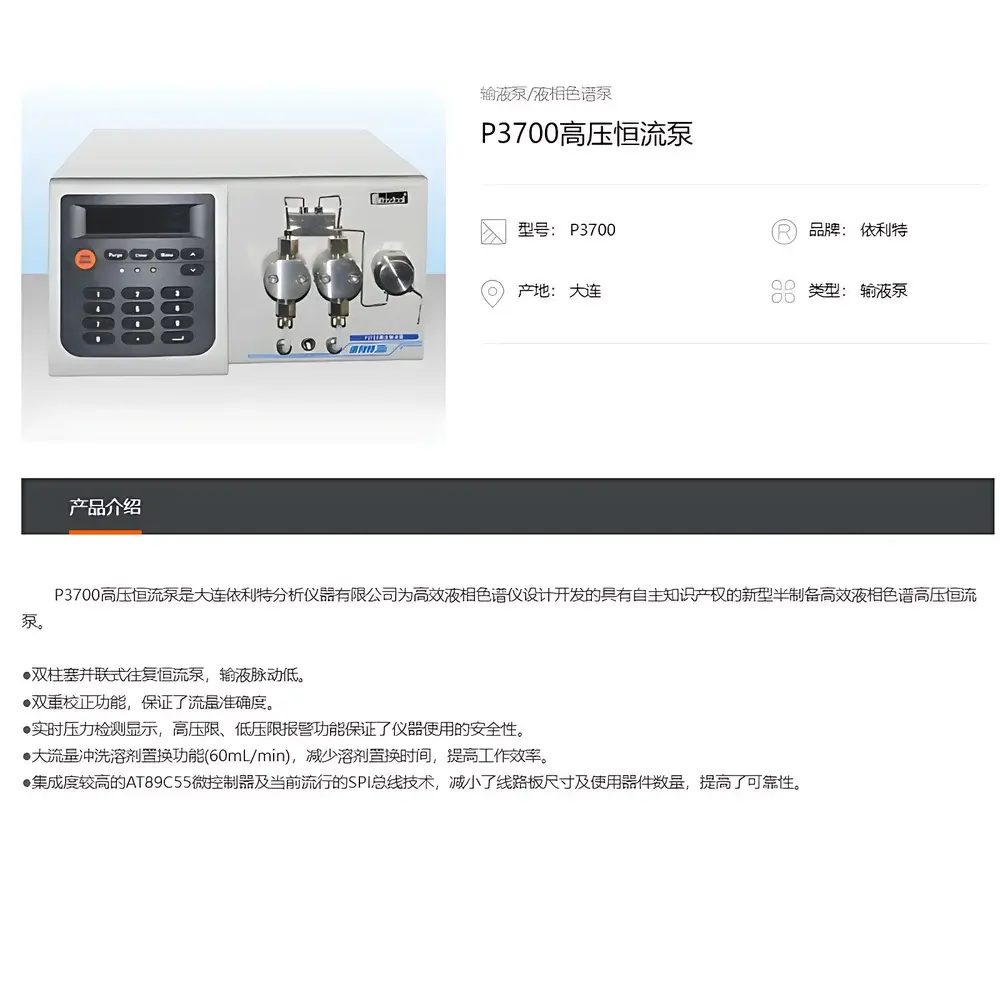
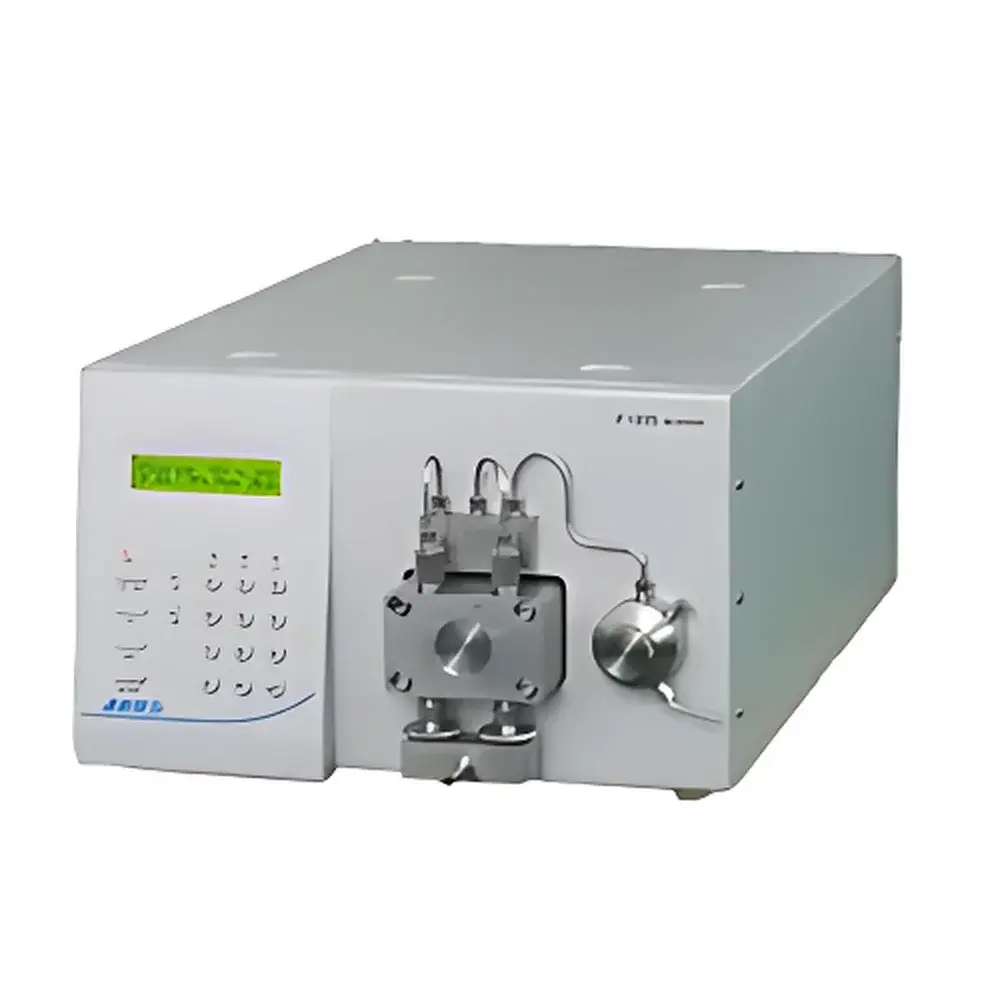
Elite P1000 High-Pressure Preparative HPLC Pump
| Brand | Elite |
|---|---|
| Origin | Jiangsu, China |
| Manufacturer Type | OEM Manufacturer |
| Product Origin | Domestic (China) |
| Model | P1000 |
| Instrument Type | Conventional High-Performance Liquid Chromatography (HPLC) System |
| Application Scope | General-purpose preparative chromatography |
| Flow Rate Range | 0–1000 mL/min |
| Maximum Operating Pressure | 0–7 MPa |
| Flow Accuracy | ≤ ±3% |
| Flow Precision (RSD) | ≤ 1% |
| Drive Motor | Brushless DC Servo Motor |
| Pump Head | Dual-piston Reciprocating Design |
| Communication Interface | RS-485 |
| Pressure Units | MPa / psi / bar (selectable) |
| Pressure Monitoring | Real-time display with over-pressure alarm and user-defined upper/lower limits |
| Flow Compensation | ±15% adjustable compensation range |
| Control Mode | Full computer reverse control via external workstation |
Overview
The Elite P1000 High-Pressure Preparative HPLC Pump is an engineered solution for scalable liquid delivery in analytical and preparative chromatographic workflows. Designed specifically for high-flow applications—ranging from laboratory-scale purification to pilot-scale process development—the P1000 operates on the principle of reciprocating dual-piston positive displacement, delivering consistent solvent delivery under sustained backpressure up to 7 MPa (1015 psi). Its architecture integrates a brushless DC servo motor with precision motion control, eliminating mechanical resonance and minimizing acoustic emissions during extended operation. Unlike standard analytical HPLC pumps limited to sub-10 mL/min flow rates, the P1000 supports volumetric throughput up to 1000 mL/min—enabling compatibility with large-bore columns (e.g., 20–50 mm ID), packed-bed extractors, and multi-column continuous chromatography systems. The pump’s hydraulic design incorporates floating-guided piston alignment and high-tolerance sealing interfaces using imported fluoropolymer-based seal materials, ensuring long-term dimensional stability and reduced maintenance intervals.
Key Features
- Dual-piston reciprocating pump head with floating-guided columnar alignment for uniform wear distribution and extended service life
- Brushless DC servo motor drive delivering high torque at low RPM, resulting in low operational noise (<62 dB(A)) and no electromagnetic interference with adjacent instrumentation
- Real-time digital pressure and flow monitoring with on-board LCD interface and configurable alarm thresholds for over-pressure conditions
- RS-485 serial communication port compliant with Modbus RTU protocol, enabling seamless integration into third-party chromatography data systems (CDS) or custom SCADA environments
- Three selectable pressure units (MPa, psi, bar) and programmable flow compensation (±15%) to correct for system compressibility, viscosity shifts, or temperature-induced density changes
- Full reverse control capability: remote initiation, flow/pressure setpoint adjustment, status polling, and fault logging via host workstation software
Sample Compatibility & Compliance
The P1000 is compatible with common HPLC mobile phases—including aqueous buffers, organic solvents (acetonitrile, methanol, THF), and corrosive additives (TFA, formic acid)—when used with chemically resistant wetted materials (316L stainless steel pump body, sapphire-ruby check valves, PEEK and ETFE tubing pathways). It meets structural and electrical safety requirements per GB/T 14710–2009 (Chinese Environmental Adaptability Standard for Analytical Instruments) and conforms to EMC directive IEC 61326-1:2013 for laboratory equipment. While not certified to ISO/IEC 17025 or FDA 21 CFR Part 11 out-of-the-box, its RS-485 interface supports audit-trail-capable integration with validated CDS platforms operating under GLP/GMP frameworks. Users deploying the P1000 in regulated environments must implement supplementary electronic record controls and periodic performance verification per ASTM E2656–21 (Standard Guide for Validation of Preparative Chromatography Systems).
Software & Data Management
The P1000 does not include proprietary control software but provides open-protocol RS-485 connectivity for interoperability with industry-standard chromatography platforms such as Chromeleon™ (Thermo Fisher), OpenLab CDS (Agilent), or custom LabVIEW- or Python-based automation suites. All operational parameters—including actual flow rate, measured pressure, motor current, and error codes—are accessible via register mapping defined in the Elite P1000 Communication Protocol Specification (v2.3). Data logging frequency is user-configurable up to 10 Hz, supporting time-synchronized acquisition alongside UV/Vis detector outputs or fraction collector triggers. For traceability, timestamped event logs (e.g., pressure limit breach, motor stall, communication timeout) are retained in non-volatile memory for post-run forensic analysis.
Applications
- Preparative purification of natural products, peptides, and synthetic intermediates using medium-pressure flash or semi-preparative HPLC systems
- Mobile phase delivery in simulated moving bed (SMB) and multi-column countercurrent chromatography (MCCC) configurations
- Method development scaling from analytical to production-ready conditions, maintaining linear velocity consistency across column diameters
- High-throughput solvent gradient generation in parallel purification workflows with multi-pump synchronization
- Process validation studies requiring documented flow stability (RSD ≤1%) and pressure fidelity over >8-hour continuous runs
FAQ
What is the maximum recommended operating pressure for continuous use?
The P1000 is rated for continuous operation up to 7 MPa; however, sustained use above 5 MPa requires thermal management of the pump head and verification of seal integrity at elevated temperatures.
Can the P1000 be integrated into a fully automated preparative HPLC system with fraction collection?
Yes—via RS-485 command sets, the pump synchronizes start/stop, flow ramping, and pressure-triggered events with external fraction collectors and UV detectors supporting TTL or analog trigger inputs.
Is flow accuracy verified per ISO 5725 or USP <621>?
Elite provides factory calibration certificates traceable to national standards (CNAS-accredited lab), but users must perform in-house verification per USP <621> Chapter “Chromatography” using gravimetric or timed-volume methods appropriate for high-flow regimes.
Does the pump support gradient mixing?
No—the P1000 is a single-channel high-pressure pump; gradient formation requires external low-pressure mixing modules or additional synchronized P1000 units in binary or ternary configurations.
What maintenance intervals are recommended for routine operation?
Piston seal replacement is advised every 6 months under continuous use at >500 mL/min and >4 MPa; check valve inspection is recommended quarterly, with cleaning intervals dependent on mobile phase composition and particulate load.




