
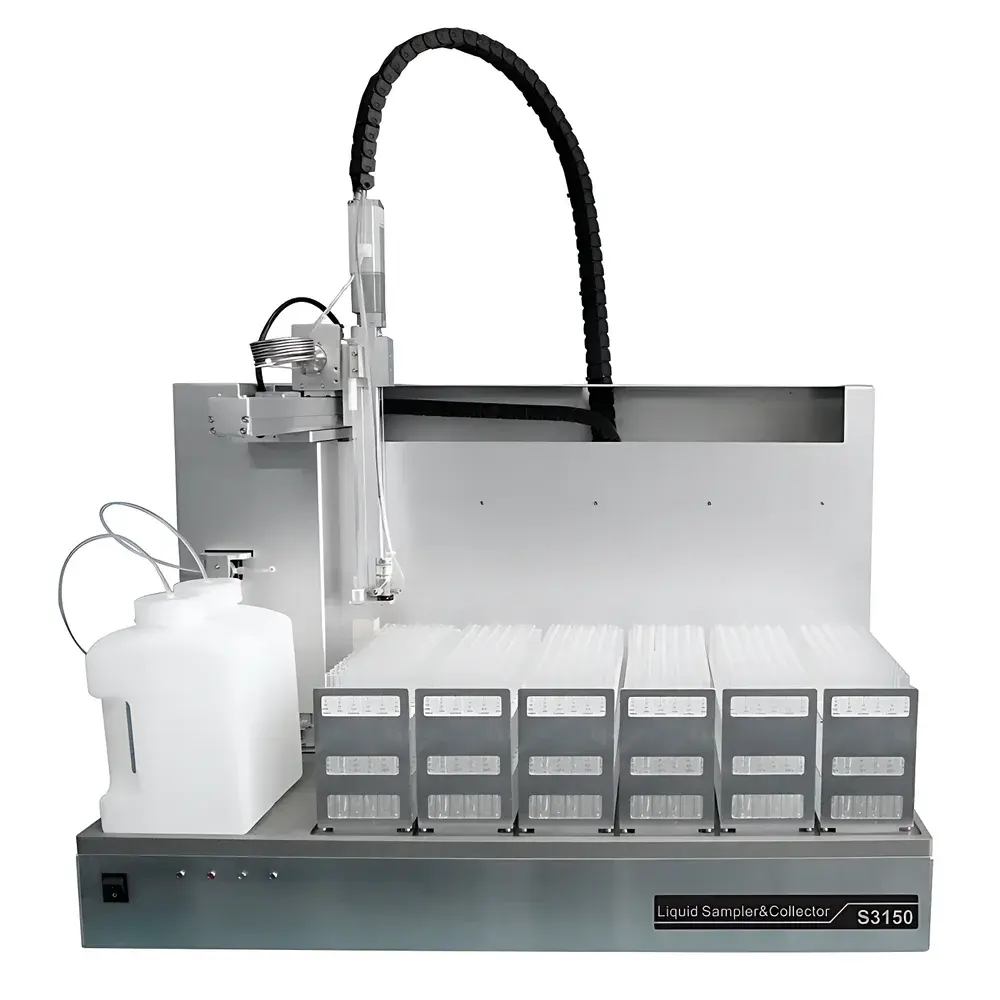
Elite S3150 Prep-LC Autosampler & Fraction Collector Integrated System
| Brand | Elite |
|---|---|
| Origin | Liaoning, China |
| Manufacturer Type | Direct Manufacturer |
| Regional Classification | Domestic (PRC) |
| Model | S3150 |
| Price Range | USD 14,000 – 28,000 (FOB) |
| Application Tier | Industrial-Scale Preparative Chromatography |
| Instrument Type | High-Pressure Preparative Liquid Chromatography System |
| Flow Rate Range | 1–100 mL/min |
| Flow Precision (Partial-Loop Injection) | RSD ≤ 0.5% |
| Maximum Operating Pressure | 21 MPa |
Overview
The Elite S3150 Prep-LC Autosampler & Fraction Collector Integrated System is a purpose-engineered platform for scalable, reproducible preparative liquid chromatography in industrial and pilot-scale purification workflows. Built upon a high-pressure modular architecture, the system operates within a validated pressure envelope of up to 21 MPa (3,045 psi), enabling compatibility with both wide-bore and narrow-bore preparative columns packed with silica, polymer-based, or hybrid stationary phases. Its core design integrates two functionally synchronized subsystems—precision autosampling and time- or peak-triggered fraction collection—within a single compact chassis. This integration eliminates inter-unit timing latency and ensures strict synchronization between injection events and fraction boundary decisions, critical for maintaining compound integrity during multi-step isolation protocols. The system adheres to fundamental principles of isocratic and gradient elution chromatography, supporting method transfer from analytical to preparative scale under controlled flow dynamics governed by positive displacement piston pumping and real-time pressure feedback control.
Key Features
- Integrated dual-function architecture: Co-located autosampler and fraction collector share common fluidic pathways and centralized timing logic, reducing carryover risk and improving cycle-to-cycle reproducibility.
- Wide dynamic flow range: Programmable flow delivery from 1 mL/min to 100 mL/min, optimized for column diameters from 10 mm to 50 mm ID, with active backpressure regulation to maintain laminar flow profiles across viscosity gradients.
- High-precision partial-loop injection: Achieves ≤ 0.5% RSD in volumetric delivery using temperature-stabilized syringe actuation and pressure-compensated valve sequencing—validated per ISO 5725-2 guidelines for intermediate precision.
- Rugged stainless-steel wetted path: All fluid-contact components—including sample loop, injection valve, transfer lines, and fraction tubing—are constructed from 316L stainless steel or PEEK, ensuring chemical resistance to organic solvents (acetonitrile, methanol, THF), aqueous buffers (pH 2–12), and mild acids/bases used in peptide and small-molecule purification.
- Modular expansion readiness: Supports optional UV/Vis absorbance detection (200–400 nm), conductivity monitoring, and mass-directed fraction triggering via analog/digital I/O interfaces compliant with RS-232 and Ethernet TCP/IP protocols.
Sample Compatibility & Compliance
The S3150 accommodates sample volumes from 10 µL to 5 mL per injection, with vial formats including 10 mL glass screw-top, 15 mL conical polypropylene, and standard 96-well plates (with optional adapter). It supports solvent systems meeting USP and ICH Q2(R2) method robustness requirements, and its operational firmware includes audit trail logging aligned with FDA 21 CFR Part 11 Annex 11 expectations for electronic records. While not certified as GMP-compliant out-of-the-box, the system’s mechanical traceability, user-accessible calibration logs, and password-protected method editing mode facilitate qualification under GLP and internal SOP frameworks for pharmaceutical intermediates, natural product isolates, and catalyst recovery applications.
Software & Data Management
Controlled via Elite ChromaLink v3.x software (Windows 10/11 64-bit), the S3150 provides intuitive sequence programming, real-time chromatogram overlay, and fraction mapping visualization. Method files store full parameter sets—including gradient profiles, dwell volume compensation, fraction trigger thresholds (UV threshold, time window, or external TTL input), and post-run wash cycles—with SHA-256 checksum validation. Raw data are saved in vendor-neutral .csv and .mzML-compatible formats; audit trails record operator ID, timestamp, parameter changes, and hardware status flags with immutable write-once storage. Software supports IQ/OQ documentation templates and integrates with LIMS via HL7 and ASTM E1384-compliant export modules.
Applications
- Purification of synthetic peptides and oligonucleotides requiring high-resolution separation under denaturing conditions.
- Isolation of bioactive natural products (e.g., flavonoids, alkaloids, terpenoids) from crude plant extracts at gram-to-100g batch scales.
- Recycling and recovery of chiral catalysts and transition-metal complexes in fine chemical manufacturing.
- Preparative cleanup of reaction mixtures prior to NMR or X-ray crystallography analysis.
- Method development bridging analytical HPLC (e.g., Waters Acquity UPLC) to production-scale purification on 21.2 mm × 250 mm or larger columns.
FAQ
What column dimensions and packing materials are compatible with the S3150?
The system supports columns with internal diameters from 10 mm to 50 mm and lengths up to 500 mm, including silica gel (5–20 µm), C18-bonded silica, polymeric resins (e.g., Toyopearl, Sephadex LH-20), and specialty media for ion exchange or size exclusion.
Does the S3150 support gradient elution?
Yes—it features dual-solvent high-pressure mixing with programmable gradient profiles (0–100% B over 0.1–120 min), dwell volume compensation, and real-time pressure monitoring to ensure gradient fidelity across flow rates.
Can the fraction collector be triggered by an external detector signal?
Yes—via TTL-compatible analog input (±5 V) or digital edge-triggering, enabling synchronization with third-party UV, MS, or ELSD detectors.
Is remote operation supported?
The system includes embedded Ethernet connectivity and supports secure remote access through ChromaLink Remote Client, with role-based authentication and session logging.
What maintenance intervals are recommended for routine operation?
Piston seal replacement every 6 months (or 500 hours), injection valve rotor seal inspection every 3 months, and annual full-system pressure calibration using NIST-traceable dead-weight testers.
Related Products




