
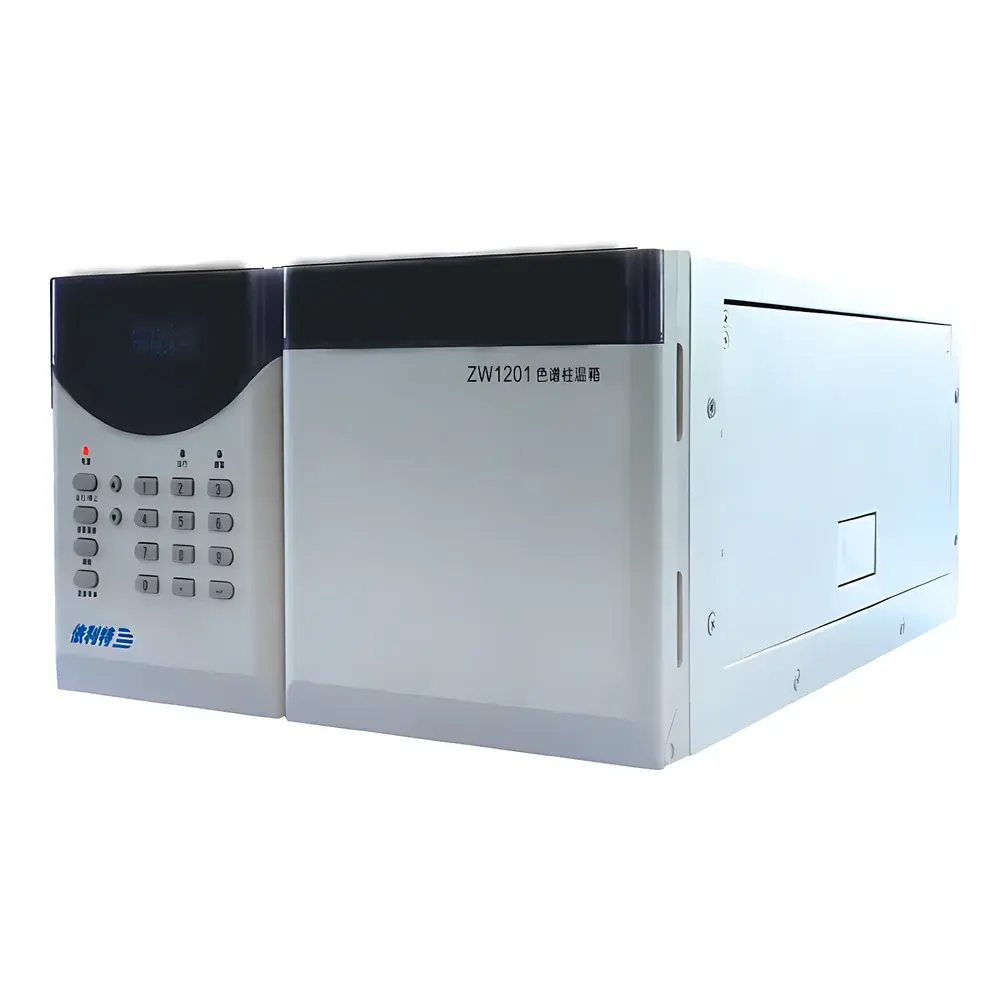
Elite ZW1201 Column Oven for HPLC and GC Systems
| Brand | Elite |
|---|---|
| Origin | Liaoning, China |
| Manufacturer Type | Direct Manufacturer |
| Country of Origin | China |
| Model | ZW1201 |
| Price Range | USD 1,400 – 2,800 (FOB) |
| Temperature Control | Heating-Only (No Active Cooling) |
| Temperature Range | Ambient +5 °C to 80 °C |
| Temperature Accuracy | ±0.1 °C |
| Temperature Precision | ±0.5 °C |
| Temperature Setting Resolution | 0.1 °C |
| Display | Dual-Line LCD (Actual Temp / Setpoint) |
| Over-Temperature Protection | Automatic Cut-Off with Audible Alarm |
| Column Compatibility | ID 2–10 mm, Max Length 250 mm |
| Capacity | 1–3 Analytical Columns |
| Heating Power | 100 W |
| Power Supply | AC 220 V ±10%, 50 Hz |
| Dimensions (L×W×H) | 420 × 300 × 175 mm |
Overview
The Elite ZW1201 Column Oven is a precision-engineered thermal management system designed specifically for high-performance liquid chromatography (HPLC), gas chromatography (GC), and other analytical separation platforms requiring stable, reproducible column temperature control. Operating on resistive heating principles with PID-based feedback regulation, the ZW1201 maintains consistent thermal environments across the chromatographic column—critical for retention time stability, peak shape integrity, and method robustness. Unlike ambient-compensated enclosures, this oven actively regulates temperature from ambient +5 °C up to 80 °C with ±0.1 °C accuracy and better than ±0.5 °C long-term precision—meeting essential requirements for pharmacopeial methods (e.g., USP , EP 2.2.46) and routine QC/QA workflows in pharmaceutical, environmental, and food testing laboratories.
Key Features
- PID-controlled heating module with rapid thermal response and minimal overshoot, enabling stable equilibration within ≤15 minutes from ambient to 60 °C
- Dual-line backlit LCD interface displaying real-time column chamber temperature (upper line) and user-defined setpoint (lower line)
- Integrated over-temperature safety circuit that triggers audible alarm and automatic power cutoff at ≥85 °C—compliant with IEC 61010-1 Class II safety standards
- Modular internal rail system supporting interchangeable column brackets for seamless adaptation to columns with inner diameters from 2 mm to 10 mm and lengths up to 250 mm
- Optional pre-heating zone for transfer lines (up to 1.5 m of 1/16″ stainless steel or PEEK tubing), reducing thermal gradients between column outlet and detector interface
- Thermally insulated enclosure with low-power consumption (100 W max) and uniform internal airflow distribution to minimize radial temperature gradients (<0.3 °C across column bed)
Sample Compatibility & Compliance
The ZW1201 accommodates standard analytical-scale HPLC columns (e.g., 4.6 × 150 mm, 3.0 × 100 mm) as well as narrow-bore and capillary GC columns (e.g., 0.25 mm ID × 30 m fused silica). Its mechanical design allows concurrent operation of one preparative column (up to 10 mm ID) or three parallel analytical columns—ideal for method development, gradient optimization, or multi-analyte screening protocols. The unit complies with ISO/IEC 17025:2017 requirements for equipment qualification, supports IQ/OQ documentation templates, and provides traceable temperature calibration capability via front-panel offset adjustment (±5.0 °C range in 0.1 °C increments).
Software & Data Management
While the ZW1201 operates as a standalone hardware module, its analog temperature output (0–5 V DC proportional to chamber temperature) enables integration with third-party data acquisition systems (e.g., Empower™, Chromeleon™, OpenLab CDS) for synchronized logging and audit trail generation. All operational parameters—including setpoint history, alarm events, and power-on duration—are stored in non-volatile memory and retrievable via RS-232 serial port (optional adapter kit available). Firmware supports GLP-compliant event logging with timestamping and user-access level restrictions, satisfying FDA 21 CFR Part 11 requirements when deployed within validated laboratory networks.
Applications
- Stabilizing retention times in reversed-phase, ion-exchange, and size-exclusion HPLC methods under variable lab ambient conditions
- Improving resolution of closely eluting peaks in chiral separations performed at elevated temperatures (e.g., polysaccharide-based CSPs)
- Maintaining consistent viscosity and diffusion coefficients during UHPLC method transfers from 2.1 mm to 4.6 mm ID columns
- Enabling reproducible GC method validation per ASTM D3606 and EPA Method 8021B through precise oven ramping and isothermal hold fidelity
- Supporting stability-indicating assays per ICH Q5C by eliminating column temperature drift-induced baseline artifacts
FAQ
Does the ZW1201 support active cooling or refrigeration?
No—the ZW1201 is a heating-only column oven. It does not incorporate thermoelectric or compressor-based cooling. For sub-ambient applications, external chillers or alternative oven models with dual-mode thermal control are recommended.
Can the ZW1201 be used with UHPLC systems operating above 1000 bar?
Yes—its mechanical structure and internal clearance are compatible with all commercially available 2.1 mm and 3.0 mm ID UHPLC columns rated for ≥1300 bar, provided column ferrules and fittings remain outside the heated zone.
Is temperature calibration traceable to NIST standards?
The unit includes a factory calibration certificate (traceable to national metrology institutes); end-users may perform in-house verification using a calibrated PT100 probe inserted into the designated sensor port—procedures align with ISO/IEC 17025 Clause 6.5.
What maintenance is required for long-term reliability?
No scheduled maintenance is required. Users should periodically inspect heater contacts and clean dust from ventilation grilles using compressed air; no lubrication or recalibration is needed under normal operating conditions.
How is compliance with 21 CFR Part 11 ensured during remote monitoring?
When connected to a compliant CDS platform, the ZW1201’s event logs (alarm triggers, setpoint changes, power cycles) are embedded into the electronic record with digital signatures, role-based access controls, and immutable audit trails—fully satisfying electronic records and signature requirements.
Related Products





