
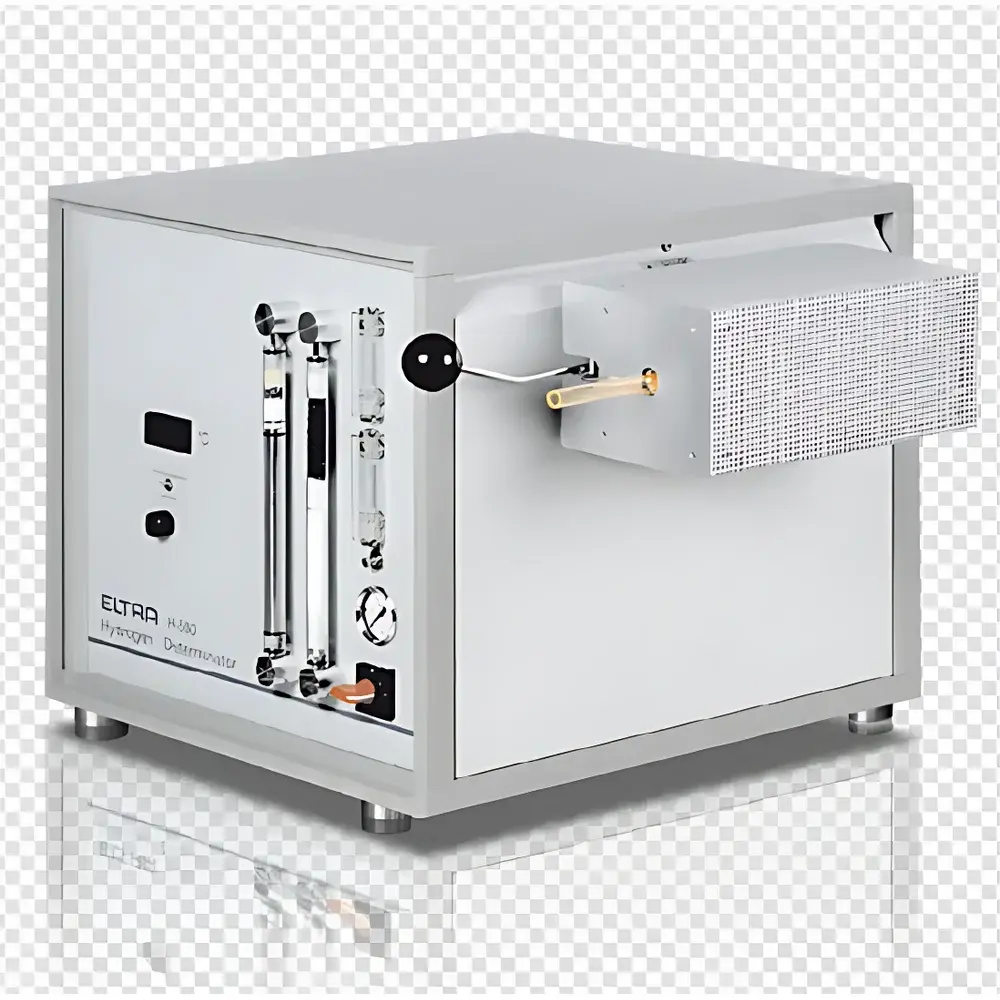
ELTRA H-500 Hydrogen Analyzer
| Brand | ELTRA |
|---|---|
| Origin | Germany |
| Model | H-500 |
| Instrument Type | Hydrogen Analyzer |
| Analysis Range (Low-H) | 0.1 ppm – 200 ppm |
| Analysis Range (High-H) | 10 ppm – 2% |
| Accuracy (Low-H) | ±0.1 ppm or ±1% |
| Accuracy (High-H) | ±2 ppm or ±1% |
| Sensitivity (H) | 0.01 ppm |
| Analysis Time | 2–3 min |
| Maximum Sample Mass | 10 g |
| Sample Dimensions | ≤ 0.8 × 6 cm |
| Furnace Max Temperature | 1000 °C (1 °C adjustable) |
| Carrier Gas | High-purity N₂ |
| Detector Configuration | Dual thermal conductivity cells with differential sensitivity |
Overview
The ELTRA H-500 Hydrogen Analyzer is a high-precision, thermally driven elemental analyzer engineered for the quantitative determination of residual hydrogen in metallic materials—including carbon steels, stainless steels, nickel- and titanium-based alloys, copper, and aluminum. It operates on the principle of inert gas fusion coupled with thermal extraction: solid samples are heated under controlled nitrogen atmosphere in a horizontal quartz-tube furnace, releasing interstitial and occluded hydrogen as molecular H₂. The evolved gas is swept through a high-sensitivity dual thermal conductivity detector (TCD) system, where hydrogen concentration is determined by its distinct thermal conductivity relative to nitrogen. This method complies with standardized test protocols including ASTM E1447, ISO 14284, and DIN 50976, ensuring traceability and regulatory acceptance in metallurgical QA/QC, R&D, and failure analysis laboratories.
Key Features
- Thermal extraction furnace with programmable temperature control up to 1000 °C (±1 °C resolution), optimized for rapid and complete hydrogen release from refractory and high-alloy matrices.
- Dual-range thermal conductivity detection system—comprising two independently calibrated TCD cells—enables high accuracy across both ultra-trace (0.1–200 ppm) and higher-concentration (10 ppm–2 wt%) hydrogen measurement ranges.
- Horizontal sample loading geometry ensures reproducible positioning and minimizes thermal gradient effects during ramping; sample introduction occurs via gravity-fed transfer into the hot zone, eliminating mechanical feed mechanisms and associated contamination risks.
- Integrated carrier gas purification train—including oxygen and moisture traps—ensures baseline stability and long-term detector integrity without routine recalibration.
- Robust quartz-tube reactor design withstands repeated thermal cycling and aggressive matrix volatilization, supporting >10,000 analyses with minimal maintenance.
- Self-contained electronics and embedded microprocessor control enable standalone operation or seamless integration with laboratory networks via Ethernet or RS-232 interfaces.
Sample Compatibility & Compliance
The H-500 accommodates solid metallic specimens up to 10 g mass and 0.8 cm × 6 cm dimensions—suitable for drill chips, turnings, wire segments, and machined coupons. It is validated for use with ferrous and non-ferrous alloys per ISO 14284 (steel), ASTM E1447 (titanium and nickel alloys), and JIS G 1258 (aluminum). All measurement workflows support full audit trail generation compliant with FDA 21 CFR Part 11 requirements when paired with ELTRA’s optional GLP/GMP software module. Calibration verification follows internal standard protocols using certified reference materials (CRMs) traceable to NIST or BAM standards.
Software & Data Management
The H-500 is operated via ELTRA’s proprietary MultiWin™ software—a Windows-based platform supporting multilingual UI (English, German, French, Chinese, Japanese), customizable report templates, and real-time signal visualization. Each analysis automatically logs raw TCD response curves, furnace temperature profiles, gas flow rates, and calculated results with timestamped metadata. Data export options include CSV, XML, and direct LIMS integration via ODBC or HL7. Software features include automatic blank subtraction, drift correction algorithms, statistical process control (SPC) charting, and user-access-level management (administrator/operator/auditor roles) to meet ISO/IEC 17025 documentation requirements.
Applications
- Hydrogen-induced cracking (HIC) susceptibility assessment in pipeline steels and pressure vessel materials.
- Quality control of vacuum-melted superalloys used in aerospace turbine components.
- Verification of hydrogen desorption efficiency after electroplating or pickling processes.
- Research into hydrogen embrittlement mechanisms in advanced high-strength steels (AHSS) and magnesium alloys.
- Batch certification of welding consumables and filler metals per AWS A5.18 and EN ISO 14341.
- Failure analysis of brittle fracture incidents linked to hydrogen accumulation at grain boundaries.
FAQ
What sample preparation is required prior to analysis?
Minimal preparation is needed: samples must be clean, dry, and free of surface oxides or oils. Drill chips or lathe turnings are preferred; cross-sectioned specimens should be mechanically polished to remove heat-affected zones.
Can the H-500 measure hydrogen in non-metallic materials such as ceramics or polymers?
No—the H-500 is specifically engineered for conductive metallic matrices. Non-metals require alternative techniques such as vacuum hot extraction with mass spectrometric detection.
Is carrier gas purity critical for accurate results?
Yes. High-purity nitrogen (≥99.999% N₂, O₂ & H₂O < 0.1 ppm) is mandatory; impurities directly affect TCD baseline stability and detection limit reproducibility.
How frequently must the purification tubes be replaced?
Under normal usage (≤20 analyses/day), oxygen and moisture traps require replacement every 6–12 months; frequency increases with high-humidity lab environments or elevated sample hydrogen content.
Does the system support automated sample changers?
Not natively—the H-500 is designed for manual, operator-verified sample loading to ensure optimal positioning and safety. However, third-party robotic handlers can be integrated via digital I/O signals and external trigger protocols.
Related Products





