
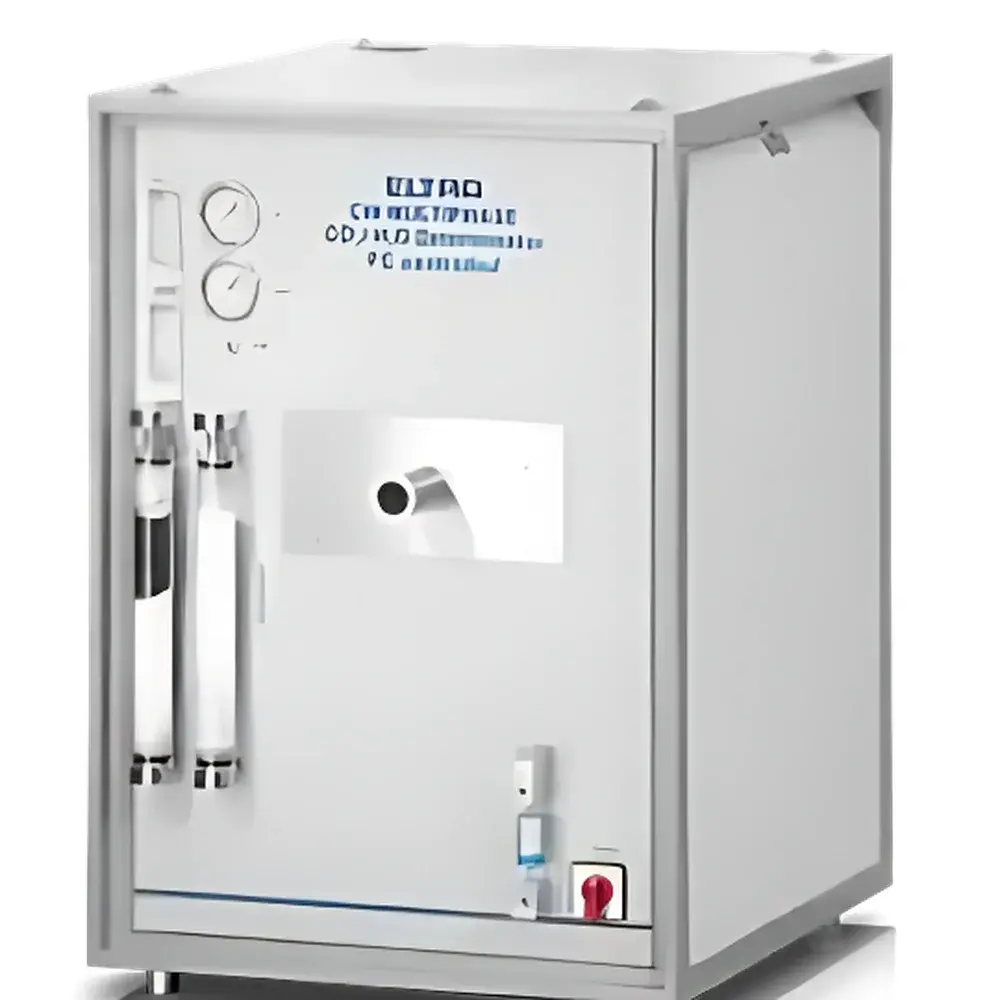
ELTRA CW-800M CO₂ and Moisture Analyzer
| Brand | ELTRA |
|---|---|
| Origin | Germany |
| Model | CW‑800M |
| Heating Furnace Temperature Range | Up to 1000 °C (adjustable in 1 °C increments) |
| Detection Principle | Solid-State Infrared Absorption |
| IR Detector Cells | 1–2, gold-plated |
| Typical Analysis Time | 2–3 min |
| Carrier Gas | Ultra-high-purity nitrogen (99.995 %, 2–4 bar / 30–60 psi) |
| Power Supply | 230 V, 50/60 Hz, max. 10 A, 2300 W |
| Dimensions (W×H×D) | 55 × 80 × 60 cm |
| Weight | ~65 kg |
| Sample Container | Quartz boat |
| Reagents | Magnesium perchlorate (for H₂O), sodium hydroxide (for CO₂) |
| Compliance | Designed for GLP/GMP-aligned workflows |
Overview
The ELTRA CW-800M CO₂ and Moisture Analyzer is a high-precision, dual-parameter combustion-based elemental analyzer engineered for the simultaneous quantification of carbon dioxide (as a proxy for carbonate-bound carbon) and moisture (as total bound water) in inorganic solid matrices. Operating on the principle of high-temperature resistive furnace combustion coupled with selective solid-state infrared (IR) absorption detection, the instrument thermally decomposes samples at precisely controlled temperatures—up to 1000 °C—in a quartz tube under a continuous flow of ultra-pure nitrogen carrier gas. Released CO₂ and H₂O vapors are sequentially or concurrently directed through dedicated, gold-plated IR detection cells, where their characteristic absorption bands (at 4.26 µm for CO₂ and 2.7 µm for H₂O) are measured with high specificity and linearity. This architecture eliminates cross-sensitivity between analytes and ensures robust performance even with halogen-rich or acidic samples—enabled by the chemically inert gold coating on the IR cells. The system is designed for routine use in quality control laboratories, geological survey facilities, and cement/minerals production environments where regulatory traceability, method reproducibility, and minimal operator intervention are critical.
Key Features
- Resistive furnace with digital temperature control (range: ambient to 1000 °C, resolution: 1 °C), ensuring thermal stability and repeatability across diverse sample types including limestone, gypsum, clinker, and soil.
- Gold-plated infrared detection cells (1 or 2 configurable units) provide long-term resistance to corrosion from acidic gases (e.g., HCl, HF) and halogen compounds—eliminating the need for halogen scavengers or frequent cell replacement.
- Electronically regulated mass flow control for carrier gas ensures constant flow rate throughout analysis, independent of upstream pressure fluctuations—critical for quantitative accuracy and retention time consistency.
- Integrated reagent train using magnesium perchlorate (H₂O trapping) and sodium hydroxide (CO₂ trapping) enables selective, stoichiometric capture prior to IR measurement; no consumable catalysts or proprietary cartridges required.
- Modular hardware design supports seamless integration into existing laboratory infrastructure: compatible with standard analytical balances (0.1 mg readability), external PCs, and calibrated quartz boats.
- Robust mechanical construction (65 kg steel frame, vibration-damped base) ensures operational stability in shared lab or plant-floor environments without dedicated anti-vibration tables.
Sample Compatibility & Compliance
The CW-800M is validated for use with heterogeneous, non-volatile inorganic solids—including Portland cement, hydrated lime, dolomite, kaolin, fly ash, mine tailings, and sedimentary rock powders. Samples are loaded into standardized quartz boats and introduced manually into the furnace zone; no grinding or pelletization is required for most applications. The system complies with core principles of ISO 10536 (carbonate determination in limestones), ASTM C114 (chemical analysis of hydraulic cement), and EN 196-2 (methods of testing cement). When operated with ELTRA’s validated software suite (v5.0+), full audit trails, electronic signatures, and 21 CFR Part 11–compliant data handling—including user access logs, method versioning, and raw signal archiving—are supported for regulated QC/QA environments.
Software & Data Management
Control and data acquisition are managed via ELTRA’s Windows-based Analytical Software Suite, supporting multilingual UI (English, German, French, Spanish, Chinese) and customizable report templates compliant with internal SOPs or external client specifications. Real-time visualization includes furnace temperature profile, carrier gas flow rate, IR detector baseline stability, and integrated peak area calculation. Calibration routines support both single-point verification and multi-point linear regression using certified reference materials (CRMs) traceable to NIST or BAM standards. All raw spectral data, intermediate calculations, and final reports are stored in encrypted, timestamped binary files with SHA-256 checksum integrity verification. Export options include CSV, PDF/A-2, and XML formats compatible with LIMS integration.
Applications
- Construction materials: Quantification of free moisture and carbonate content in cement, plaster, and gypsum board—directly informing setting time prediction and compressive strength modeling.
- Geological and mining labs: Rapid assessment of hydration state in clay minerals (e.g., smectite vs. kaolinite) and CO₂ liberation profiles in carbonate ores during thermal pretreatment.
- Environmental remediation: Monitoring moisture-driven leaching potential in contaminated soils and tracking decarbonation kinetics during thermal desorption processes.
- Recycling & circular economy: Verification of residual organics and hydration level in crushed concrete aggregates prior to reuse in structural applications.
- Research & development: Method development for novel binders (e.g., calcium sulfoaluminate cements) where precise H₂O/CO₂ ratio determination informs phase stability studies.
FAQ
What sample mass is typically required for accurate analysis?
Standard protocols recommend 0.1–0.5 g for most mineral matrices; optimal mass is determined empirically based on expected CO₂/H₂O concentration to ensure detector linearity and avoid saturation.
Is the instrument capable of distinguishing between different forms of water (e.g., adsorbed vs. structural)?
No—the CW-800M reports total moisture as a single value. Differentiation requires complementary techniques such as thermogravimetric analysis (TGA) coupled with evolved gas analysis (EGA).
Can the furnace temperature program be customized beyond fixed-temperature operation?
The base CW-800M operates at user-defined isothermal conditions; optional firmware upgrades enable ramp-hold temperature profiles for advanced decomposition studies.
What maintenance intervals are recommended for the IR detection cells?
Under normal use with gold-plated cells and proper reagent management, no routine cleaning or replacement is required; annual verification against CRMs is advised.
Does the system support automated sample introduction?
The standard CW-800M uses manual quartz boat loading; robotic autosamplers (e.g., ELTRA AS-800) are available as factory-integrated accessories for unattended batch operation.





