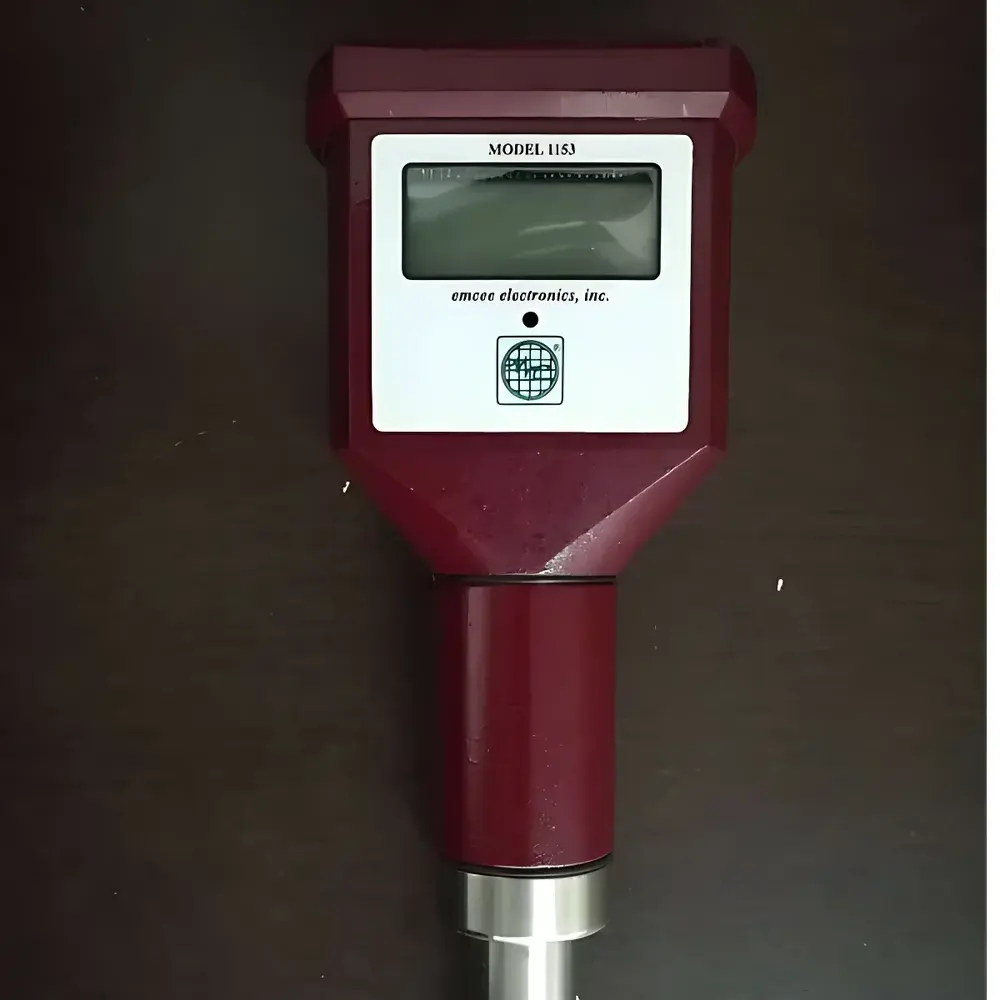
EMCEE 1153 Digital Conductivity Meter
| Brand | EMCEE |
|---|---|
| Origin | USA |
| Model | 1153 |
| Conductivity Range | 0–2000 pS/m |
| Accuracy | ±2% of reading |
| Resolution | ±1 pS/m (0–2000 pS/m) |
| Dimensions | 200.7 mm × 70 mm × 43.2 mm (L×W×D) |
| Operating Temperature | 0–50 °C |
| Power Supply | Three 3 V lithium batteries |
| Intrinsic Safety Certification | Class I, Division 1, Group D |
| Display | 5-digit LCD with status text |
| Probe Diameter | 19.05 mm |
| Weight | 365.8 g |
| Enclosure | Solvent-resistant rigid plastic carrying case |
Overview
The EMCEE 1153 Digital Conductivity Meter is a portable, intrinsically safe instrument engineered for precise static electrical conductivity measurement of hydrocarbon-based liquids—particularly aviation turbine fuels (e.g., Jet A, JP-5, JP-8) in accordance with ASTM D2624 Standard Test Method for Electrical Conductivity of Aviation Fuels. Unlike conventional aqueous conductivity meters calibrated in µS/cm, the 1153 operates exclusively in picosiemens per meter (pS/m), the internationally accepted unit for low-conductivity hydrocarbon fluids where charge dissipation and electrostatic hazard mitigation are critical. Its measurement principle relies on a guarded two-electrode cell geometry with constant-current excitation and high-impedance voltage sensing, optimized to minimize polarization errors and stray capacitance effects inherent in ultra-low conductivity media (<100 pS/m). The device is designed for field use in fuel handling facilities, aircraft refueling operations, laboratory quality control labs, and refinery blending units where rapid, repeatable, and traceable conductivity verification is required prior to transfer or storage.
Key Features
- Intrinsically safe design certified for Class I, Division 1, Group D hazardous locations—enabling safe operation in fuel depots, hangars, and loading racks without explosion risk.
- Single-button dual-function interface: initiates measurement cycle and toggles between conductivity and optional temperature mode (with external probe).
- 5-digit LCD display with dynamic status text—including auto-indication of range, battery level, and measurement completion—enhancing operational clarity under variable lighting conditions.
- Integrated LED illumination activated during the standardized 3-second measurement cycle (per ASTM D2624), ensuring visual confirmation of active sampling even in low-light environments.
- Onboard data retention: last measured value remains displayed until overwritten by the next valid reading—supporting manual logging without external recording devices.
- Robust mechanical architecture: solvent-resistant hard-shell carrying case, O-ring sealed probe housing (19.05 mm diameter), and lightweight aluminum enclosure (365.8 g) optimized for handheld ergonomics and field durability.
- Low-power electronics powered by three standard 3 V lithium batteries, delivering >1,000 measurements per set under typical usage conditions.
Sample Compatibility & Compliance
The 1153 is validated for use with non-aqueous, low-polarity liquids including kerosene-type jet fuels, diesel fuel oils, naphthas, and other refined hydrocarbons with conductivity values spanning 0–2000 pS/m. It is not intended for aqueous solutions, acids, bases, or conductive solvents (e.g., methanol, ethanol/water blends), as electrode polarization and electrolytic corrosion would compromise accuracy and sensor longevity. The instrument conforms to ASTM D2624–22 (Standard Test Method for Electrical Conductivity of Aviation Fuels), and its intrinsic safety certification complies with UL 913 8th Edition and ANSI/ISA-12.12.01–2022. While not FDA-regulated, its design supports GLP-aligned documentation practices through unambiguous digital readout and stable zero-point repeatability.
Software & Data Management
The EMCEE 1153 operates as a standalone, microprocessor-controlled analog-to-digital conversion system with no embedded firmware update capability or USB/Bluetooth connectivity. All calibration and configuration parameters are factory-set and non-user-adjustable, ensuring metrological integrity and eliminating drift-prone software variables. Measurement data exists solely as transient digital display output; no internal memory or timestamping functionality is provided. For audit-trail compliance in regulated environments (e.g., airline maintenance organizations adhering to FAA AC 150/5370-10 or DEF STAN 91-91), users must manually record readings alongside environmental conditions (temperature, sample ID, operator ID) in bound logbooks or validated electronic systems. Optional temperature measurement (via external RTD probe) enables basic correction using published fuel-specific temperature coefficients, though full compensation algorithms are not implemented onboard.
Applications
- Pre-transfer verification of aviation fuel conductivity at bulk storage terminals and mobile refuelers to ensure compliance with IATA Guidance Material and UK CAA CAP 1617 requirements (minimum 50 pS/m for safe grounding).
- Routine QC testing in refinery laboratories to monitor additive effectiveness (e.g., Stadis 450) and detect contamination-induced conductivity loss.
- Field validation during aircraft fuel sampling per ATA Spec 103 and SAE ARP4776 protocols.
- Monitoring conductivity decay during long-term fuel storage to assess antioxidant depletion or water ingress.
- Supporting root-cause analysis in electrostatic discharge incidents involving hydrocarbon handling systems.
FAQ
Is the 1153 suitable for measuring conductivity of water or aqueous solutions?
No. The 1153 is calibrated and optimized exclusively for hydrocarbon liquids in the 0–2000 pS/m range. Aqueous solutions typically exhibit conductivities >100 µS/cm (i.e., >100,000,000 pS/m), exceeding the instrument’s upper limit by five orders of magnitude and risking sensor damage.
Does the instrument require periodic calibration?
EMCEE recommends annual verification against traceable NIST-traceable reference standards (e.g., 50 pS/m and 1000 pS/m hydrocarbon simulants) in accordance with ISO/IEC 17025–accredited laboratories. Field zero-checks using clean, dry air or certified insulating oil are permissible but do not replace formal calibration.
Can the 1153 be used in sub-zero ambient temperatures?
Operation is specified from 0 °C to 50 °C. Below 0 °C, lithium battery output declines significantly, and fuel viscosity increases may impede proper probe immersion and electrochemical response time—both compromising measurement validity.
What does “intrinsically safe” mean for this device?
It signifies that the 1153’s electrical energy levels (voltage, current, power) are permanently limited below the minimum ignition energy threshold for Group D vapors (e.g., gasoline, jet fuel) under worst-case fault conditions—eliminating spark or thermal ignition hazards in classified areas.
Is temperature compensation automatic?
No. Temperature measurement is an optional add-on function requiring a separate RTD probe. No automatic compensation is applied to the conductivity reading; users must apply published temperature correction factors manually if required by procedure.