
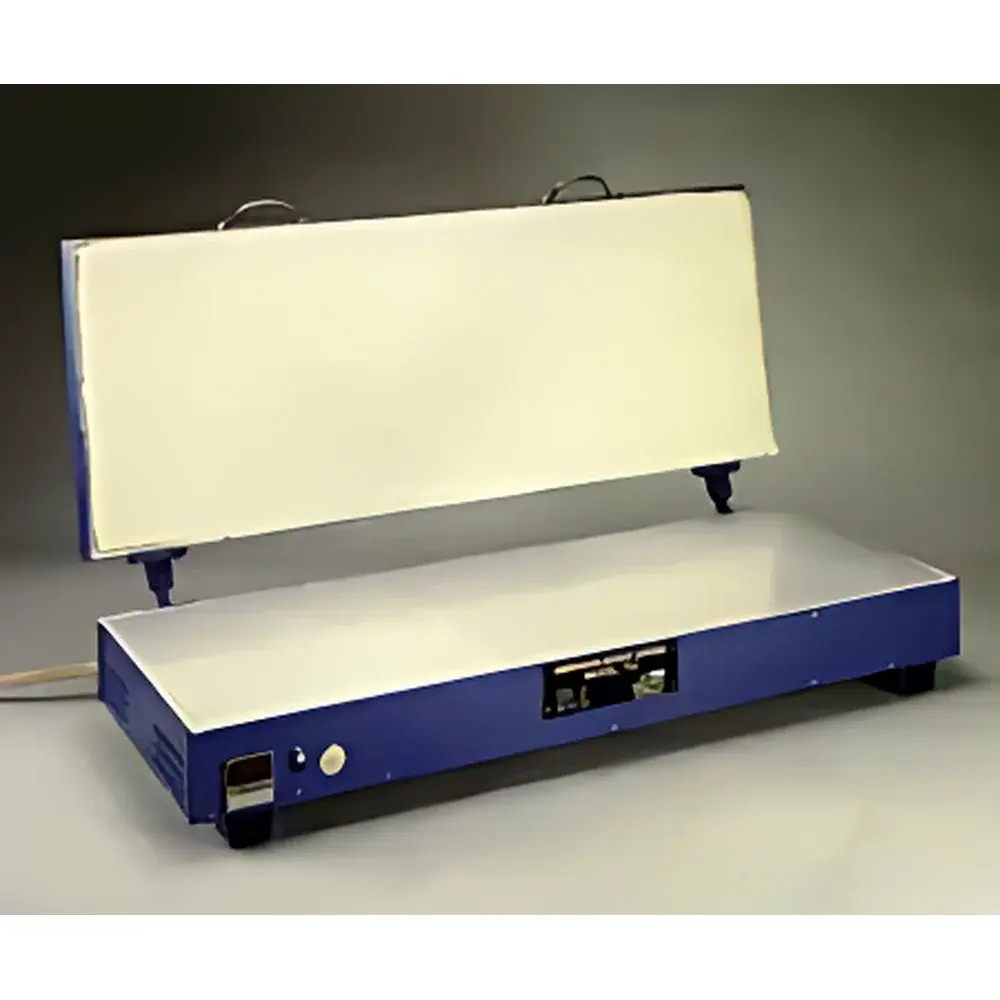
Emerson Model 130 Precision Moisture Determination Oven
| Origin | USA |
|---|---|
| Manufacturer Type | Authorized Distributor |
| Origin Category | Imported |
| Model | Model 130 |
| Pricing | Upon Request |
Overview
The Emerson Model 130 Precision Moisture Determination Oven is a laboratory-grade, gravimetric moisture analyzer engineered specifically for the pulp and paper industry. It operates on the principle of thermogravimetric analysis (TGA), wherein a pre-weighed sample is dried under controlled, uniform thermal conditions until constant mass is achieved; the mass loss is then calculated as moisture content (% w/w). Designed to meet the stringent repeatability and traceability requirements of industrial quality control laboratories, the Model 130 delivers rapid, standardized moisture determination in accordance with TAPPI T 412 om-22, ASTM D644–23, CPPA Standard C5, and APPITA Standard 9001. Its robust aluminum heating platen—thermally massive and electrically heated—ensures minimal temperature fluctuation (< ±1°C at 105°C) even under variable sample loads, thereby guaranteeing high reproducibility across consecutive runs. The instrument supports two operational temperature configurations: standard 150°C and optional high-temperature 230°C mode, enabling extended applicability to nonwovens, specialty fiber mats, and thermally stable pulp derivatives where conventional low-temperature drying is insufficient.
Key Features
- Thermally stabilized aluminum heating platen (61 cm × 35.6 cm) with integrated digital PID temperature controller for precise setpoint maintenance (±1°C at 105°C)
- Hinged rear-mounted pressure lid fitted with non-asbestos, breathable fabric gasket—functions as a calibrated drying blanket to ensure uniform sample contact and prevent curling or edge lifting during desiccation
- Configurable temperature range: 150°C standard; 230°C optional upgrade for high-thermal-stability substrates including nonwoven webs and chemi-thermomechanical pulps
- Dual-scale digital display (°C / °F) with intuitive keypad interface and real-time temperature monitoring
- Structural housing fabricated from powder-coated steel; designed for continuous operation in industrial environments (e.g., mill QC labs, R&D pilot lines, ISO 17025-accredited testing facilities)
- Compliance-ready architecture: supports GLP/GMP documentation workflows via manual logbook integration; compatible with external analytical balance interfaces for automated mass data capture
Sample Compatibility & Compliance
The Model 130 accommodates a broad spectrum of fibrous and sheet-form materials relevant to pulp, paper, and nonwoven manufacturing: unbleached and bleached kraft pulp sheets, newsprint, linerboard, corrugating medium, tissue and towel grades, handsheets per TAPPI T 205, concentration pads, groundwood pulp, and synthetic/natural fiber nonwovens. All drying protocols align with internationally recognized standards—including TAPPI T 412 (moisture in paper and board), ASTM D644 (moisture in paper products), CPPA C5 (Canadian Pulp and Paper Association method), and APPITA 9001 (Australian standard for paper moisture)—ensuring interlaboratory comparability and regulatory acceptability. The instrument’s thermal design minimizes radiant asymmetry and convective drift, satisfying the uniformity-of-heating criteria specified in ISO 2889:2020 for gravimetric moisture ovens.
Software & Data Management
While the Model 130 operates as a standalone hardware platform without embedded software, its analog/digital hybrid architecture enables seamless integration into enterprise-level LIMS and QMS ecosystems. Temperature setpoints, dwell times, and operator IDs can be recorded manually in audit-trail-compliant logbooks aligned with FDA 21 CFR Part 11 principles (when paired with validated electronic records systems). Optional RS-232 or USB-to-serial adapters permit connection to external PCs running custom data acquisition scripts or commercial QC software (e.g., Minitab, JMP, or LabWare LIMS). All calibration procedures—including temperature mapping per ASTM E2251—and performance verification tests are fully documented in the supplied operator manual, supporting ISO/IEC 17025 clause 6.4.10 and internal metrological traceability requirements.
Applications
- Routine moisture verification of finished paper rolls prior to slitting and packaging
- Process control of dryer section efficiency in paper machines (via handsheet correlation studies)
- Moisture profiling of recycled fiber blends to assess deinking stability and fibrillation potential
- Validation of moisture equilibrium in coated papers exposed to varying RH conditions
- Research-grade moisture sorption isotherm generation for cellulose nanocrystal composites
- QA release testing of nonwoven medical gauze and filtration media per AAMI ST79:2017 Annex D
FAQ
What standards does the Model 130 comply with for moisture testing?
It conforms to TAPPI T 412 om-22, ASTM D644–23, CPPA Standard C5, and APPITA 9001 for paper and board; additional validation per ISO 2889 may be performed in-house.
Is the 230°C option factory-installed or field-upgradable?
The 230°C configuration is available as a factory-configured option only; retrofitting post-purchase is not supported due to thermal safety interlock redesign requirements.
Does the instrument include temperature uniformity validation documentation?
Yes—the user manual includes a recommended temperature mapping protocol compliant with ASTM E2251, along with blank calibration record templates for internal QA use.
Can the Model 130 be used for food or pharmaceutical moisture testing?
No—it is not designed or certified for GMP-regulated food or pharma applications; its construction, airflow profile, and validation scope are optimized exclusively for fibrous industrial materials.
What maintenance is required to sustain accuracy over time?
Annual verification of heater element resistance, thermocouple calibration against NIST-traceable reference, and periodic replacement of the breathable fabric gasket (supplied as spares) are recommended per the maintenance schedule in Section 7 of the manual.





