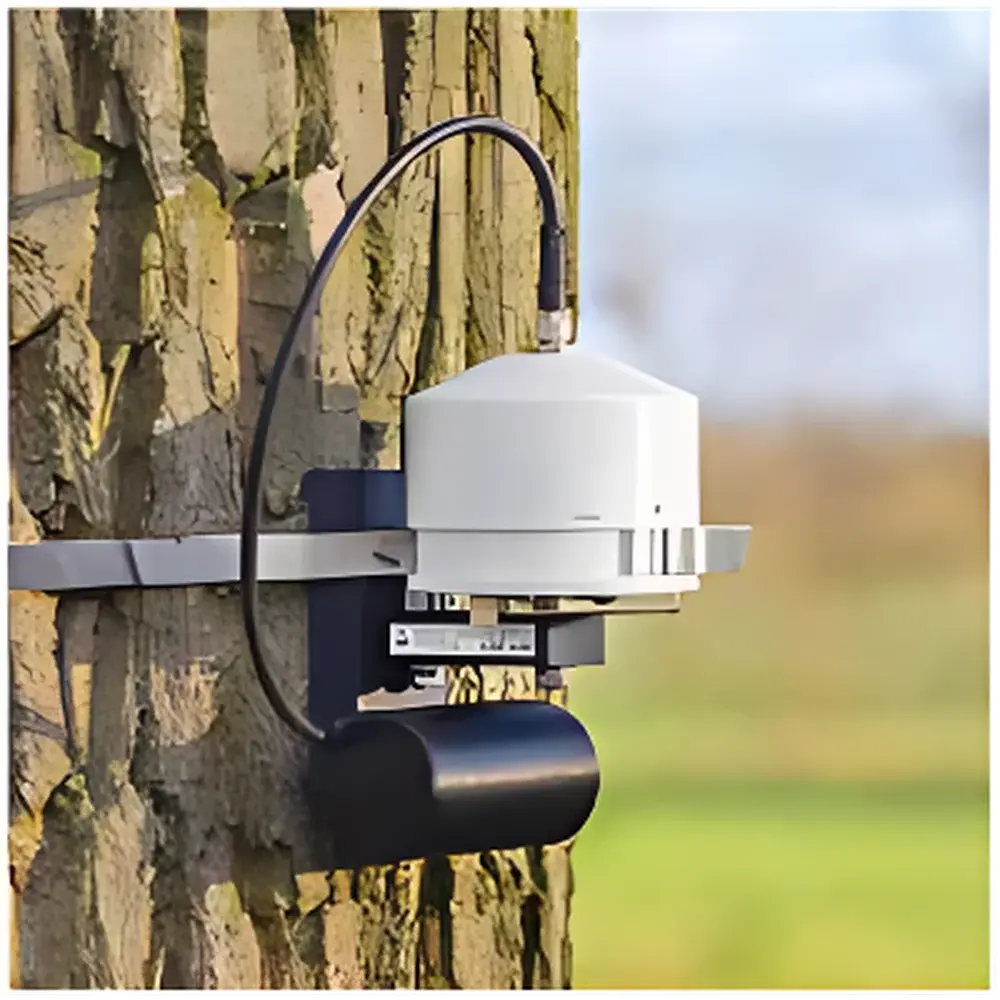
EMS DRT27 LTE Tree Stem Growth Monitor
| Brand | EMS |
|---|---|
| Origin | Czech Republic |
| Model | DRT27 LTE |
| Measurement Principle | High-Resolution Capacitive Displacement Sensing with Temperature-Compensated Mechanical Expansion Band |
| Range | 71 mm |
| Resolution | < 1 µm |
| Minimum Trunk Diameter | 8 cm |
| Operating Temperature | −30 to +60 °C |
| Relative Humidity | 0–100 % RH |
| Internal Temperature Sensor Accuracy | ±0.3 °C |
| Actuation Force | 15–20 N |
| Weight | 350 g |
| Band Dimensions | 12 × 0.2 mm stainless steel |
| Thermal Expansion Coefficient of Band | 16 µm/(m·K) |
| Default Sampling Interval | 30 min |
| Default Storage Interval | 30 min |
| Configurable Transmission Intervals | 2 / 4 / 8 / 12 h |
| LTE Module | Embedded Cat-M1/NB-IoT compatible |
| Battery Life | >3 years (2 measurements/day + daily LTE transmission) |
| Enclosure Material | UV-stabilized polymer + stainless steel |
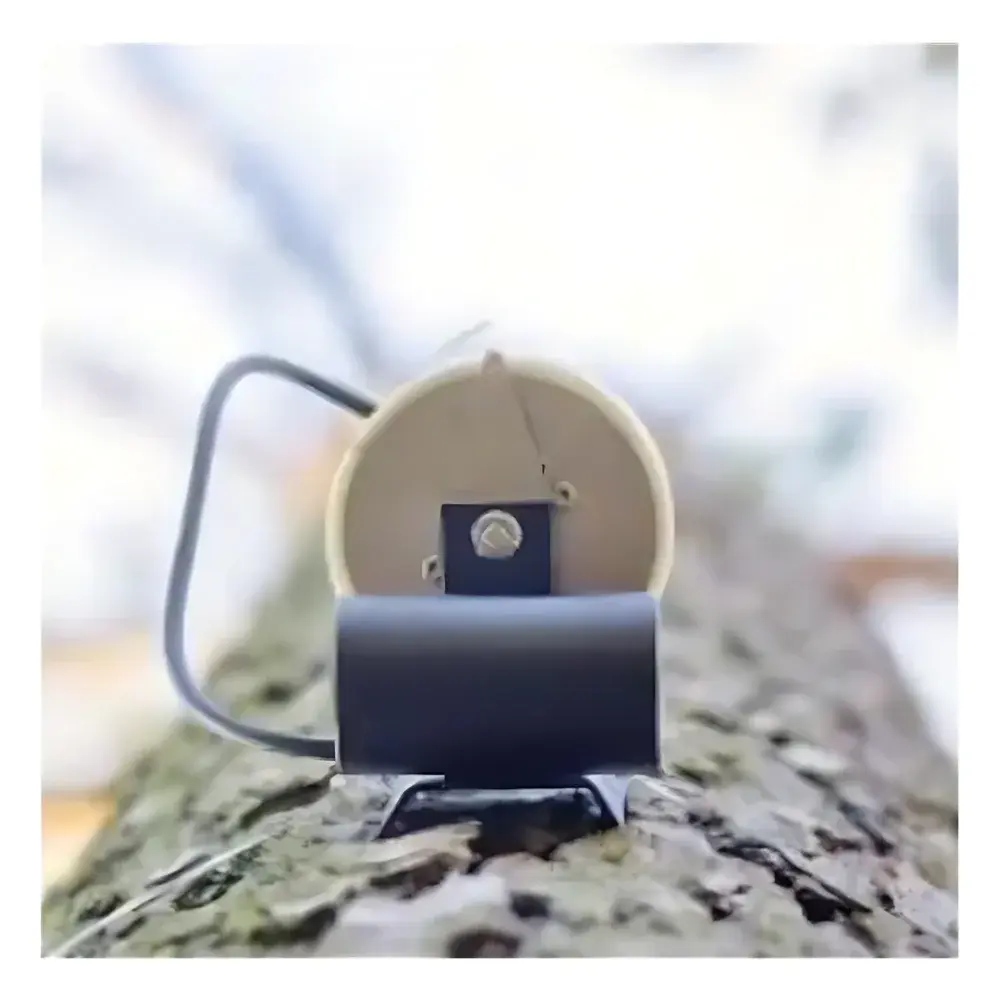
| Mounting | Non-invasive, tension-adjustable circumferential band |
Overview
The EMS DRT27 LTE Tree Stem Growth Monitor is an autonomous, field-deployable dendrometric sensor engineered for long-term, high-fidelity monitoring of radial stem diameter variation in woody plants. It operates on a hybrid mechanical–electronic principle: a precision-engineered stainless-steel expansion band encircles the trunk and translates minute circumferential changes—induced by turgor-driven growth, water deficit, or diel shrink-swell dynamics—into linear displacement at a capacitive transducer. This displacement is resolved with sub-micrometre resolution (< 1 µm), enabling detection of physiological responses occurring at sub-hourly timescales, including nocturnal growth pulses, drought-induced contraction, and rehydration recovery kinetics. Unlike optical or strain-gauge-based systems, the DRT27’s direct-contact, temperature-compensated band design eliminates parallax error and thermal drift artifacts—critical for multi-year ecological studies requiring metrological consistency across seasonal and climatic gradients.
Key Features
- Integrated LTE-M/NB-IoT connectivity for real-time, low-power wide-area network (LPWAN) data transmission—no external gateway or local base station required.
- Self-contained architecture: embedded lithium-thionyl chloride battery, onboard data logger, and industrial-grade microcontroller—all sealed within an IP67-rated housing.
- Non-invasive, tool-free installation: adjustable 12 mm × 0.2 mm stainless-steel band applies consistent 15–20 N pre-tension, minimizing bark compression while maintaining mechanical coupling across cambial activity cycles.
- Onboard temperature compensation: dual-point thermal calibration corrects for band expansion (16 µm/m·K) and sensor drift using a high-accuracy ±0.3 °C internal thermistor.
- Configurable temporal resolution: sampling, storage, and transmission intervals are independently programmable via EMScloud—supporting adaptive protocols aligned with phenological phases or experimental treatments.
- Robust environmental rating: operational from −30 °C to +60 °C and 0–100 % RH, validated for deployment in boreal, alpine, Mediterranean, and tropical forest ecosystems.
Sample Compatibility & Compliance
The DRT27 accommodates trunks ≥8 cm in diameter with no upper size limit—validated on species ranging from Pinus sylvestris (diameter at breast height, DBH = 12 cm) to mature Fagus sylvatica (DBH > 120 cm). Its mechanical design conforms to ISO 17025-aligned calibration traceability protocols for displacement sensors, and its firmware implements deterministic timestamping compliant with GLP data integrity requirements. Data provenance—including sensor ID, firmware version, battery voltage, and thermal offset logs—is embedded in every transmitted packet. The device meets CE marking requirements for electromagnetic compatibility (EN 61000-6-3/4) and radio equipment (RED Directive 2014/53/EU), and supports audit-ready metadata export for regulatory submissions under EU Horizon research frameworks or NSF-funded ecosystem observatories.
Software & Data Management
Data flows automatically to EMScloud—a secure, ISO 27001-certified SaaS platform that performs real-time validation (range checks, monotonicity filters, outlier rejection), time-series archiving, and interactive visualization. Users access calibrated growth curves, derivative growth rates (µm/h), and normalized diel amplitude metrics via responsive web dashboards. Raw and processed datasets export in CSV, NetCDF, or DCV format; metadata adhere to ISA-Tab standards for interoperability with FAIR-aligned repositories (e.g., EUDAT, PANGAEA). The RESTful API enables programmatic ingestion into institutional LIMS, R/Shiny analytics pipelines, or Python-based phenotyping workflows—supporting webhook-triggered alerts, automated report generation, and integration with weather station APIs for environmental covariate alignment.
Applications
- Long-term dendroclimatology: quantifying climate–growth sensitivity across decades using interannual radial increment variance.
- Irrigation scheduling optimization: detecting early stomatal closure signatures via pre-dawn shrinkage rate acceleration.
- Phenological phase detection: identifying onset of cambial reactivation, xylem differentiation, and latewood formation through growth rate inflection points.
- Ecophysiological modeling: parameterizing hydraulic architecture models (e.g., Tardieu-Davies) with high-temporal-resolution turgor dynamics.
- Urban forestry monitoring: assessing drought resilience of street trees under impervious surface stress gradients.
- Carbon allocation studies: correlating diel growth patterns with eddy-covariance net ecosystem exchange (NEE) data.
FAQ
How is thermal expansion of the measurement band compensated?
Thermal drift is corrected in real time using a factory-characterized coefficient (16 µm/m·K) and concurrent readings from the integrated ±0.3 °C thermistor—applied prior to displacement conversion.
Can the device be deployed on irregular or furrowed bark?
Yes—the flexible band conforms to surface topography; optimal contact is ensured by manual tension adjustment during installation, verified via tactile feedback and diagnostic impedance check.
Is raw sensor output accessible for custom processing?
Yes: EMScloud provides uncalibrated capacitance counts alongside temperature-corrected displacement values; full firmware documentation and calibration certificates are available under NDA.
What happens if LTE coverage is temporarily lost?
Up to 30 days of data are stored onboard in non-volatile memory; transmission resumes automatically upon signal restoration with sequence-verified packet retransmission.
Does the system support synchronization with other EMS sensors (e.g., sap flow, soil moisture)?
Yes—EMScloud natively aligns timestamps across heterogeneous sensor types using GPS-derived UTC and internal RTC drift correction, enabling cross-variable correlation analysis.