
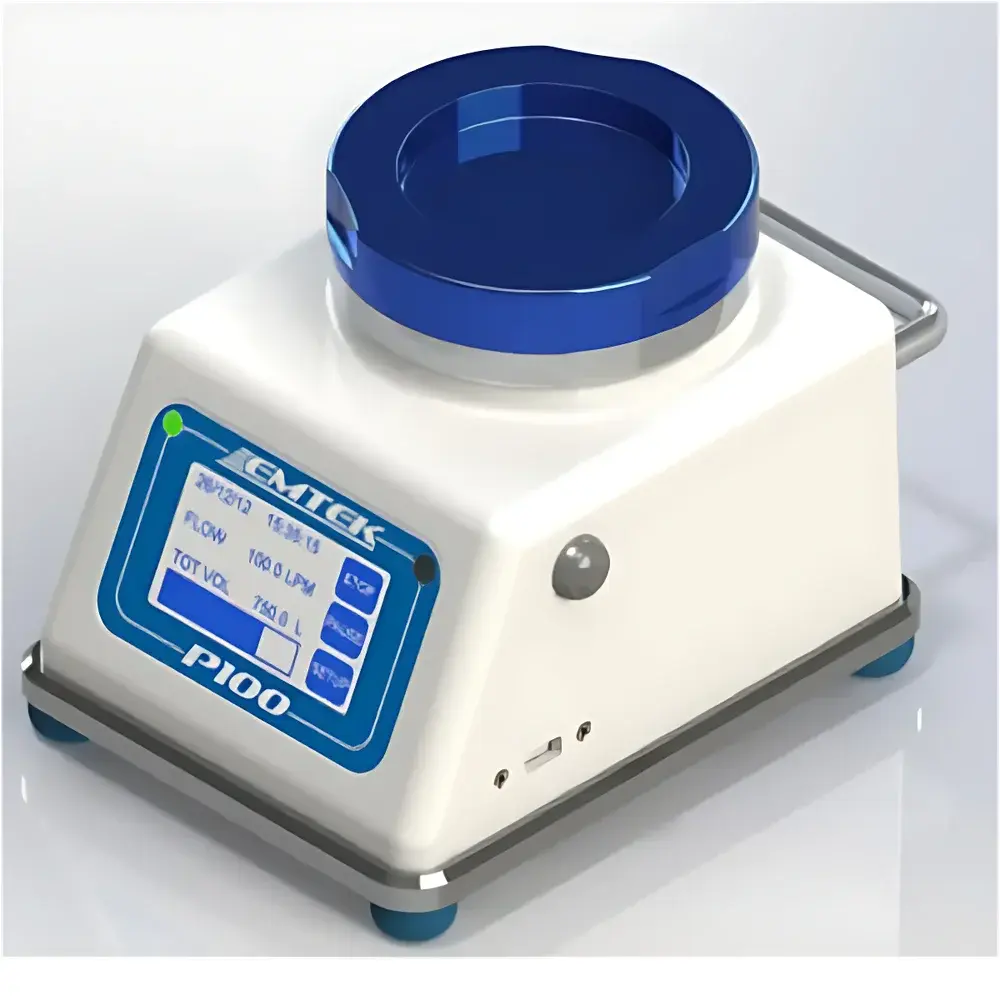
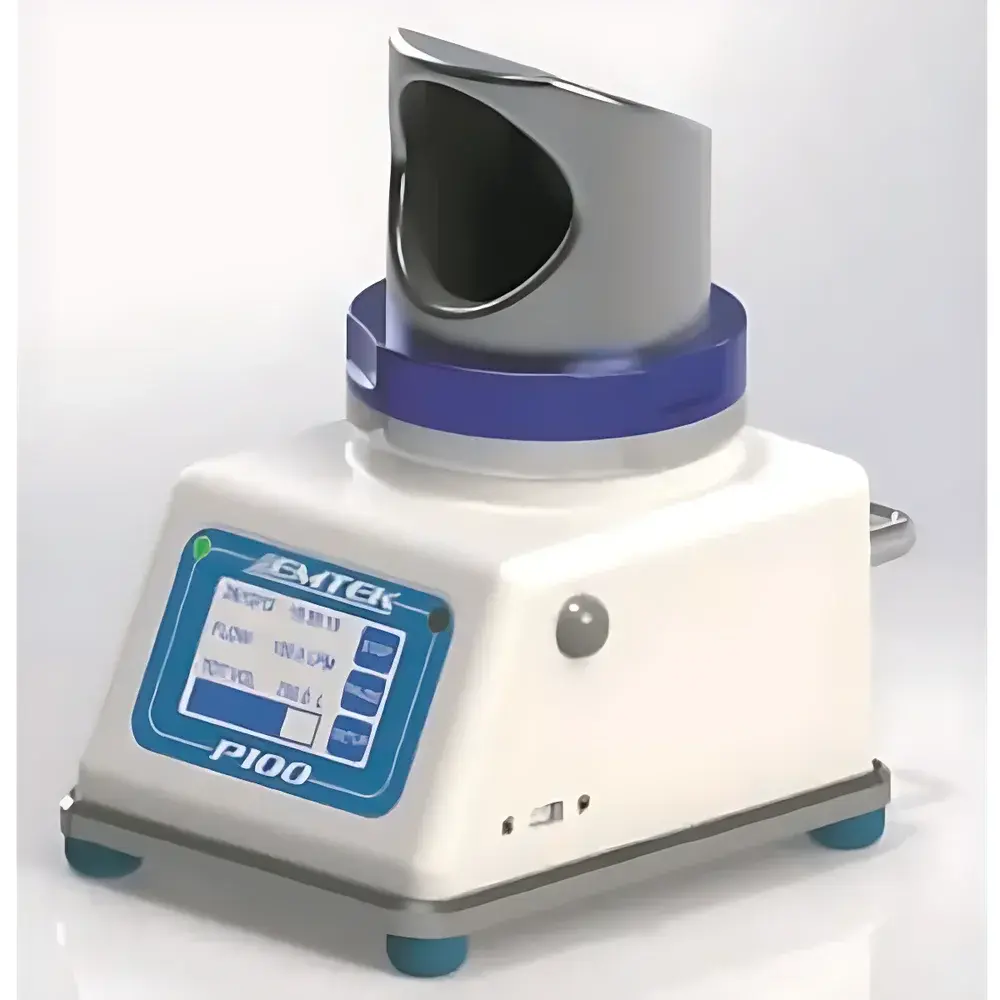
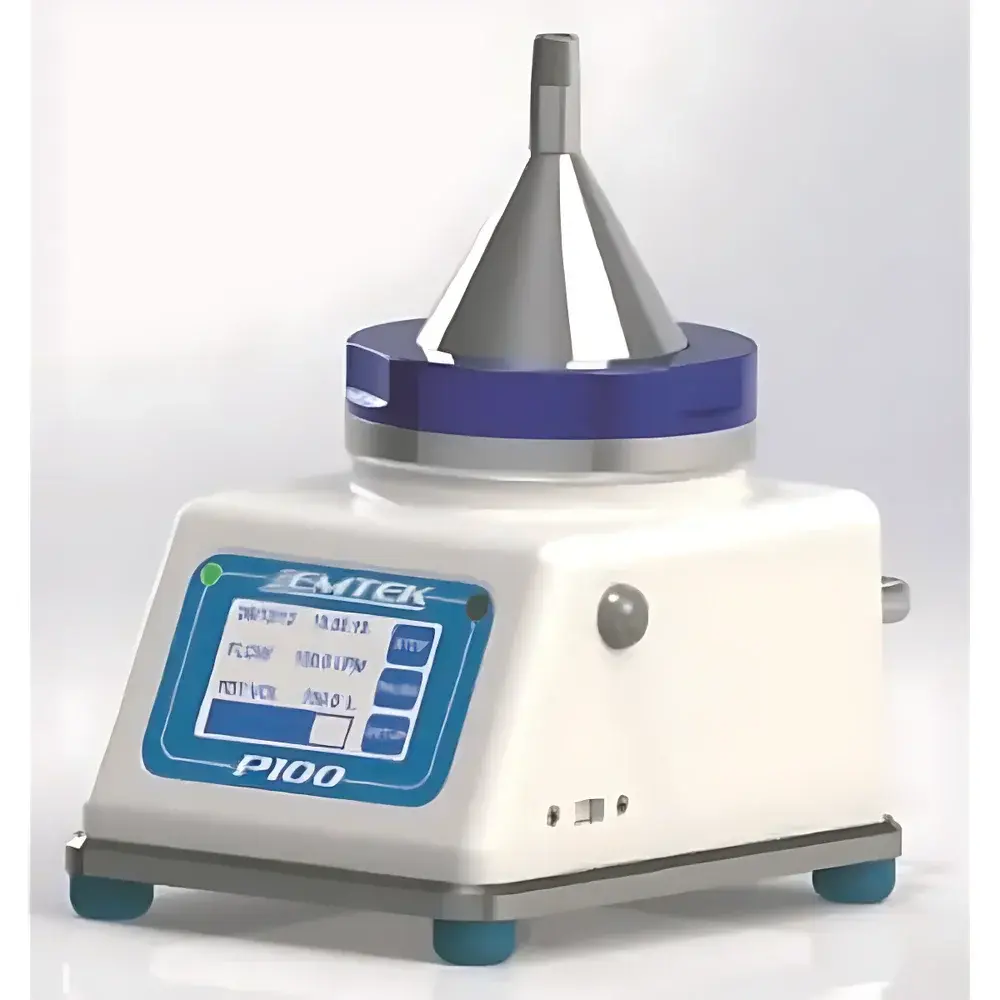
EMTEK P100 Air Microbial Sampler
| Brand | EMTEK |
|---|---|
| Origin | USA |
| Model | P100 |
| Sampling Flow Rates | 28.3 L/min or 100 L/min |
| Dimensions | 19.05 cm (L) × 13.97 cm (W) × 15.24 cm (H) |
| Weight | <2.45 kg |
| Inlet Cap | 300-hole precision array |
| Exhaust Filtration | Integrated HEPA filter (optional remote exhaust tubing) |
| Display | Touch-enabled LCD screen |
| Battery Life | >12 hours at 28.3 L/min |
| Data Storage | 500 sample records |
| Communication | Infrared remote control (start/stop/pause/resume) |
| Housing Material | Kydex® with Microban® antimicrobial protection |
| Inlet & Base Material | Anodized aluminum |
| Optional Accessories | Rotational slit sampler head, standard impactor head, directional inlet cap for unidirectional airflow sampling, compressed air/gas inlet adapter, extended sampling tubes |
Overview
The EMTEK P100 Air Microbial Sampler is a portable, isokinetic active air sampler engineered for quantitative collection of viable airborne microorganisms in controlled and uncontrolled environments. It operates on the principle of inertial impaction—either via standardized single-stage slit-to-agar rotation or fixed-orifice impactor geometry—ensuring precise particle deposition onto nutrient agar surfaces under physiologically relevant conditions. Designed to comply with ISO 14698-1:2003 (Biological contamination control — General principles and methods of microbiological monitoring) and aligned with Annex 1 (2022 revision) requirements for environmental monitoring in sterile pharmaceutical manufacturing, the P100 maintains isokinetic sampling velocity across its inlet aperture, minimizing particle bounce and re-entrainment. Its compact form factor (<2.45 kg), integrated HEPA exhaust filtration, and battery-powered operation support deployment in Grade A–D cleanrooms, isolators, biosafety cabinets, outdoor ambient sites, and field-based epidemiological surveys—without compromising biological recovery efficiency.
Key Features
- Isokinetic inlet design with 300 precision-machined orifices ensures uniform velocity matching between sampling jet and ambient airflow—critical for representative microbial concentration assessment in laminar and turbulent flow regimes.
- Dual-flow configuration: selectable 28.3 L/min (standard for ISO 14698-1 compliance) or high-volume 100 L/min mode enables flexible exposure time optimization across diverse contamination risk profiles.
- Modular head architecture supports interchangeable sampling geometries: standard 400-jet impactor head for routine monitoring and patented rotational slit head for temporally resolved, non-overlapping colony deposition—eliminating edge crowding and enabling time-stamped contamination event mapping.
- Microban®-infused Kydex® housing and anodized aluminum inlet components prevent device-mediated bioburden carryover, satisfying GMP-grade instrument surface hygiene requirements per EU GMP Annex 1 §8.42.
- Programmable sampling logic: user-defined start delay, cycle count, interval duration, and dwell time allows synchronized multi-point monitoring across shifts or production batches without manual intervention.
- Integrated touch-LCD interface with infrared remote control minimizes operator proximity during critical sampling—reducing personnel-induced contamination risks in aseptic zones.
- Adjustable agar height compensation mechanism accommodates variable media thickness (e.g., pour depth variations ±1 mm), maintaining consistent impaction energy and minimizing assay variability.
Sample Compatibility & Compliance
The P100 is validated for use with standard 90 mm Petri dishes containing TSA, SDA, or other ISO 14698-1–recommended growth media. Its impactor geometry achieves ≥95% collection efficiency for particles ≥0.1 µm aerodynamic diameter under nominal flow conditions, as verified per ASTM E2994-15 (Standard Practice for Determining Collection Efficiency of Air Samplers). All wetted surfaces are non-pyrogenic and autoclavable (except electronics). The system meets FDA 21 CFR Part 11 readiness when paired with optional audit-trail-capable data export software; raw sample logs include timestamp, flow rate, total volume, head type, and operator ID. Regulatory alignment includes ISO 14698-1, USP , EU GMP Annex 1 (2022), and CDC/NIOSH bioaerosol sampling guidance.
Software & Data Management
Onboard memory retains up to 500 complete sampling records—including date/time stamp, cumulative volume, flow setting, head type, and user-defined batch ID. Data export is supported via USB interface to Windows-compatible analysis platforms. Optional thermal label printer generates peel-and-stick specimen labels compliant with ISO/IEC 15415 barcode standards for LIMS integration. Exported CSV files contain column headers compatible with statistical process control (SPC) tools and trending dashboards used in pharmaceutical quality systems. Audit trail functionality—when enabled—logs all parameter changes, session starts/stops, and firmware updates with digital signature and timestamp per ALCOA+ principles.
Applications
The EMTEK P100 serves as a primary environmental monitoring tool in regulated life science operations: routine Grade A isolator qualification, HVAC system validation in sterile manufacturing suites, hospital infection control surveillance (ORs, ICUs, transplant units), biosafety level 2/3 laboratory containment verification, fermentation facility airshed profiling, and food-grade cleanroom environmental qualification. Field applications include agricultural bioaerosol dispersion studies, post-disaster mold assessment, and occupational hygiene screening in wastewater treatment plants or composting facilities. Its portability and battery endurance make it suitable for mobile labs conducting real-time outbreak investigations or longitudinal indoor air quality cohort studies.
FAQ
What regulatory standards does the P100 meet for pharmaceutical cleanroom monitoring?
It complies with ISO 14698-1:2003, EU GMP Annex 1 (2022), and USP , supporting viable particle monitoring in Grades A–D environments.
Can the P100 be used for non-viable particle correlation studies?
While optimized for culturable microorganisms, its isokinetic inlet enables concurrent placement with optical particle counters (OPCs) for spatial-temporal correlation of viable/non-viable counts.
Is the rotational slit head compatible with all P100 base units?
Yes—both head types mount identically and require no hardware modification; only firmware calibration differs per head geometry.
Does the HEPA exhaust filter require periodic replacement?
Yes—filter service interval depends on cumulative sampling volume and ambient dust load; recommended replacement every 500 L/min-hours or per manufacturer’s logbook protocol.
How is calibration traceability maintained?
Flow sensors are factory-calibrated against NIST-traceable rotameters; users perform daily flow verification using a calibrated primary standard (e.g., bubble meter or electronic flow calibrator) per ISO 17025–accredited procedures.







