
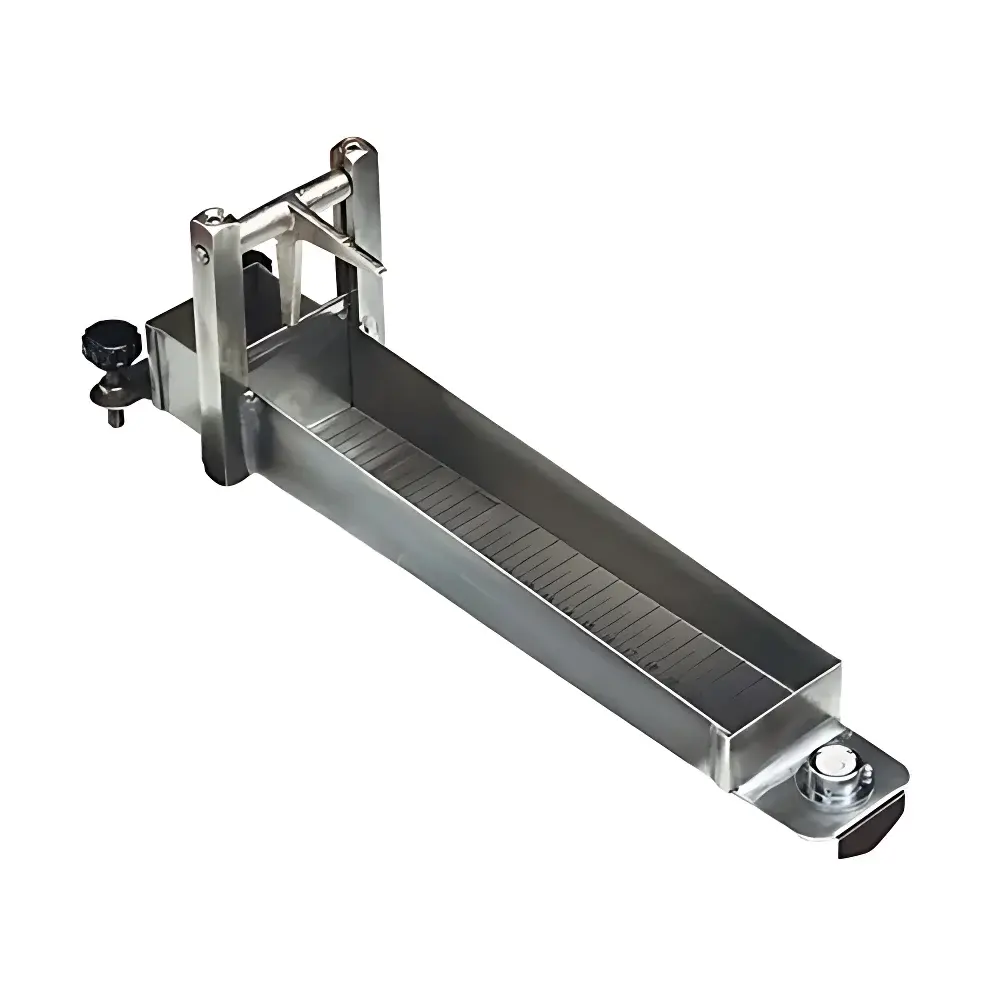
Endecotts Bostwick Consistometer ZXCON-CON1
| Origin | UK |
|---|---|
| Manufacturer Type | Authorized Distributor |
| Origin Category | Imported |
| Model | ZXCON-CON1 |
| Instrument Type | Bostwick-type Flow Consistometer |
| Viscosity/Consistency Range | 1–2,000,000 mPa·s (equivalent to flow distance 0–30 cm in 30 s) |
| Test Channel Length | 240 mm (standard), optional 300 mm |
| Minimum Scale Division | 0.5 cm |
| Channel Width | 84 mm |
| Overall Dimensions | 355 × 88 × 104 mm |
| Adjustable Height Range | 110–139 mm |
| Material | 2 mm electropolished stainless steel |
| Sample Volume | 75–100 mL |
| Compliance | ASTM F1080-93, MIL-SPEC R-81294D |
Overview
The Endecotts Bostwick Consistometer ZXCON-CON1 is a precision-engineered, gravity-driven flow consistency tester designed for rapid, reproducible assessment of semi-solid and highly viscous materials. Unlike rotational or capillary viscometers, the Bostwick method quantifies consistency by measuring the distance (in centimeters) a defined volume of sample flows under its own weight over a fixed time interval—typically 30 seconds—along a calibrated, inclined channel. This empirical yet standardized approach is widely adopted across food science, coatings, cosmetics, and chemical manufacturing where yield behavior, structural breakdown, and flow initiation are critical quality attributes. The ZXCON-CON1 adheres strictly to ASTM F1080-93 (“Standard Test Method for Consistency of Tomato Products Using the Bostwick Consistometer”) and MIL-SPEC R-81294D, ensuring traceable, inter-laboratory comparable results in regulated environments.
Key Features
- Electropolished 2 mm stainless steel construction for long-term corrosion resistance, mechanical stability, and compliance with hygienic processing standards (e.g., FDA 21 CFR Part 11–compatible documentation workflows).
- Precision-machined 240 mm test channel (standard), with optional 300 mm configuration (Order No. 14262), engraved with 0.5 cm increments—providing ±0.25 cm resolution and minimizing parallax error during endpoint determination.
- Integrated bubble-level vial and dual adjustable leveling feet ensure consistent 0° inclination angle prior to gate release, eliminating operator-induced variability.
- Spring-loaded hinged gate mechanism enables instantaneous, repeatable sample release—critical for capturing true yield point behavior without premature shear history.
- Compact footprint (355 × 88 × 104 mm) and low sample requirement (75–100 mL) support high-throughput QC labs and pilot-scale production lines alike.
- No external power, sensors, or software required—ensuring operational robustness, minimal maintenance, and intrinsic GMP/GLP suitability for audit-ready manual testing protocols.
Sample Compatibility & Compliance
The ZXCON-CON1 delivers reliable consistency data for non-Newtonian, thixotropic, and yield-stress fluids where conventional viscosity metrics are insufficient. Validated applications include tomato paste (Brix 24–36%), fruit purées, yogurt gels, salad dressings, epoxy removers, polyurethane coatings, cosmetic emulsions (e.g., O/W lotions at 40–60% oil phase), and industrial slurries. Its mechanical design meets ISO 8587:2021 requirements for sensory and physical property instrumentation validation. When used within documented SOPs—including temperature-controlled sample equilibration (20 ± 0.5°C per ASTM F1080), standardized filling technique, and timed gate release—the instrument supports data integrity frameworks aligned with FDA 21 CFR Part 11 Annex 11 expectations for manual measurement devices.
Software & Data Management
As a fully mechanical, analog measurement system, the ZXCON-CON1 operates independently of firmware or proprietary software. All measurements are recorded manually into laboratory notebooks or LIMS-compatible spreadsheets. For digital traceability, users may integrate the device into validated electronic record systems via structured entry templates that capture operator ID, sample ID, ambient temperature, test duration, flow distance (to nearest 0.5 cm), and calibration verification status. Endecotts provides a certified calibration certificate (traceable to NPL UK) and annual verification checklist supporting ISO/IEC 17025:2017 accreditation requirements.
Applications
- Food Processing: Monitoring consistency shifts during thermal concentration of tomato products; evaluating gel strength in pectin-based jams; assessing syneresis resistance in strained yogurts.
- Coatings & Adhesives: Quantifying sag resistance in vertical-applied primers; verifying batch-to-batch rheological equivalence in solvent-borne alkyd paints.
- Personal Care: Benchmarking pump-dispense performance of shower gels; correlating spreadability scores with consumer sensory panels for facial moisturizers.
- Chemical Manufacturing: Screening flocculant efficiency in mineral suspensions; validating dispersion stability of pigment concentrates pre-dilution.
FAQ
What is the difference between Bostwick consistency and dynamic viscosity?
Bostwick measures flow distance under gravity over time—a macroscopic, yield-dominated parameter—whereas dynamic viscosity (e.g., from rotational rheometry) quantifies shear stress vs. shear rate response. They are complementary, not interchangeable.
Can the ZXCON-CON1 be used for regulatory submissions?
Yes—ASTM F1080-93 compliance enables direct inclusion in FDA GRAS dossiers, EU Novel Food applications, and BRCGS-certified facility audits when operated per validated SOPs.
Is temperature control integrated?
No—ambient or bath-controlled sample conditioning must be performed externally; the instrument itself is temperature-stable due to solid stainless steel mass.
How often does it require recalibration?
Annual verification against certified gauge blocks is recommended; full recalibration is only necessary after physical impact or channel deformation.
Does Endecotts supply certified reference materials?
While no CRM is specified for Bostwick testing, Endecotts provides traceable dimensional calibration kits (NPL-traceable depth and length standards) for routine verification.



