
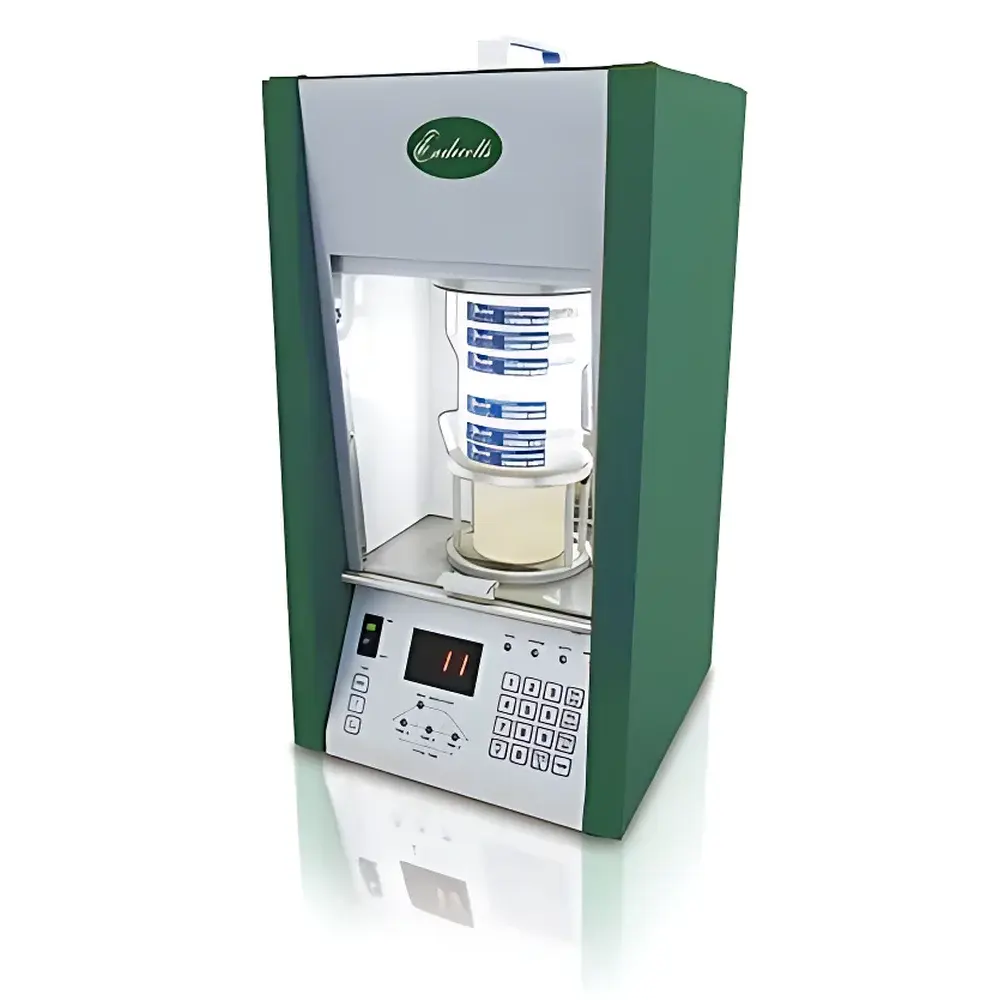
Endecotts SONIC SIFTER Ultrasonic Precision Sieve Analyzer
| Brand | Endecotts |
|---|---|
| Origin | United Kingdom |
| Model | SONIC SIFTER |
| Principle | Air-Jet Assisted Vibratory Sieving (Ultrasonically Enhanced) |
| Dimensions (H×D×W) | 508 × 254 × 254 mm |
| Door Opening Height | 623 mm |
| Net Weight | 16.8 kg |
| Gross Weight (incl. packaging) | 28 kg |
| Power Supply | 230 V, 50 Hz, 70 VA / 115 V, 60 Hz, 90 VA |
| Vibration Frequency | 3000 rpm |
| Tap Modes | None / Vertical-only (30 taps/min) / Alternating Vertical & Horizontal (60 taps/min) |
| Sieving Time Range | 0–119 min (0.1-min increments) |
| Sieve Capacity | Up to six full-height standard test sieves OR one precision sieve + four standard sieves (spacer kits required for non-standard stack configurations) |
| Particle Size Range | Down to 5 µm (dry powders) |
Overview
The Endecotts SONIC SIFTER Ultrasonic Precision Sieve Analyzer is an advanced dry-powder particle size distribution analyzer engineered for high-reproducibility mechanical sieving of fine and cohesive materials. Unlike conventional vibratory or rotary sievers, the SONIC SIFTER integrates controlled ultrasonic energy with precisely regulated air-jet agitation to overcome interparticle adhesion, electrostatic forces, and surface moisture effects that commonly impede accurate sieving below 20 µm. Its core principle relies on synchronized vertical oscillation (3000 rpm) combined with programmable tap action—either vertical-only or alternating vertical/horizontal—to generate dynamic fluidization of the sample bed. A directed column of filtered air passes upward through each sieve layer, continuously lifting and reorienting particles to maximize exposure to aperture geometry. This dual-mode excitation mechanism ensures minimal particle attrition, preserves intrinsic material morphology, and eliminates blinding—critical for regulatory-compliant particle sizing in pharmaceutical, catalyst, ceramic, and advanced battery material workflows.
Key Features
- Ultrasonically enhanced air-jet sieving for reliable separation down to 5 µm without thermal or chemical alteration of samples
- Three programmable tap modes: no tap, vertical-only (30 taps/min), or alternating vertical/horizontal (60 taps/min) to address varying cohesivity and agglomeration tendencies
- Microprocessor-controlled timing with 0.1-minute resolution (6-second granularity) and storage capacity for up to 10 user-defined sieving protocols
- Quiet operation (<65 dB(A)) suitable for shared laboratory environments and ISO Class 5–7 cleanroom-adjacent use
- Modular sieve stack configuration supporting either six full-height standard sieves (per ISO 3310-1 / ASTM E11) or hybrid stacks (one precision sieve + four standards), with optional spacer kits for non-standard arrangements
- No mechanical wear on sieve meshes due to non-contact air-assisted particle mobilization and low-amplitude, high-frequency vibration
- Compact footprint (508 × 254 × 254 mm) and low power consumption (70–90 VA), compatible with both 115 V/60 Hz and 230 V/50 Hz mains supplies
Sample Compatibility & Compliance
The SONIC SIFTER is validated for dry, free-flowing to moderately cohesive powders—including metal oxides, API intermediates, spray-dried lactose, nano-ceramic precursors, and graphite anode materials. It excludes samples requiring wet dispersion or those prone to oxidation under ambient airflow. All operational parameters comply with ISO 2591-1 (sieving methods for particle size analysis), ISO 9276-1 (representation of particle size distribution), and ASTM C136/C780 (standard test methods for sieve analysis of fine and coarse aggregates). The instrument’s deterministic motion profile and repeatable energy input support GLP documentation requirements; audit trails for time, amplitude, tap mode, and sieve configuration can be manually logged per batch record. While not inherently 21 CFR Part 11 compliant, its deterministic control architecture enables integration into validated data capture systems via external logging interfaces.
Software & Data Management
The SONIC SIFTER operates via an embedded microcontroller with a tactile membrane keypad and LCD display—designed for robustness, electromagnetic immunity, and long-term calibration stability. No proprietary software installation is required; all parameter settings (duration, tap mode, start/stop confirmation) are entered directly on-device. Ten protocol slots allow pre-programming of common analytical sequences—for example, “Pharma Lactose QC” (1.5 min, alternating tap, 45–150 µm stack) or “Battery Cathode Screening” (2.0 min, vertical tap only, 5–45 µm precision stack). Mass-on-sieve data is recorded manually post-run per ISO 9276-2 guidelines. For automated reporting, users may integrate digital balance outputs (RS-232 or USB-serial) using third-party lab information management systems (LIMS) or Excel-based templates aligned with USP and ICH Q5A particle characterization expectations.
Applications
- Quality control of inhalable drug powders (e.g., DPI formulations per USP ) where aerodynamic cut-points must correlate with mechanical sieve fractions
- Routine monitoring of granulation endpoint in high-shear wet granulation processes
- Characterization of additive manufacturing metal powders (Ti-6Al-4V, Inconel 718) prior to laser powder bed fusion
- Validation of milling efficiency in ceramic slurry drying lines
- Batch release testing of catalyst supports (e.g., γ-Al₂O₃) where pore accessibility correlates strongly with <10 µm fines content
- Research-scale fractionation of graphene oxide flakes or carbon nanotube agglomerates for dispersion optimization studies
FAQ
Is the SONIC SIFTER suitable for hygroscopic or electrostatically charged powders?
Yes—its air-jet fluidization reduces static buildup, and the absence of mechanical scraping minimizes charge generation. Pre-drying or nitrogen purging of the sample chamber is recommended for highly hygroscopic materials.
Can it replace laser diffraction for sub-10 µm analysis?
No—it is a mechanical sieving instrument and does not measure volume-weighted distributions. It provides mass-based cumulative % retained per aperture, complementary to LD or SEM-EDS for orthogonal validation.
What sieve standards are supported?
Full compatibility with ISO 3310-1 (metric) and ASTM E11 (imperial) test sieves, including stainless steel woven wire mesh and electroformed nickel precision sieves (e.g., 5–20 µm nominal apertures).
Does Endecotts provide calibration certificates?
Yes—NIST-traceable sieve calibration certificates (per ISO/IEC 17025) are available upon request; instrument performance verification reports include tap frequency accuracy, timer drift assessment, and air-flow consistency checks.
Is maintenance required beyond routine cleaning?
Only periodic inspection of the air filter (replaced annually), verification of seal integrity on the sieve holder, and recalibration of the internal real-time clock every 12 months—no lubrication or alignment procedures are needed.



